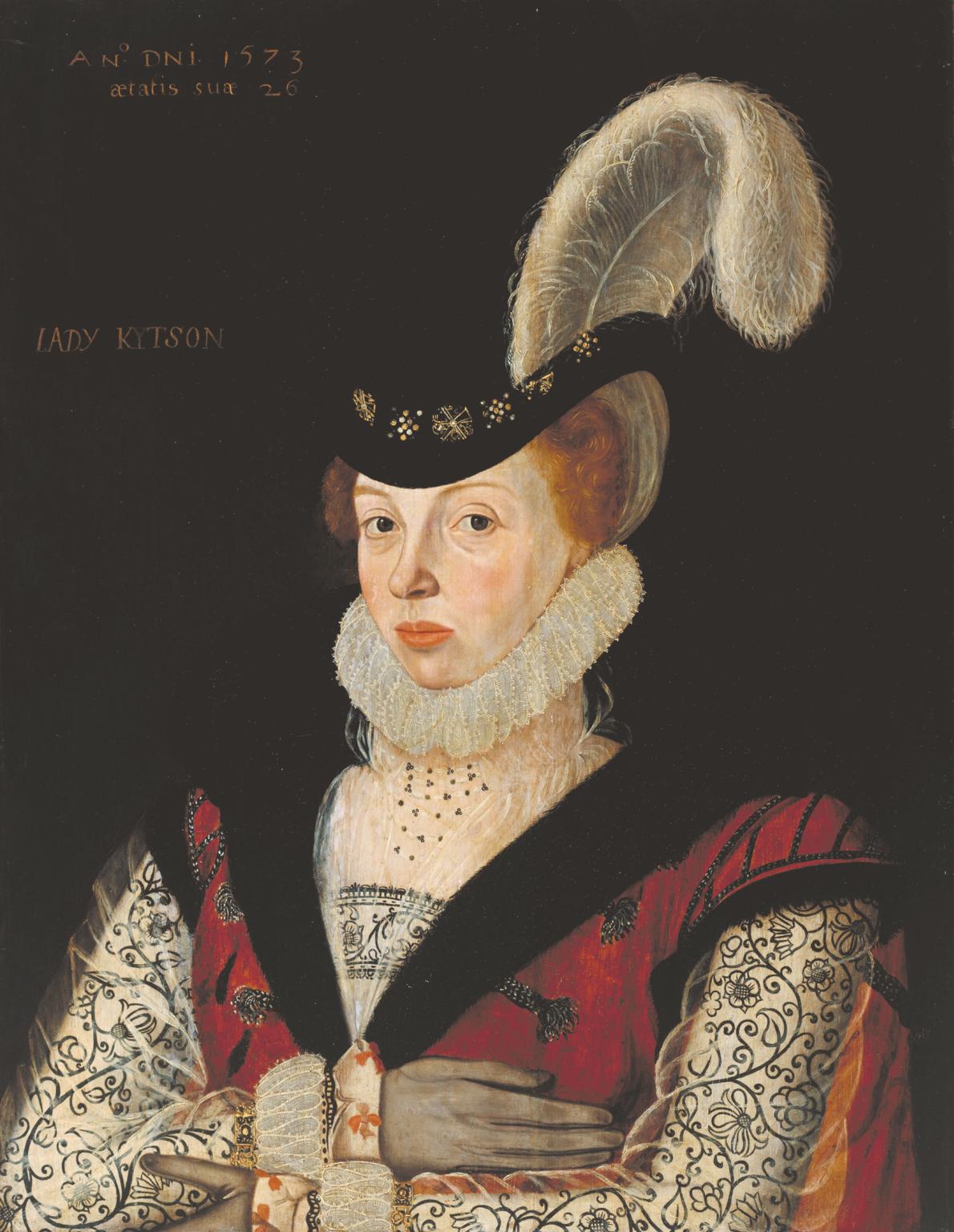
Partlets (also called bavari and gorguera) are an element of sixteenth century clothing which were commonly worn by both high and lower class ladies, although ladies of nobility tended to wear more elaborately decorated versions which often had lace and/or embroidery on them.
I have been embroidering a partlet. My partlet with bees and flowers was inspired by the chemise and partlet set worn by the sitter in the Portrait of Helena von Snakenborg by the British School circa 1569-
Image from: Wikipedia
https://upload.wikimedia.org/wikipedia/commons/thumb/8/8a/British_School_16th_century_-_A_Young_Lady_Aged_21%2C_Possibly_Helena_Snakenborg_-_Google_Art_Project.jpg/547px-British_School_16th_century_-_A_Young_Lady_Aged_21%2C_Possibly_Helena_Snakenborg_-_Google_Art_Project.jpg
The top edge of the chemise can be clearly seen under the edges of the partlet, which suggest that this is a set of garments rather than a high necked smock (although both styles were worn in the sixteenth century). The garments have a boldly coloured floral decoration, which may be painted but is more likely to have been embroidered. I did not have the time to do a completely filled embroidered motif, but also prefer a more subtle design for most of my clothing. My persona has ties to both the English and Italian courts, and I wear both styles of clothing, but Italian is my favourite.
This Italian allegorical portrait by Francesco Melzi shows Flora wearing a chemise embroidered with motifs
Image from: https://en.wikipedia.org/wiki/Flora_(Francesco_Melzi)
The design on this extant 16th century camicia held by the Met museum was also an inspiration in choosing my design-
Image from Pinterest: https://www.pinterest.com.au/pin/366058275939624940/
Many examples of portraits of noble ladies of both the Italian and Elizabethan courts show exquisitely embroidered partlets. Monochrome and polychrome embroidery became increasingly popular from the 1510s to the end of the sixteenth century as a way of displaying wealth and rank. Portraits from artists as diverse and geographically widespread as Anthonis Mor, Hans Holbein, Guillim Scrots, Moroni and Veneto show sitters with lavishly decorated embroidered garments. Portrait evidence shows a great deal of versatility; some ensembles have the partlet matching another costume element such as sleeves, ruff or stomacher, and others show a partlet decorated in a completely different style to the sleeves. The underlying desire seems to have been to display wealth and show off beautiful garments.
Monochrome and polychrome embroidery was popular on chemises and smocks, partlets, collars and cuffs, ruffs, coifs and caps and other linens. It was executed in counted form (usually in running stitch or double running stitch) or in non-counted form, in stitches such as stem, braid, chain, speckling, feather stitch, backstitch, long and short stitch, herringbone stitch and split stitch. Extant items can be seen with all these stitches. Addition of spangles, gold or silver threads, plain or metallic lace, and pearls and beads all added to the lavish effect.
Portrait of Lady Dacre by Hans Eworth (1540) shows the sitter wearing an elaborately embroidered (monochrome) partlet and smock. This is an English style.
Image from http://www.wga.hu/frames-e.html?/html/e/eworth/l_dacre.html
In contrast, the images below show Italian styles:
Tintoretto’s Portrait of a Lady (1570s) from
http://realmofvenus.renaissanceitaly.net/wardrobe/JTintorettoPOALady.jpg
Veronese’s Portrait of a Woman (1570s) from
http://realmofvenus.renaissanceitaly.net/wardrobe/VeronesePOAVenetianWomanBarnes.jpg
Bernadino Licinio’s c1550 Portrait of a Family from
http://realmofvenus.renaissanceitaly.net/wardrobe/LicinioPOAFamily2.jpg
I have created a collarless partlet in the Italian style (shown above) as this style is very comfortable, is not restrictive, and matches the style of Italian gown I prefer. The three pattern pieces were sewn together with enclosed seams by machine, and then the seams were sewn flat by hand. A small folded hem was sewn by hand on all raw edges. I decided to embroider the partlet
after it was sewn together to ensure accurate design placement, although this does make it more difficult to embroider.


Floral designs were very popular for embroidery in the sixteenth century, due in part to the proliferation of printed pattern-books and the discovery of the strange flora of foreign lands and the New World. Designs were often copied from pattern-books, as well as bestiaries and herbals. Other designs such as geometric designs, grotesques and allegorical emblems were very popular and can be seen in portraits from across Europe. There was no notion of or way of enforcing copyright during this time, so designs were lifted and adapted, and versions of the same designs can be seen in design model books from the 1530s and into the seventeenth century. The same designs crop up in books published in England as well as in Europe.
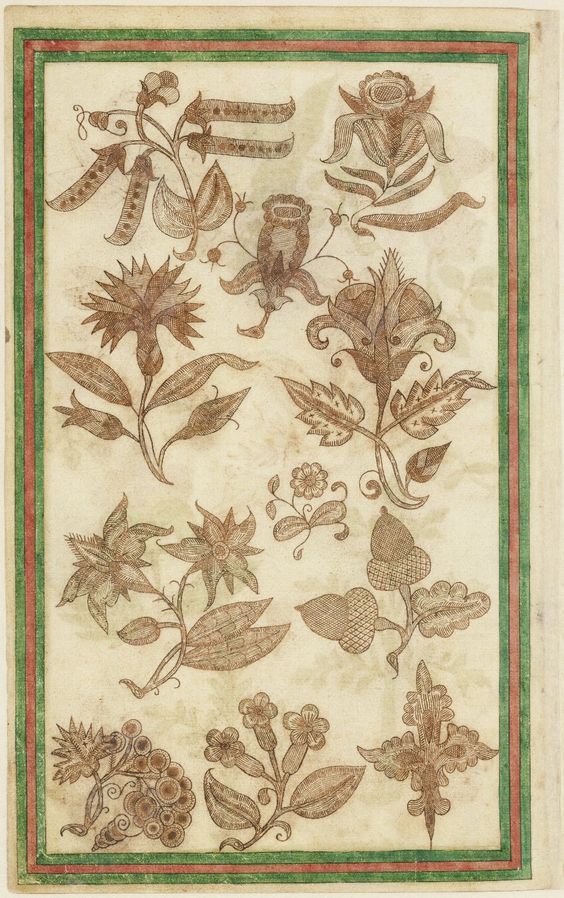
The flower design that I have used comes from the 1608 Trevellyon Miscellanny-
Image from Pinterest: https://www.pinterest.com.au/pin/384283780703543752/
A similar version of the same motif is also seen in Shorleyker’s 1603 (and reprints) publication of “A Scholehouse for the Needle”-
The bee design also comes from “A Scholehouse for the Needle” from 1608
Image from Pinterest: https://www.pinterest.com.au/pin/515099276116821937/
(This image is a reproduction of a page of the 1632 reprint)
but there are many bee designs as well as extant examples from the late sixteenth century, mainly due to the popularity of bugs and flower designs in Elizabethan embroidery (such as the piece below)
Textile of block-printed linen, England, 1600-1649. Museum Number T.174B
Image from Pinterest: https://www.pinterest.com.au/pin/6262886952240249/
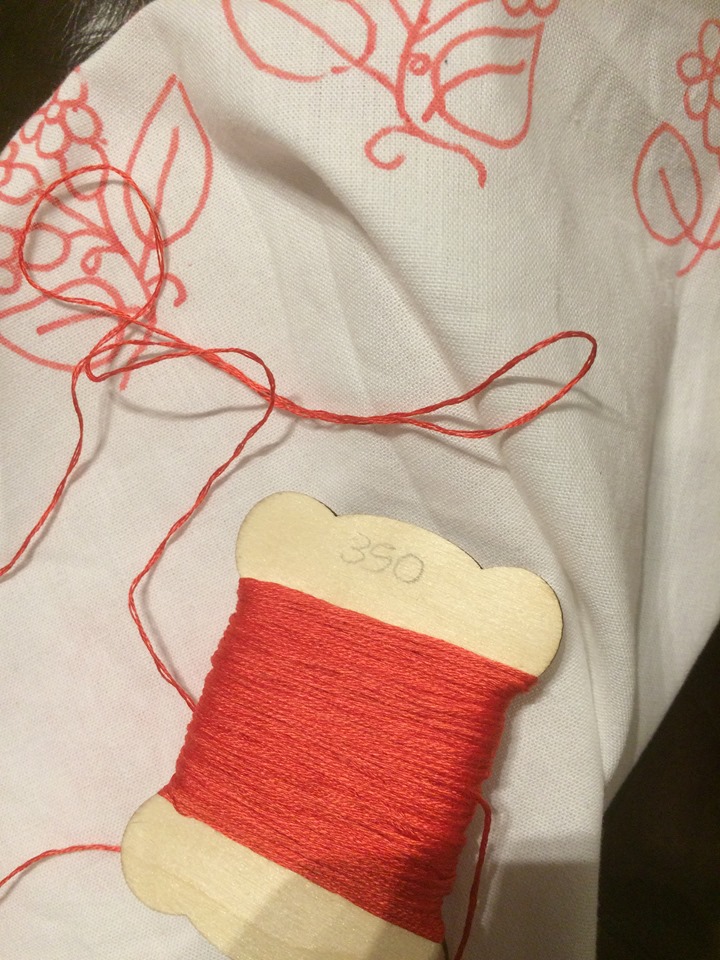
The design was traced out in removable pen and worked predominantly in split stitch and double running stitch in orange DMC cotton floss with two threads, and some running stitch with a single thread (bees). In period, silk floss would most likely have been used for embroidery but I can’t afford silk. The background fabric is cotton linen blend. Linen was mostly commonly used for undergarments in the sixteenth century, as it was widely available (being produced from flax plants) and easy to launder. There are many extant examples of linens for use as underwear (both embroidered and plain) in museums and textile collections worldwide. Linen was relatively easy to launder in our time period; un-embroidered linen bleaches easily in the sun and becomes softer with wear, wicks away sweat and is long lasting. Linen blends offer some of these benefits, but are more in line with my budget than pure linen, as well as being more readily available.

Polychrome embroidery and decoration on a late sixteenth century extant linen shirt held by the Met Museum showing the use of bold colours in Italian embroidery, Accession Number 10.124.1 from
https://www.metmuseum.org/art/collection/search/83861
I have not yet finished the embroidery, but I plan to add more decorative elements when I have. I am considering adding some smaller motifs along the front edge, and I think some bobbin or needle lace in orange and white threads will finish the piece off nicely. Some of my inspiration pieces are below:
Extant 16thC Camicia held by the Met Museum
Image from: https://www.pinterest.com.au/pin/532269249682155573/
Extant 16thC Camicia held in Prato, Museo Del Tessuto
Image from Pinterest: https://www.pinterest.com.au/pin/567594359271816517/
The pattern of the partlet I made differs from those used in period ; I wear a 'dickie' style that I can get into by myself as I don't have anyone to help me dress. The side seams under the arms are sewn rather than being loose and having the partlet tied on. Patterns for and images of partlets from the sixteenth century mainly seem to involve pinning or tying them in place under gowns (although some are pinned on over gowns also).
Partlets (with ties) hanging on the line in this scene painted by Allori in the Palazzo Pitti (c. 1598)
Image from https://www.uffizi.it/en/artworks/loggetta-dell-allori
Extant Spanish partlet which has ties:
Extant sixteenth century partlet held by Instituto Valencia de Don Juan
Image from Pinterest: https://www.pinterest.com.au/pin/513410426253249839/
An Italian style of partlet (which would be pinned on), from Elisabetta Parasole's book of partlets (bavari) patterns from 1604 “Ornamento nobile per ogni gentil matrona, dove si contiene bavari , frisi d'infinita bellezza, lavori, per linzuoli traverse, e facuoli” at
https://gallica.bnf.fr/ark:/12148/btv1b10526091w/f10.item
Reproduced at https://www.facebook.com/modelbuchmuse/
Bibliography
Arnold, J. 1988, Queen Elizabeth’s Wardrobe Unlock’d, W S Maney and Son Ltd, London.
Arnold, J; Tiramani, J; and Levey, S. 2008, Patterns of Fashion 4, Pan Macmillan Ltd, London.
Compleat Anachronist 115: Wrought with flowers of Black Silk, Prudence Catesby
Compleat Anachronist 31: An introduction to Blackwork, Shoshonnah Jehanne ferch Emrys
Dress at the Court of King Henry VIII, Maria Hayward (2007, Maney Publishing, UK).
The Encyclopedia of Embroidery Techniques, Pauline Brown (1994, Simon and Schuster, Australia).
Geddes, E and McNeill, M. 1976, Blackwork Embroidery, Dover Publications, New York.
Mikhaila, N and Malcom-Davies, J. 2006, The Tudor Tailor, B T Batsford Ltd, London.
Orsi Landini, R and Niccoli, B. 2005, La Moda a Firenze 1540-1580, Pagliai Polistampa, Florence.
Synge, L. 1982, Antique Needlework, Blandford Press, New York.
With many thanks to Modelbuch Muse for inspiration and for conveniently posting images in one place so I don’t need to search through my books for designs - https://www.facebook.com/modelbuchmuse/