Monday, September 30, 2013

Reference Notes - Images of Squirrel in Medieval and Renaissance Art


I recently did some research on squirrels in Medieval and Renaissance art to help me design my embroidered German brustfleck. Here are some of my notes.


Squirrels in imagery have had various symbolic meanings throughout the ages. Sometimes they were seen as symbols of grasping covetousness, and at other times they were seen as an affectionate friend. (Biographer Jonas of Bobbio describes Saint Columbanus of Ireland as having a squirrel companion.) (Ref: http://www.abbeville.com/blog/?p=390)
The squirrels' sensible hoarding of food for winter was not properly understood and was considered greedy.

Squirrel fur was used widely in clothing. Squirrel fur was also depicted in heraldry. Vair is the representation of patches of squirrel fur in an alternating pattern.
See  http://en.wikipedia.org/wiki/Vair for more information.


Image of Squirrels in De natura rerum by Thomas of Cantimpre
Dutch translation by Jacob Van Maerlant, Flanders, c. 1350
Koninklijke Bibliotheek, The Hague, MS KA 16, 11 x 11 1/4 in. (27.8 x 20.8 cm)

Folio 68v: Squirrels

Image from: http://www.abbeville.com/blog/?p=390


The illustration is from a fourteenth century Book of Hours of the use of S.-Arnoul-les-Metz. It is now in the collection of the Beinecke Library at Yale University.    Image source: Beinecke MS 657. General Collection, Beinecke Rare Book and Manuscript Library, Yale University. Image believed to be in the public domain.
Image taken from Pinterest, from the page of Scrolls and Scribal SCA  http://pinterest.com/pin/52565520621769458/

The page is from a fourteenth century Book of  Hours in the Beinecke Libarary Collection of Yale University. Beinecke MS 657.
Also http://sunsite3.berkeley.edu/hehweb/index2.html


Unspecified Medieval Manuscript Fragment

Medieval squirrel!
Image from: Pinterest http://pinterest.com/pin/277393658271781988/


Medieval Tile Fragments from Malmesbury Abbey


Image from: http://www.flickr.com/photos/29320962@N07/6203279058/


Squirrel Sculpture


Image from: http://www.scalarchives.com/web/dettaglio_immagine.asp?idImmagine=0046332&posizione=1&numImmagini=1&prmset=on&ANDOR=and&xesearch=0046332&ricerca_s=0046332&SC_PROV=RR&SC_Lang=ita&Sort=8

This image is from a Baptistry door frame in Florence and dates from the early Renaissance. It was created by the artist Lorenzo Ghiberti (1378-1455). Please see the SCALA archives for more lovely images and information.


Two Squirrels by Albrecht Durer (1492)

File:Durer-ecureuil.jpg
Image from: http://commons.wikimedia.org/wiki/File:Durer-ecureuil.jpg

Albrecht Durer (1471-1528) was a German printmaker, painter, mathematician, theorist and engraver. He is famous for his engravings, religious works and meticulously detailed natural imagery. More information is available at http://en.wikipedia.org/wiki/Albrecht_D%C3%BCrer


Page from 'Lart de bien viure et de bien mourir' in the Rare Book and Special Collections Division of the Library of Congress (P342)
LC control no. 48033846


Image from: http://lcweb2.loc.gov/cgi-bin/ampage?collId=rbc3&fileName=rbc0001_2004rosen0424page.db&recNum=341


Portrait of a Lady with a Squirrel and a Starling by Hans Holbein The Younger (1526-28)


Image from: http://commons.wikimedia.org/wiki/File:Hans_the_Younger_Holbein_-_A_Lady_with_a_Squirrel_and_a_Starling_(Anne_Lovell%3F)_-_Google_Art_Project.jpg

This oil painting was done on an oak panel and is believed by some to depict Anne Lovell. The sitter wears Tudor clothing.


Portrait of a Lady with a Squirrel by Francesco Montemezzano


Image from: http://starlightmasquerade.com/PortraitGallery/Ladder-Laced-Venetian/inspiration-pages/openbodice22.htm


Embroidered Bookbinding for the New Testament c. 1635

This embroidered book cover is listed in English Embroidered Bookbindings by Cyril James Humphries Davenport. This book has been published as an e-book and can be found at the link above. The book was published in 1625 and bound in 1635. The binding shows the figures of Hope and Faith. The e-book gives more information about this binding, but unfortunately does not describe what stitches have been used, or the materials.


Further references to explore:

Animals in Medieval Art - Met Museum
http://www.metmuseum.org/toah/hd/best/hd_best.htm

Reframing Medieval Art: Difference, Margins, Boundaries by Madeline H. Caviness
http://dca.lib.tufts.edu/caviness/chapter3.html

Saturday, September 28, 2013

Pompadour Court Shoe


Another drool-worthy shoe from American Duchess is now available:


"Pompadour" French Court Shoes (Ivory)(Pre-Order)
I'm having visions of spangled fans, beautiful fabrics, gilded everything and tons of diamonds!

Details are available from http://www.american-duchess.com/shoes-18th-century/pompadour-french-court-shoe-white


Medieval cooking - Sauce Galentyne and Powme Dorrys

In the last six months or so, I have become quite interested in medieval and renaissance cooking, and have been trying my hand at a few recipes. I am particularly interested in recipes that I am unfamiliar with or which contain ingredients that I have not tried before.

I made Powme Dorrys and Sauce Galentyne in August. The recipes come from Liber cure cocorum - which can be found online at http://www.pbm.com/~lindahl/lcc/


Sauce Galentyne

"Take crust of bread and grind it small, take powder of galingale and mix with all,
Powder of ginger and salt also; Mix it with vinegar ere you do more,
Draw it through a strainer then, And serve it forth before good men."

I used:

1 and a quarter cups of white wine vinegar
1 tsp salt
1 tsp ginger
1 cup of white wine
70g chopped and pounded fresh galingale
1 and a quarter cups of breadcrumbs
three quarters of a teaspoon powdered cinnamon.

The cinnamon and wine were added because they show up as ingredients in other versions of Sauce Galentyne recipes (e.g. p. 562 of Take a Thousand Eggs or More Vol. 2- from Ashmole MS 1439 and Harleian MS 4016.) I thought these ingredients would make for a richer sauce.

I was unable to obtain powdered galingal, so had to use the fresh root. Pounding fresh galingal is not an easy task. The piece I obtained was quite fibrous and woody. I believe that this sauce is normally a pink colour. Mine turned out beige coloured; I think because of the fresh galingal. Next time I make it, I might reduce the vinegar by a quarter of a cup.

I mixed the ingredients and let them soak, then passed the mixture through a sieve.


The strained sauce.


I wanted to try this sauce because it sounded interesting; I couldn't imagine that it would taste very nice. Although it tended to separate in the serving dish, it was actually a really tasty and piquant sauce that would be great with any meat. My family are unaccustomed to medieval flavours but were really impressed with this sauce as well.


The Powme Dorrys or Glazed Meatballs seemed perfect to go with this sauce.

Powme Dorrys (also from Liber cure cocorum)

"Take pork and grind it raw, I teach,
Mix it with beaten eggs; then
Cast powder to make it in a ball;
In boiling water you shall cast it
To harden, then you take,
Spit it fair for God's sake.
Baste it with yolks of eggs then
With a feather at fire, as I teach you;
Both green and red you may make it.
With juice of herbs I undertake;
Hold under a dish that naught be lost,
More commendable it is
as well you know."

I substituted chicken mince for pork mince as many people in my barony do not eat pork. I added small amounts of salt and pepper, and used rice flour as the powder to "make it in a ball". A wise friend who tasted the dish suggested that the "powder" mentioned in the recipe may have been Powdre Douce or a similar spice/seasoning powder commonly used in medieval cooking. Once she mentioned it, I couldn't believe that I hadn't thought of it. Using Powdre Douce or similar would make these meatballs much tastier. On their own they were a little bland (but very good with the sauce above.) I would also like to try this again using pork mince for a richer taste.

I used:

1 kilogram of chicken mince
One quarter cup of rice flour 
salt and pepper to taste
extra rice flour for rolling
2 eggs to bind
2 egg yolks for basting
(makes approximately 55 rum-ball sized balls)

Mix flour, mince, 2 eggs and salt and pepper to an even consistency. Make small balls with hands and roll lightly in the extra rice flour. carefully drop balls into a shallow pan of boiling water and boil for 10-15 minutes (depending on size of ball and whether doing in one or two batches.) When cooked, drain.
Add cooked balls to a bowl containing well beaten egg yolks and coat until all balls are yellow. I fried mine lightly in a small amount of olive oil.

I omitted the herb juice dressing at the end because all I had at the time was spinach and sage, and because I planned to serve them with a sauce anyway. 

These meatballs would also be good with garlic and onion powder added and cooked in chicken stock instead of water.


The boiled meatballs being coated with egg yolk prior to frying.


The fried meatballs showing lovely colour and slightly crisped surfaces.


Saturday, September 14, 2013

Trefoil Pattern Linen Pouch

I have been working on a linen presentation pouch. I am using the new fine wool that I purchased recently. This is my first attempt at any sort of wool work. The trefoil design is being worked in split stitch. I intend to fill in the leaves once all the outlines are done.


All the other projects that I am working on are surprises for other people, and I can't post pictures until they have been presented.

Monday, September 9, 2013

More packages!


Another lovely package arrived; this time it was a beautifully wrapped package of embroidery wools from The Orange Daisy. I will post pictures of what I do with them.


Saturday, September 7, 2013

Nice surprise!

Look at what came in the mail recently! It is full of lovely coloured plates and will be very useful as inspiration for illumination.


Wednesday, September 4, 2013

Current projects

I haven't been posting much lately, but I have been busy. I have been working on several items for other people. (I will not be able to post about them until they have been presented.)

Another big project that is taking a lot of my time is preparing research notes for publication on my blog. I spend an awful lot of time researching imagery to support decisions I make in creating the things that I make, so I thought that I should collate my notes and post them so that they can help other people as a starting point for their own research. But it is proving to be a BIG job!

Tuesday, September 3, 2013

More drool-worthy shoes

Check out these wonderful 1930's Oxford shoes available on special (pre-order) from American Duchess. That store, with all those beautiful shoes, is almost enough to tempt me to branch out into costuming from later periods!


from: http://www.american-duchess.com/shoes-1920s-1930s

Thursday, August 15, 2013

IRCC3 - August Update


Well, this final month of the Challenge flew past! I didn't manage to complete much, but I am pleased with what I have achieved.

I have a new adapted gown pattern, and a gown cut out ready to sew.

I have a new adapted coat pattern, and a coat partially sewn.

I have a set of large pockets mostly finished.


I have a terracotta red silk underskirt completed and awaiting some embroidery.


I have a partially sewn chemise.

I have a lovely new feather fan.


Plus all the semi-completed and finished products from the earlier months of the Challenge.

This is much more than I would normally achieve in a year, and more than I thought I could achieve, so I am very happy with my progress. (I will post pictures and details of items as they are finished.)

Best of all, I have really enjoyed learning from and being inspired by the other participants in the Challenge. My confidence has improved and I feel very motivated.


Sunday, August 11, 2013

To Surf Or Not To Surf

As you all know, I tend to work slowly and erratically on projects. And I suffer terribly from that most SCA-ish affliction of wanting to do everything, right now. Obviously, the two tendencies don't really compliment each other. I am wondering if I should just stop surfing the net, and focus on the projects that I already know that I want to do, and leave the distractions for that time when - miraculously- I will be up to date, with free time. Oh no - my internet provider will probably lose so much money that they will go out of business!

Saturday, August 10, 2013

Monochrome Collar and Cuffs - Shirt Presentation

You might remember that earlier this year I was working on some red monochrome embroidery on linen for a shirt. Well, back in June I had a very nice surprise; my friend had made up the shirt that the embroidery was destined for. She did a great job, and the shirt was presented in court as a surprise gift.


Here are some pictures from my earlier posts about the embroidery:

 
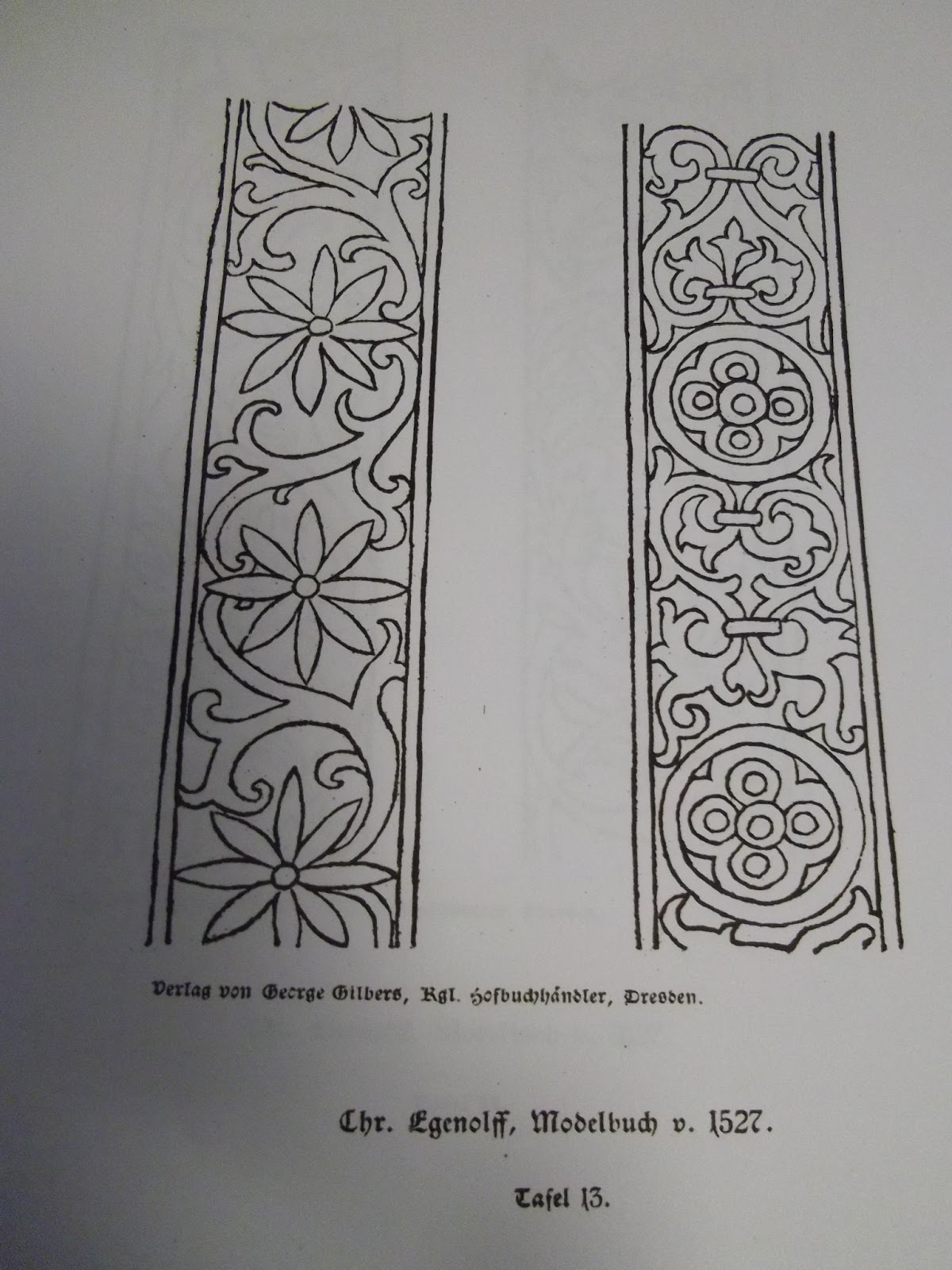
The pattern from Modelbuch Aller Art


 The finished embroidery


Many thanks to Clair Abrahams for the photo of the completed shirt.

Friday, August 9, 2013

AoA Scroll Blank #1

Recently I have been working on my first scribal assignment; colouring an Award of Arms scroll blank.

The blank was designed by Master Richard de la Croix and is derived from a 1440 manuscript fragment. The blank shows a bastard Gothic hand which was very popular on the continent and in England in the fifteenth century.

I opted for classic red, blue and gold treatments. This excellent book given to me by my sister has been invaluable as a design reference, as it has many close-up pictures of extant manuscript pages in similar styles:


And here is my attempt. Unfortunately the colours really haven't shown up very well on the photos.

(Of course I can't show the name or device or it wouldn't be a surprise!)


Monday, August 5, 2013

Update - August

Despite the lack of postings, I have been consistently working on several projects. Unfortunately, most of them are surprises for other people, so I will have no pictures for you for a little while!

Sunday, July 7, 2013

White tie-on sleeves

I needed new sleeves to go with my (relatively) new blue drill, pointed front gown, but hesitated because I wasn't sure about what pattern to use. I have tie on sleeves for other gowns, but have never been completely happy with the fit or the shape of the pattern.

I was so unsure of how to tackle the problem that I procrastinated about it until two weeks before I needed the finished sleeves. Desperation caused me to make a decision! The sleeve is not an accurately period pattern, being reasonably wide with a modern underarm seam. I added extended my existing sleeve pattern in the area around the arm pit, as I didn't want any chemise or smock to puff out there. The end result is very user-friendly. The sleeves are comfortable, look nice, and are not restrictive. One day when I am feeling confident, I will move the seam on the paper pattern to a more appropriate place.

Tacking on the ribbon prior to hand sewing


The sleeves are white cotton drill, lined in white cotton broadcloth. They are trimmed with a commercial ribbon that I have had in my stash for several years. The ribbon was hand sewn on. The sleeves needed to be wearable with Italian and English sixteenth century gowns. I would have preferred horizontal stripes to vertical, but I did not have enough trim. I thought some added gold ribbon would have been nice, but did not have the time to add it.


As I was rushing to prepare for an event, the sleeves were made without a piccadil strip, but I intend to add one in on each sleeve later.


Saturday, July 6, 2013

Medieval gingerbrede and Omelettes

Recently I have been trying out some medieval recipes. A few weeks ago I tried Medieval gingerbrede. The consistency was quite unusual compared to the modern sort. I think that the next time I try the recipe I might use a blender to 'grate' fresh bread rather than use toasted breadcrumbs. The recipe called for the gingerbread to be sliced into pieces, but I rolled it into balls and dipped it in sugar so that it would be easier for people to nibble on.


I also tried a broad bean omelette, which I made in a frittata dish. It wouldn't take much to put me off  eggs, and I had never tried broad beans, but I did enjoy the frittata. My family are not familiar with Medieval food, and they all enjoyed it too. So I was very pleased with that recipe!


Tuesday, July 2, 2013

Elizabethan Hood and Hairstyle

As part of my outfit for the event I recently attended, I decided to make an Elizabethan Hood. For ease of wearing, I replaced the hood with a caul. I used a Tudor hood pattern that I adapted from the one in the Tudor Tailor. I was very happy with my Tudor hood except for the fact that the buckram in the 'visor' went quite limp. The fit was good and I felt that it looked good.

These images of Queen Elizabeth I show the sort of style I was going for, although I wanted my hood to be very understated:
Elizabeth as Princess, c. 1555.Miniature Portrait of Queen Elizabeth I c. 1565. attr. to Levina TeerlincQueen Elizabeth I, c. 1565-1570. Previously attributed to Eworth.

I cut the hood base back by about half to allow for the padded rolls of hair to be worn in front. I couldn't find my buckram, so I used two layers of stiff needlepoint canvas, a think layer of interfacing and a layer of felt. These were all stitched together and wired along the front brim. The fabric 'case' was then inserted over the top, and the caul gathered up into the back of the band. I added a billiment of beads and pearls with gold trim at the front and a piece of starched gold lace at the back. I added a wig clip inside the brim, but I didn't need to use it; the hood stayed fairly secure without it.


To do the Elizabethan rolls in front of the hat, I parted my hair horizontally just behind my ears (because my hair is very thin right now,) and barrel curled the front section. I sprayed the hair with strong hair spray and teased it. I managed to put it up over the 'hair riser' combs quite easily and smoothly. Then I pinned it behind the combs and tucked the ends into the bun that I had made with the rest of my hair. Another hefty spray of hair spray and the whole 'do' was as solid as a rock. I added a pearl drop and put on the hat. Easy.


Getting the teasing and spray out of my hair was not quite as easy. When I took the hair riser combs and pins out, my hair wanted to stay in the roll shape. I could have pinned it all back up and worn it again without the combs, it was so stiff.
Post-revel hair!

Luckily, my sister was on hand to give me some hair treatment gel that really helped. Once the hot water from the shower hit it, all the spray and tangles just eased away, and a bit of shampoo and thorough conditioning brought it all back to normal. Flat, boring, normal. I was never a fan of big, 80's hair, but I do love my Elizabethan hair!

Tools of the trade: bun clips, hair riser comb and barrel curler. Plus hairspray and pins.

One of my previous Elizabethan hair styles, done using the same techniques (just different hair accessories).

Monday, July 1, 2013

Blue pointed bodice dress


Finally, here is a picture of the blue dress that I finished back in April. This is a picture of me, running late and about to rush off to an event. My lacing is askew, my partlet and girdle are not sitting right, my skirt is twisted- pictures like these make me consider never eating anything but cabbage water or getting in front of a camera again! There were lots of 'wardrobe malfunctions' while I was getting ready for the event, including my partlet ties pulling through and my farthingale being too big since I last wore it. Hence no farthingale.


The white tie-on sleeves and Elizabethan hood and caul were new for the event, and the girdle was made as part of the Italian Renaissance Costuming Challenge III.

Dancing Figures Solteltie

This week I have spent a lot of time creating a solteltie for a Ball and feast. The base was created from gingerbread which was then covered with commercially produced fondant icing. The figures were roughly marked out as an imprint, based on an early Renaissance image of a betrothal. I tweaked the image to make it look like people dancing, and added a tassel hanging in front of the banner of my Barony as there was to be a tassel kicking competition at the event.

I had hoped to try out my new edible ink felt tip pen, but it just collected the icing. Back to the old fashioned way- food colouring and a small paintbrush. Most of the colours were gel food colourings mixed with a little bit of vodka. I thought that they covered very well.

Decorating the icing took a long time, but I thought that the result was worth the time. The silver 'balls' are soft sugar pearls. They look like cachous but do not have that horrible tooth-cracking feeling when you bite into them. The little daisies are made of fondant.

The 'naked' gingerbread


The iced gingerbread


Some figures have been marked out..


Nearly completed


The piece with the inspiration images beside it

The finished piece. I added caster sugar around the edges later, to cover the platter