Showing posts with label renaissance clothing. Show all posts

Monday, February 10, 2020

Partlet with Holly Berries

My first 'holly' project is going to be a partlet decorated with the holly design in one of Trevellyon's borders from his Miscellany. (I plan to register a heraldic badge that has holly on it, so there my be more holly themed items in the future.)

A page from Thomas Treveyllon's Miscellany from 1608
The base fabric is a lovely fine linen. The design was marked out with an iron-away Frixion marker. The berries are embroidered in two strands of red DMC 498 cotton, and the leaves and stems in two strands of green DMC 3818 cotton. I considered other colourways, but decided to go with realistic colours for this first project. In period, of course, silk would most likely have been used for this project. I have used cotton due to cost and availability issues.

The stems, leaves and berry outlines are being worked in split stitch, and the line across each berry is done in double running (Holbein) stitch.

When making partlets, I often do what is not recommended, and make up the garment first. I use a small hand-sewn hem on my Italian partlets, and I find having the centre front hem completed can be useful in ensuring that the design is perfectly aligned with the centre front edge of the partlet. If you decide to do it this way, you should be careful to ensure that the edges of the garment do not get stretched and warped by your hoop. I use a very small hoop and move it often, being careful not to stretch the linen base fabric.


Monday, July 29, 2019

Over-Partlet made from Remnants and Op Shop Materials


The construction of this over-partlet was inspired by a remnant purchase and the recent bout of very cold weather in my local area.


  The wool blend remnant

As you know, I am very passionate about women’s dress accessories; I love the variety in sixteenth century dress accessories and the inventive and beautiful ways sixteenth century women had of displaying their wealth and creativity. Dress accessories are usually the first thing I notice about women’s garb, and I find the history and construction endlessly fascinating. I also believe that good accessories are a way to separate real clothing from a costume. I put a fair bit of effort into dress accessories for my persona, but it wasn’t until I started to get quite chilly at events that I realised that my wardrobe lacked an over-partlet/gollar.

As someone who does not enjoy sewing and who lacks patterning skills, the reasons behind the lack are fairly obvious. I recently picked up a pretty wool blend remnant for $12, and this inspired me to try making an over partlet.

Over-partlets are a good way to be able to layer clothing to stay warm, while still having the garment be easily removable. Tudor ladies wore small outer partlets that could be pinned or tied on. They were made in contrasting or matching colours to gowns, and some were fur lined. Variations of over-partlets/gollars are seen across Europe in the sixteenth century, and figure strongly in Tudor and German portraiture.

Even within the same region and time period, there seems to be a lot of variety in style and cut of gollars or over-partlets. A quick review of German fashions in the first half of the sixteenth century shows wealthy women as well as trossfrau and camp followers wearing over-partlets in a range of styles. Decoration varies (fur-lined, figured silks, applique decoration, applied trims etc.) but the actual cut of the garment varies a lot as well. Some are worn closed at the front, some have are wider and extend past the shoulders- others are quite narrow. Some are roughly the same length front and back, others have extended panels at the front which hang down further than the back section. I chose to make my partlet quite wide as I wanted to keep the tops of my arms (where there is a gap in my sleeves) warm. I also chose to make the front panels roughly the same as the back section. I decided to save any extremes of fashion for later experiments.


Portrait of a Lady with Playing Cards by Urs Graf 1515
Image from: https://www.pinterest.com.au/pin/236157574187882145/


Elegant Couples Dancing (detail) by Ambrosius Benson (1545)
Image from: https://www.pinterest.com.au/pin/546061523544879141/


Portrait of a Lady by Master A. W. (active from 1536) held by The Courtauld Gallery
Image from: https://artuk.org/discover/artworks/portrait-of-a-lady-207305


Portrait of Anna-Regula Schärer c 1515 by Gattin des Junkers Andreas Schmid
Image from: https://commons.wikimedia.org/wiki/File:AnnaRegulaSch%C3%A4rer.jpg


Portrait of a lady by an Unknown German artist c 1525 showing a fur-lined partlet
Image from: https://www.pinterest.com.au/pin/459859811934181911/


An old woman offering money to a young man by Jacob Goltzius c. 1600 (held by Museum Bijmans Van Beuningen) – showing a fur-lined partlet
Image from: https://www.boijmans.nl/en/collection/artworks/151647/an-old-woman-offering-money-to-a-young-man

I reviewed “Drei Schnittbucher” (Three Austrian Master Tailor Books of the 16th Century” to try and find an actual sixteenth century pattern guide for the garment, but could not find one. The Tudor Tailor had a pattern for making a Tudor style partlet, but nothing with a rounded bottom edge. In the end, I made an educated guess as to what the pattern would look like, using the Tudor Tailor partlet pattern as a guide to how the grown-on style collar should look. I made a paper pattern, and used it to cut out a toile from an old sheet. I ended up doing three toile drafts before I was satisfied with how the garment was sitting.

Once I had the pattern, I placed the pieces on my wool remnant. I was happy with the placement, and I still have enough wool left to make a matching hand warmer or snozkyn. Next I had to place the pattern pieces on the fake fur. This was more challenging, as the fur remnant had pieces cut into it and there was not a lot there. I had four attempts before I got it right. I wanted the hair strands to all be flowing away from the neckline. One of the pieces had to be positioned slightly diagonally to make it fit, but the difference was not noticeable. I cut the wool pieces out. I had to be careful with the fur pieces, attempting to cut the base fabric rather than the hairs because cutting the hair itself makes it look shorn and unnatural.

The successful pattern mock up

   Pattern lay out on wool

  Pattern Layout on fur - attempt 1


 Pattern Layout on fur – attempt 2


    Pattern Layout on fur – attempt 3


I sewed the wool pieces together, and then the fur pieces together. The seams of both the wool section and the fur section were quite thick so I used a hand stab stitch to sew them flat to reduce bulk.
The next step was to pin the wool piece and the fur piece together, right side to right side. I tried not to catch too much hair inside the seam, but inevitably a lot of hair got caught. I used the sewing machine to sew a continuous seam around all the edges, leaving about fifteen centimetres unsewn to be able to turn the garment right side out.

Once the seam was sewn, I cut into the seam allowance on the corners and tight areas, giving the fabric some ease to stop bunching. I also cut away the bulk on the front centre corners. Then I turned the partlet right side out. I used a bone turner to poke the edges out and make sure the seam was sitting cleanly.

The two fabrics were quite thick, and with the seam allowance turned under the edges were quite bulky. To reduce the bulk and make the edges sit neatly, I went around the edges with a needle and thread and tried to invisibly catch all the pieces together with a stab stitch. When this was completed, I whip stitched the hole where the garment was pulled right side out closed. 


Pinned and ready to stab stitch


I had some cotton bias binding leftovers that I got in a bulk pack from an op shop, and picked a cream coloured one that was similar in colour to the fake fur. I had previously washed it to make sure it was colour fast, and it needed to be ironed to make the hems sit properly. Once this was done, I marked out where I wanted the bias trim to sit, and pinned it all down. The trim started at the centre back of the neck and travelled around all the edges before finishing at the centre back neck. I hand sewed down both sides of the bias trim with cotton thread. In the sixteenth century, the tailor or seamstress would have had to make their own bias strips and join it with hand sewing. I have made my own bias before, and I am very glad to have the luxury of commercially prepared bias binding.


Portrait of a city woman with haube by Hans Baldung 1520 showing a single line of trim decoration
Image from: https://www.pinterest.com.au/pin/236157574187886064/


Portrait of a Lady by the Master of the Angrer Portraits c. 1519 showing a double line of trim decoration
Image from: https://www.pinterest.com.au/pin/449726712762196713/


Marking placement and attaching bias trim

There are portrait examples of ladies wearing over-partlets with one line of trim, two lines of trim, and multiple lines of trim. I decided to go with elegant simplicity and do a single line of bias trim. I mitred the corners to make them neat; I haven’t been able to see the portraiture closely enough to make out details on whether that was done in period, but as it is a neat and logical way to make the trim sit properly, I don’t think that it is unlikely that a seamstress thought to do it in period.

The hairs that were caught in the seams had to be coaxed out gently in small amounts with a needle. There are still areas that need more hair removed from the seams- it is a tedious business.
I toyed with the idea of adding decorative wooden thread wrapped buttons to the partlet, but I don’t think it needs the extra decoration. I do have a coat hook stashed away somewhere which might be useful to add to the centre bottom of the front panels to invisibly secure the garment – only wearing it for an event will suggest whether this is necessary or not.

Prices
Wool/nylon blend remnant $12
Fake fur op shop remnant $2
Bias binding remnants (op shop) 8 pack for $2 =25c
Op shop sheet for toile $1
Lunch paper for patterning approx. $1.50/roll
Threads – already in stash
I was very happy that this garment came in under $20AU total – and probably closer to under $15. I also have enough wool left over to make a matching hand warmer, although I will need to keep my eye out for another remnant of fake fur.


Bibliography

Arnold, J; Tiramani, J; and Levey, S. 2008, Patterns of Fashion 4, Pan Macmillan Ltd, London.
Barich K and McNealy, M. 2015, Drei Schnittbucher, Nadel and Faden Press, USA.
Mikhaila, N and Malcom-Davies, J. 2006, The Tudor Tailor, B T Batsford Ltd, London.

Saturday, May 11, 2019

Tie-on Sleeves in Plum Cotton Fabric

You may remember that an ongoing project is the creation of a suite of tie-on sleeves to complement my Italian style gowns. The other day I was bed-ridden and I was trying to work on sewing down the inside of the seams on one of the pairs.

The sleeves are cut out and zigzag stitch put along the cut edges. Then the side seam is machine sewn (or hand-sewn if I have the time and manual dexterity, which I usually don't).

Th idea with the inside seam is to press or finger-press the seam open and flat on the inside and sew it down with tiny invisible stitches so that it doesn't bunch or twist with wear.

I'll admit that I was struggling with the project, so I was pretty satisfied when I was done.
  I put the project down to admire my achievement........ and looked closer.....
Yep, those are two right sleeves!
Of course, I noticed this after the seams had been machined and then hand sewed flat. (Eyeroll.)


Monday, October 17, 2016

A pile of sleeves to be sewn...

Lately I have been working on projects for other people, teaching, and expanding my range of accessories. I haven't been very well, and just can't face taking on a large project like a new gown (although I could use a couple more.) I have cut out about ten pairs of sleeves in various styles and colours, and plan to gradually work through the pile, decorating and finishing them. A whole pile of new sleeves will certainly expand the look of my wardrobe. I think that this project is more important at the moment than making body linens, so I have changed the focus of my personal Quest to 'accessories' for the next few months.


Tuesday, January 22, 2013

Decorated coat ideas

I recently saw some photos of myself in garb at an event and decided that I want another outer coat. The hard part is deciding what style. At this stage, I am thinking loose and 3/4 length; possibly with hanging sleeves, and heavy on the decoration. It also needs to work with Elizabethan and Italian styles.


I put together some pictures that have inspirational trim/decoration:

from: bjws.blogspot.com


Eleanor of Toledo by Allesandro Allori, c.1560, image provided by Jon.
ffrom: elizabethan-portraits.com
from: wikipaintings.org

from: lib-art.com


Mary Martyn from A Who's Who of Tudor Women
from: craftster.org

from: lesderniersvalois.com
Titian's La Bella from  online.wsj.com

from: tudorplace.com.ar


Tuesday, November 13, 2012

Daily Inspiration - Titian

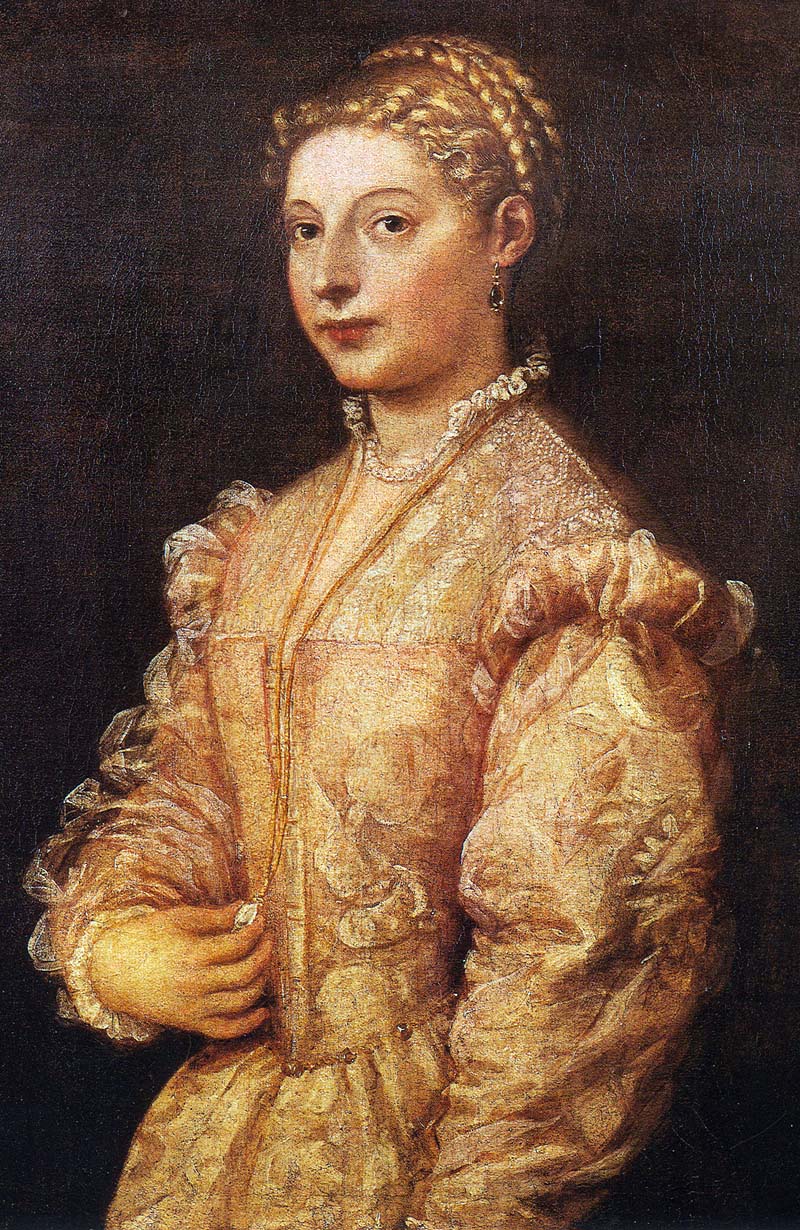
Titziano Vecellio (Titian) Portrait of a Girl (Lavinia)

Portrait of a Girl (Lavinia) by Titian
c. 1545
from: http://starlightmasquerade.com/PortraitGallery/Ladder-Laced-Venetian/inspiration-pages/Venetian10.htm


Wednesday, November 7, 2012

Daily Inspiration - Bassano

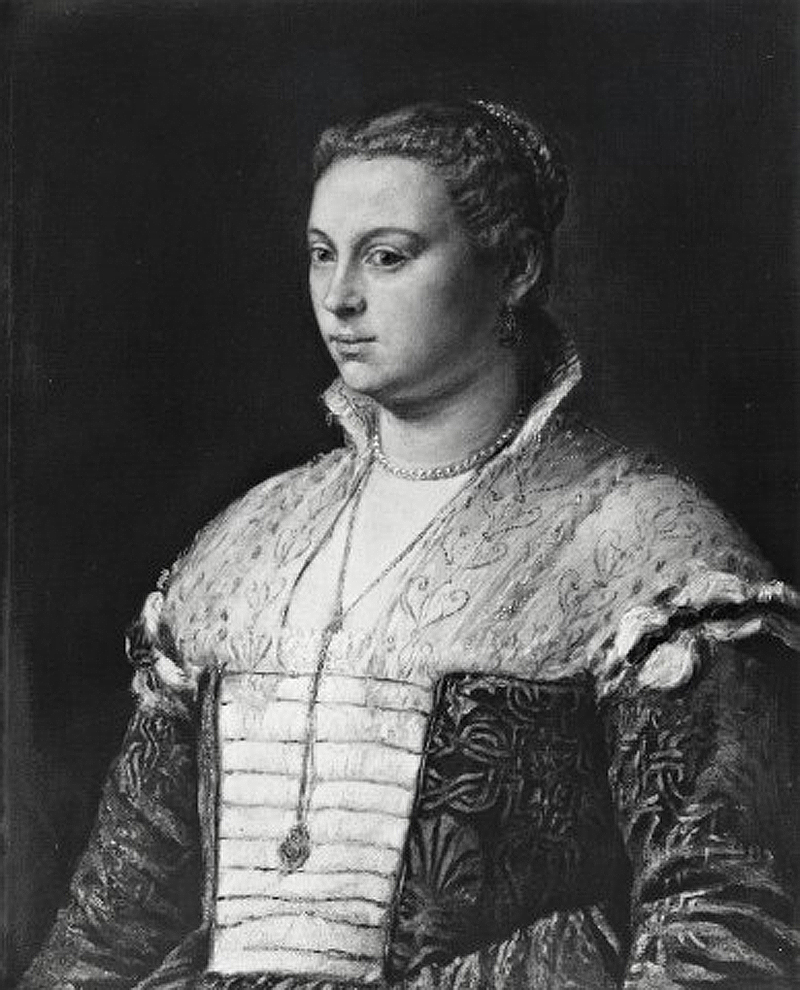
Leandro Bassano Portrait of a Lady

Leandro Bassano's 'Portrait of a Lady'
c. 1570, Norton Simon Museum, California

from: http://starlightmasquerade.com/PortraitGallery/Ladder-Laced-Venetian/inspiration-pages/openbodice6.htm

Thursday, October 11, 2012

Update

I haven't posted much lately because I have been unwell, and I have been struggling with my projects. One of the problems I have been having is with my hands, which are not working well. This has been making it difficult to get the embroidery for the 'Perfectly Period Pink' IRCC Challenge done on time.
Also, I tried on my blue front lacing dress and it looks pretty awful. I must have lost a lot of muscle tone during my recent illness because it is too big (! what a shock - that has NEVER happened before :-)  !) Now, it just looks sloppy.  (I am happy with the way it looks on the hanger.) That setback has made it hard to keep my motivation up to finish the complete outfit. I will get back into my regular exercise routine, keep plugging away at the Realm of Venus mini-Challenge, and hopefully, when I get back to the project it will look better on me.

Thursday, September 20, 2012

Blue dress update

Today I have some hand sewing to do on the sleeves that match the blue dress. I made some more bias binding which needs to be hand stitched into place.

The tie-on sleeve and lining waiting to be sewn

The sleeves will be tie-on and have gaps where the chemise will puff out. I have saved some blue fabric to do 'fancy' sleeves later.

I also bought some toupe clips to sew into my Juliet cap to help hold it in place.

Thursday, September 6, 2012

Blue dress update

Here is what I have been up to over the last few days with the blue dress...


Overstitching the edges for extra strength. There is a layer of 'fashion fabric' (cotton), an interlining of strong calico and a lining of cotton duck.


The layers of the bodice tacked and  ready to be pinned and hand stitched together.


A completed edge showing stab and whip stitching.


Preparing to mark out the gold broadcloth to make bias trim (with my furry helper!)

The skirt panels are cut and waiting to be sewn. I still need to decide on what style of pleating; I am thinking knife pleats.


Thursday, August 23, 2012

Un-corseted dress plans

I have been thinking a lot about that picture of St Ursula from the Denver Art Museum that I posted recently:

http://www.denverartmuseum.org/sites/default/files/slides/Media%20browser/collections_ps_1961_168AT.jpg

and also this, similar one
http://uploads8.wikipaintings.org/images/vittore-carpaccio/portrait-of-a-lady-1.jpg

and I am thinking of making my new un-corseted dress in a similar sort of style. I am so used to the straight up-and-down look of corseted gowns, I think I may be disappointed with how it turns out.

I have chosen a dark blue cotton for this dress because I had it in stash and also because I hope it will minimise my bust a little. If it works out okay, I might add an over-gown as well.

I have adjusted one of my existing bodice patterns to allow for the rounder bustline. I have cut the lining in a medium-heavy canvas and also a cotton lining fabric. I have made it front-lacing so that I can dress alone. I think I will have to add some sort of boning structure beside the lacing holes to give strength and to stop the cords pulling the fabric too much. I am considering light weight flat steel boning or maybe cable ties with an eyelet and ring combination. I have used heavy duty cable ties (in casings) as a light weight structural support next to eyelets before, but never in a dress that is to be worn without a corset or underbodies, so I am not sure how it will hold up.

I haven't even had a chance to edge the cut-out pattern pieces yet, so there is still time to think about it!


Thursday, August 2, 2012

New Pair of Bodies


Lately I have been going through all my projects and stash, trying to clear things out a little. I have lots of small pieces of patterned fabric in the stash. At one stage I thought I might take up quilting, but I changed my mind after I finished my first quilt.

I need a new pair of bodies. My current one has intermediate boning and is generally very comfortable, except that the front of the armhole nips quite a bit at long events. I adjusted my current pattern and made some changes after looking at The Tudor Tailor and Janet Arnold's pamphlet on Queen Elizabeth I's effigy bodies.

I hope that this new version works, because I really hate doing eyelets and I don't want to have to make another corset for at least eighteen months.

I have decided to do something very different - mainly because I was feeling guilty about the amount of fabric in my stash! I have cut out the outer layer and inner layer in modern print fabrics. All my past bodies/stays/corsets have been linen or plain cotton, and honestly, I am really bored with them! So this time I am doing something completely different. After all, no-one ever sees my underwear, and I won't shock you with a photo of me wearing the completed corset!


The fashion fabrics for front and back

I really like the front fabric, with it's vaguely Elizabethan flowers. I don't like the lining much (which is why it is lining,) but no-one will see it and it is very stiff.

I think that the finished corset would look quite nice with a bold edging like bright pink or purple. (Unfortunately the colour didn't show true in this photo; the purple binding is less blue and is  more purple.)


I did see a lovely bright hot pink and purple stripe taffeta type-fabric on the sale table at my local fabric shop, but I decided not to get it because my boning lines would probably ruin the stripey pattern, and I am supposed to be NOT buying fabric, but using stash instead.

The inner lining of the corset is two layers of a strong cotton canvas type fabric. It actually was a panel for a strong beach bag which I got on sale for less than $2.50. No-one will ever know!


I am not sure if this new style of bodies will be comfortable for me. I have a DD-E bust and have always had a fixed strap on my corsets before. Perhaps the tied-style strap will cut in around my armpit? I will have to wait and see. Here is the rough sketch I put on the pattern envelope, to give you an idea of the style:


And here is a picture of the effigy stays from freewebs.com


Clearly, there are some differences between my pattern and the effigy stays. I have opted for unboned tabs because I have done them before and also because my version of the corset is shorter. Elizabeth I was clearly a very svelte lady, and I am more (hmmm..) rotund. Hence the wider stays. Plus, I don't wear low or pointed bodices (as they just make me look fatter), so a shorter corset was a more practical option for driving etc. I like the side seam too, because I change shape a lot and altering a side seam doesn't affect the armholes like altering a side-back seam does.

I have made a pair of bodies completely by hand before, but it took a long time. My next big decision will be whether to sew the boning casings by hand or not. My machine is not too good with thick fabrics, and I just got it back from the shop. On the other hand, do I really need another incomplete project sitting around, waiting to be finished? I really don't know what to do, so I will give it some more thought. Let's face it, we all know that I have dozens of other things to finish, so I won't be bored while waiting for inspiration to strike!