Showing posts with label 1540s Italian fashion. Show all posts

Tuesday, August 16, 2022

Black Linen Summer Gown in the Italian Front-Lacing Style

I recently went through old posts looking for a recipe redaction that I had done, and found dozens of draft posts from 2019. I'm not sure why I didn't finish them and post them at the time? A lot of them aren't relevant any more, but there are some that you might find interesting.
Here is one:
I made this gown over the Christmas break for an event in January 2019. It gets very hot where I live (40 degrees Celcius +), and although events are usually postponed when it gets too hot, sometimes the show must go on.

This was a quick project with some modern sewing techniques used to save time. I modified one of my other gown bodice patterns to drop the waist a bit, make the shoulders a little wider and put a bit more depth into the point of the bodice.

The gown bodice was an experiment with no boning. The linen was lined with heavy cotton canvas and the two pieces 'bagged out' or sewn together with the machine and then turned right side out.
I hand sewed the bottom edge of the bodice and the armholes.

The trim is just simple ribbon, sewn on by hand.

The eyelets were all done by hand with an awl and sewing thread. I decided to add some bias binding along the font edges  and slip bones in for a bit of rigidity and to stop the eyelets puckering. Once I tried the completed bodice on, I felt that it needed some extra boning, so I added bias binding strips at the centre side seams and across the back of the bodice, and put four more bones in.

The skirt is simply a series of rectangles of fabric sewn together. I let the skirt hang for a long time to let the hem drop and reduce distortion due to the weight of the fabric.

I pleated the skirt on by turning the top edge under and then marking out regular dots along the skirt top edge. I ran a heavy thread through to draw the skirt up into cartridge pleats. Normally you would use a double row of thread to do this, but I cheated and only did one. The risks with one thread are that it may break and you will have to start all over again, and that the pleats may be slightly uneven if you are not very careful with your dot marking and needle placement. I usually do a two-part line of pleating; on a front opening gown, I run one line of pleating thread from centre-back to centre- front on one side, and do the same on the other. I find that it makes adjusting the pleats more manageable, especially if the skirt is very full and bulky.

Ones the lines of pleating thread are in, I put safety pins in to mark the centre-back and centre-sides of the skirt panel. I line the safty pins up with the corresponding side seams, centre-back point and centre-front point of the bodice. Then I carefully draw up my pleating thread, adjusting the pleats to sit evenly in their quarter. Then I adjust a quarter at a time to make sure the pleats are all evenly spread out and looking nice. A quarter panel at a time, I use heavy thread to sew each pleat onto the bottom edge of the bodice. I usually use four strands of sewing thread that has been waxed for strength. I also knot the thread off unobtrusively at about every 10 cm point, so that if I were to rip some pleats out by accident when wearing the dress, the whole skirt will not fall off.

Once the skirt is on, I cut the pleating thread. This is optional; if you want defined cartridge pleats, leave it in. I prefer less defined pleats so I cut the thread on mine. I hand finish the front opening gap of the gown and add a buttonhole bar at the bottom of the skirt opening for extra strength. I did not add hooks and eyes on the opening of this gown - I left a bit of extra fabric at the front of the dress that I could pin shut and would be adjustable. I then let the gown hang for several more days to  let the skirt drop if necessary and to let the pleats fall properly.

I had help from my dear Mum with the hemming, and I added some ribbon trim around the bottom when hemmed as well.

Finally, I used some scraps from gown construction and another project to make the pouffy sleeve heads that I like so much. I sewed strips of fabric together to make a panel approximately 2.5 times the size of the sleeve cap pattern that I drafted as a base. I pinned the puffs into place by eye, until I got roughly the look I was going for. This is a tedious task, but I can't think of a better way to do it. Once pinned, I hand sewed down all the puff pieces in sections to keep it secure. Then I make all the bulky fabric puffs point to the centre of the sleeve cap and then put the lining piece on top and machine sew most of the way around (without catching any of the puffs in the seam.) Then I trimmed the seams, turned the puff the right way out and hand sewed the gap shut. I also hand sewed around the edge of the entire puff to stop the bulky puff section moving or turning in. It is important to have a stable base for these puffs or they move around and stick up.

I added some lucet ties underneath so I can wear the dress with removable sleeves.

The dress was reasonably cool, but I unfortunately made the bodice a smidge too long and wide, so there is some  wrinkling that I am not happy with. I will make the next one a bit shorter so it sits better and I wont have to worry about my sash riding up or down. This one needs taking up so it sits better.
I spent a good proportion of the day adjusting my sash because the bodice is too long


(Postscript: no prizes for guessing that this dress is still in my mending pile to have the bodice fixed. I loathe mending and re-dos anyway, and throw covid lockdowns into the mix and it just hasn't happened yet.)

Thursday, September 3, 2020

Making the Purple patterned, Italian Style Caul

It has been a while since I posted a how-to on making a caul, so I thought I would share my technique. The photos and description refer specifically to the purple patterned caul that I finished recently, but my technique is pretty much the same for all my cauls, with minor changes to allow for different styles and head/hair sizes.

For this caul, I started out with a circle of pre-washed and ironed fabric. I prefer natural fabrics because they tend to breathe better than synthetics and are not as hot or as much of a fire risk. In period, this type of headwear would most likely have been silk, linen or possibly a fine wool or cloth of gold or silver. Budget is an issue for me, so sale cotton is my go-to. I prefer fabrics with a bit of body so that the hat won't look too limp. I love the way cotton velveteen sits when made up in this style. This particular fabric is a quilting cotton that I picked up on sale last year. The printed gold pattern adds a bit of stiffness.
Cutting out a plain fabric with the same pattern
The size of the circle that you use as your pattern really depends on three things:
How pouffy you want your caul to be
How big your head is
How much hair you have.
This image gives you an idea of the size circle I prefer for my large head
I tend to prefer a pouffy caul because I can just plait my hair and shove it in there without worrying about elaborate hair -dos. It also allows for when my hair is long or short, thick or thin. I have quite a bit of variation in my hair depending on which medications I am on etc. so a bit of extra space works for me. I usually use a large wire ring that I think is designed to be a wreath base.

You also have an option to make your base fabric an ova shape rather than a rectangle. Doing an oval shape tends to result in a bit more fabric around the ear area which reminds me quite a lot of the cauls that sixteenth century German ladies are shown wearing.
Once you have decided on shape, cut out your pattern piece. You will also need to cut out a piece of fabric to make the band, if you are making it out of the same fabric. I usually make my band the same length as the measurement around the head vertically, with 0.5cm allowed for ease plus seam allowance. I make the piece double the width that I want plus seam allowance and just fold it in half, but you could make the inside/lining part out of a different fabric if you wanted to. (For instance, making the lining piece out of velveteen might help it grip the hair better.)

At this point, you will need to add any decorations such as beads, ribbons, etc. I added a gold bead in the centre of each main motif,
If you are not adding extra decoration, give it the fabric a press. I usually run a zigzag stitch around the edge on the machine also, just to give it a bit more strength.

Next, run nice, even stitches all the way around your circle panel to allow you to gather it up into the headband. I actually do my gathering stitches in two separate lots to make it easier to get the gathers 'just right'. I usually mark the centre of the circle perimeter at top and bottom and run my threads between those points. On this particular caul I decided to try something different and to not gather the section on the top of my head in front of where my jewelled billiments sit, to reduce the pouf level at that point. Don't make your stitches too big or your gathers will be correspondingly large and the hat will not sit nicely. I prefer smaller gathers.

You will also need to sew the headband part. If you have cut a single piece, you'll need to sew the ends together so it is a joined piece like a ring of fabric. Then fold it in half and fold the seam allowances under, pressing or finger-pressing as you go. (Some people make the band a little shorter than they need and pop a piece of elastic in between the ends of the band. This is (obviously) not historically accurate. I don't find it necessary as I use clips to keep the caul on. I have also seen the ends of the band hemmed individually and ties or ribbons attached to tie it onto the head.)

Once your headband is sewn, gently pull up the gathering stitches until the circle (or oval) of fabric is the same size as the band. This is the part where you start adjusting the gathers so they look nice and even. Just gently move the gathers around until they look even and the bulk of fabric is evenly distributed.
I pin my gathers into place and handsew them on the inside and the outside. You could do this by machine if you prefer, I just don't like seeing visible stitching.
Once the band is on, you could call the hat finished. I thought it was lacking something at this stage though, and so experimented with different types of trim and ribbon. I chose this thin metallic ribbon and hand sewed it on to finish off the band.
 
The last thing that I do is add a metal hair comb at the centre front, sewn into the band. Some of my cauls have a wig clip sewn in at around the ear point. If you decide to do this, experiment to find out where it sits comfortably. On others I have made a little buttonole loop behind the ear to slip a bobby pin/kirby grip through to help it hold in place. You may not need this, but I have very slippery, fly -away hair, so this works for me. (I love a netted caul, but by the end of the day I have bits sticking out all over the place, despite how much product I use.) This is also why I make my bands quite wide. I have used bias binding for bands to more accurately match the portraiture, but the bigger bands work better with my difficult hair.

There is quite a lot of variation in the size of cauls depending upon the decade, as these portraits suggest:
 Titian's La Shiavona (Portrait of a Lady) 1510 held by National Portrait Gallery UK. Image from: https://en.wikipedia.org/wiki/La_Schiavona

Bellini's Portrait of a Naked Woman In Front Of Her Mirror c. 1515,  Image from: https://en.wikipedia.org/wiki/Naked_Young_Woman_in_Front_of_a_Mirror#/media/File:Giovanni_Bellini_-_Giovane_donna_nuda_allo_specchio.jpg


Portrait of a Woman by Vincenzo Catena c. 1520
Image from: https://www.italianways.com/the-venetian-portrait-painter-vincenzo-catena/


I've been tempted to make a caul that sits further back on my head like these, but I'm not sure how comfortable I would find it. I like having the bulk sit higher up on my head and not feel like it is pulling my head back.
Portrait of a Venetian Woman c. 1505 by Albrecht Durer
Image from: https://en.wikipedia.org/wiki/File:Albrecht_D%C3%BCrer_089b.jpg


Wednesday, July 3, 2019

Tournament and MOD Elevation

To follow up an emotion packed day, my good friend was being elevated to the Order of Defense the following day. I usually can't manage two events in two days, and I was extremely sore and sorry for myself, but I wouldn't have missed this ceremony for anything. I wore his colours and my fabulous new caul created by the generous and talented Mistress Fionna Goodburne MacNicol of the Midrealm. I have stories to tell about the garb created for this occasion too, but they will have to wait for another day!
I look like I have my eyes shut from smiling but I was having *real* trouble keeping them open!


Tuesday, November 22, 2016

Blue Caul


I managed to finish another caul last week. This one is very simple and is made of a remnant of fabric that I found in a bargain bin.

A caul is usually just an oval or circle of fabric gathered into a band. I tried to put less gathers over the top of the head and keep them around the side and back to make the top sit flatter on the head.
The gathers pinned into place evenly on the headband.

I baste the seams of the headband before whipping the gathers into place. This is to make sure that the headband stays evenly folded as I work.

This caul is a bit looser than the ones that I normally wear so I added wig clips for security as well as the usual comb in the centre top.


The pattern is slightly off-centre because I didn't have enough fabric on the remnant


Monday, October 31, 2016

Satisfaction!

Well, I haven't got everything on my to-do list for other people done, but a couple of weeks ago I DID manage to finish a few items. I will post dress diaries in the future, but for now, here is a picture of three reasonably long standing projects that are now finished.


The green dress is a child's dress with puffy sleeve caps in the Italian style.
The maroon coat is an infant coat (with an embroidered motif) in a generic early period style.
The jerkin and removable sleeves are triple layer to meet SCA fencing protection requirements.
All have a large amount of handsewing with only hidden seams and zigzag edging done by machine.
Lucet cord lacing on the dress and jerkin were made by Heather - many thanks!

Tuesday, November 13, 2012

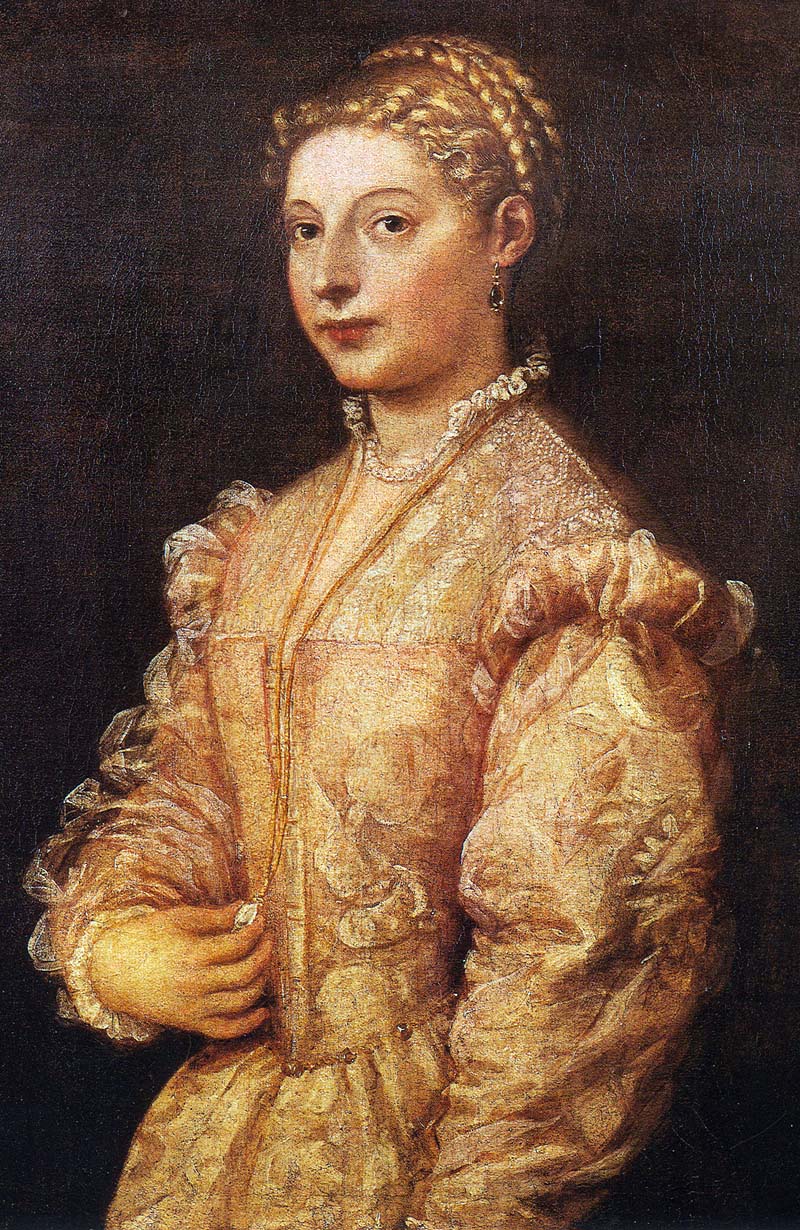
Daily Inspiration - Titian

Titziano Vecellio (Titian) Portrait of a Girl (Lavinia)

Portrait of a Girl (Lavinia) by Titian
c. 1545
from: http://starlightmasquerade.com/PortraitGallery/Ladder-Laced-Venetian/inspiration-pages/Venetian10.htm


Friday, November 2, 2012