Showing posts with label Italian renaissance dress. Show all posts

Friday, March 31, 2023

Italian Style Green Gown for a Young Woman

I have been occupied for the last few weeks with a project for a friend. 

Lochac's big SCA event 'Rowany Festival' is coming up, and a young friend wanted to learn how to make an Italian style dress and make a new one in time for Festival. It was a great opportunity to pass on skills, but (as so often happens) there wasn't enough time to get much done during our designated time together. I have been working on the outfit when my health allows, and I can finally see the light at the end of the proverbial tunnel.

The dress is made from a hard wearing and washable cotton drill and lined in drill and calico. The light boning is removable as the wearer is still adjusting to boned garments. There is a pleat at the hem to allow for growth. Three seams are machine sewn, with all other sewing, including seam felling, being done by hand. The dress has commercially made trim applied. The pattern is based on an existing 16thC style dress that is comfortable for the wearer.


Some excellent images of 16th century working class dress can be found here:

Italy: Working Class Dress (1575-1600) - Sophie Stitches (weebly.com)

including this detail from the Nativity of Mary by Pietro Ronzelli which is in the style of the recipient's wardrobe-


Tuesday, August 16, 2022

Black Linen Summer Gown in the Italian Front-Lacing Style

I recently went through old posts looking for a recipe redaction that I had done, and found dozens of draft posts from 2019. I'm not sure why I didn't finish them and post them at the time? A lot of them aren't relevant any more, but there are some that you might find interesting.
Here is one:
I made this gown over the Christmas break for an event in January 2019. It gets very hot where I live (40 degrees Celcius +), and although events are usually postponed when it gets too hot, sometimes the show must go on.

This was a quick project with some modern sewing techniques used to save time. I modified one of my other gown bodice patterns to drop the waist a bit, make the shoulders a little wider and put a bit more depth into the point of the bodice.

The gown bodice was an experiment with no boning. The linen was lined with heavy cotton canvas and the two pieces 'bagged out' or sewn together with the machine and then turned right side out.
I hand sewed the bottom edge of the bodice and the armholes.

The trim is just simple ribbon, sewn on by hand.

The eyelets were all done by hand with an awl and sewing thread. I decided to add some bias binding along the font edges  and slip bones in for a bit of rigidity and to stop the eyelets puckering. Once I tried the completed bodice on, I felt that it needed some extra boning, so I added bias binding strips at the centre side seams and across the back of the bodice, and put four more bones in.

The skirt is simply a series of rectangles of fabric sewn together. I let the skirt hang for a long time to let the hem drop and reduce distortion due to the weight of the fabric.

I pleated the skirt on by turning the top edge under and then marking out regular dots along the skirt top edge. I ran a heavy thread through to draw the skirt up into cartridge pleats. Normally you would use a double row of thread to do this, but I cheated and only did one. The risks with one thread are that it may break and you will have to start all over again, and that the pleats may be slightly uneven if you are not very careful with your dot marking and needle placement. I usually do a two-part line of pleating; on a front opening gown, I run one line of pleating thread from centre-back to centre- front on one side, and do the same on the other. I find that it makes adjusting the pleats more manageable, especially if the skirt is very full and bulky.

Ones the lines of pleating thread are in, I put safety pins in to mark the centre-back and centre-sides of the skirt panel. I line the safty pins up with the corresponding side seams, centre-back point and centre-front point of the bodice. Then I carefully draw up my pleating thread, adjusting the pleats to sit evenly in their quarter. Then I adjust a quarter at a time to make sure the pleats are all evenly spread out and looking nice. A quarter panel at a time, I use heavy thread to sew each pleat onto the bottom edge of the bodice. I usually use four strands of sewing thread that has been waxed for strength. I also knot the thread off unobtrusively at about every 10 cm point, so that if I were to rip some pleats out by accident when wearing the dress, the whole skirt will not fall off.

Once the skirt is on, I cut the pleating thread. This is optional; if you want defined cartridge pleats, leave it in. I prefer less defined pleats so I cut the thread on mine. I hand finish the front opening gap of the gown and add a buttonhole bar at the bottom of the skirt opening for extra strength. I did not add hooks and eyes on the opening of this gown - I left a bit of extra fabric at the front of the dress that I could pin shut and would be adjustable. I then let the gown hang for several more days to  let the skirt drop if necessary and to let the pleats fall properly.

I had help from my dear Mum with the hemming, and I added some ribbon trim around the bottom when hemmed as well.

Finally, I used some scraps from gown construction and another project to make the pouffy sleeve heads that I like so much. I sewed strips of fabric together to make a panel approximately 2.5 times the size of the sleeve cap pattern that I drafted as a base. I pinned the puffs into place by eye, until I got roughly the look I was going for. This is a tedious task, but I can't think of a better way to do it. Once pinned, I hand sewed down all the puff pieces in sections to keep it secure. Then I make all the bulky fabric puffs point to the centre of the sleeve cap and then put the lining piece on top and machine sew most of the way around (without catching any of the puffs in the seam.) Then I trimmed the seams, turned the puff the right way out and hand sewed the gap shut. I also hand sewed around the edge of the entire puff to stop the bulky puff section moving or turning in. It is important to have a stable base for these puffs or they move around and stick up.

I added some lucet ties underneath so I can wear the dress with removable sleeves.

The dress was reasonably cool, but I unfortunately made the bodice a smidge too long and wide, so there is some  wrinkling that I am not happy with. I will make the next one a bit shorter so it sits better and I wont have to worry about my sash riding up or down. This one needs taking up so it sits better.
I spent a good proportion of the day adjusting my sash because the bodice is too long


(Postscript: no prizes for guessing that this dress is still in my mending pile to have the bodice fixed. I loathe mending and re-dos anyway, and throw covid lockdowns into the mix and it just hasn't happened yet.)

Wednesday, April 6, 2022

Red-Gilt Tie On Sleeve in the Italian Renaissance Style

I finished another pair of sleeves this week, and boy! are they pretty. The fabric was purchased from etsy several years ago. A miscellaneous fibre content includes gilt threads. They were sold as silk brocade but I would be very surprised if they actually contain silk.

I'm very pleased with these sleeves. Eyelets are still very hard on my hands but I am getting faster at working them.

I made these sleeves to the same pattern and in the same way as the others I have blogged about recently. The lining is purple broadcloth.

Putting a small running stitch along the inside of the top edge to stop the lining rolling out with wear.


Hemming the sleeves. I sewed down the fashion fabric hem with tiny stitches, and then hemmed the lining separately.

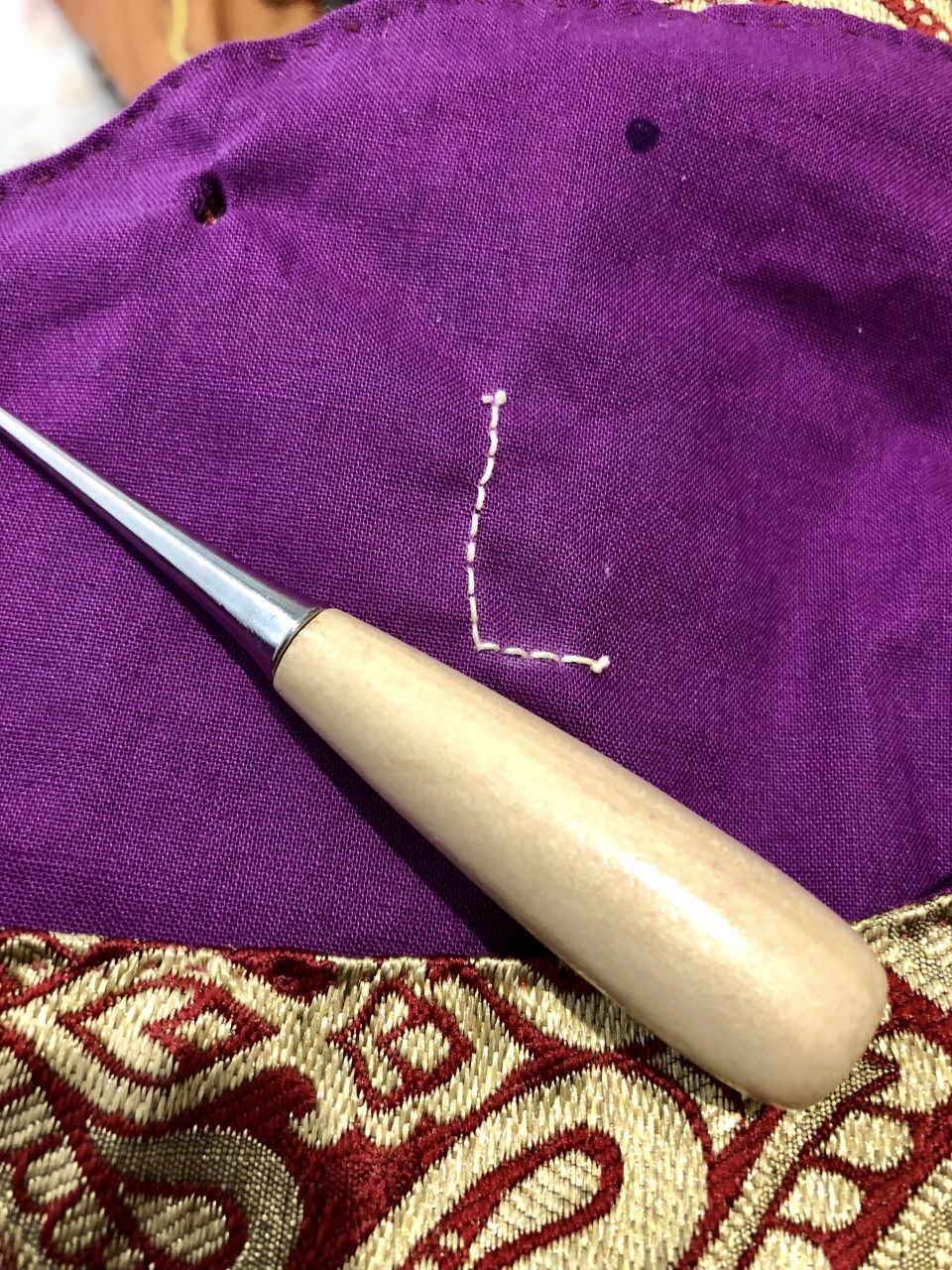
Working the eyelets. (I've added an L for Left to save time getting ready before events.)

The finished product. The pictures fail to capture the richness of the fabric.


Friday, October 30, 2020

Calontir Clothing Challenge - October Update (Post 3)


  I haven’t been able to give the Challenge as much time as I may have liked in this first month as I have had other SCA commitments. My plan has been to make a mid-sixteenth century Italian noble lady’s ensemble. I had real difficulty deciding on a specific gown to base my outfit around, and I have already had to change my plans once as a dye job did not turn out quite as I had hoped.

My sleeve fabrics and possible alternative gown fabric.

These factors have made me feel less enthusiastic than I otherwise might be about the project, and have caused a lot of doubt and second-guessing.

To help overcome this, I cut out and sewed a partlet.

While a partlet is not one of the main 4 items required for the Challenge, I feel that it is very important for the mid-sixteenth century Italian aesthetic.


I have an existing pattern that I used for the partlet. I cut it out of linen fabric and then used the sewing machine to do a small zig zag stitch around all the edges of the cut fabric. Then I machine sewed the shoulder and side seams, enclosing the seam.


Next I flattened the seam and used a small whip stitch to secure it. Then I hemmed all the edges with a small folded hem. I prefer the folded hem to a rolled hem because it tends to sit flatter under the other layers. 

I haven’t decorated the partlet yet. The decoration style and whether or not a collar will be added depends on which style I eventually decide to do.


I also managed to get a pair of sleeves cut out of fashion fabric. I could not find a nice lining fabric to suit it, so that part will have to wait. I will decide what decoration (if any) will be added when I make a final decision on the dress style that I want to do.  I'm not sure I want to do a recreation of a specific gown - more a blending of design elements from several similar portraits – but there are two main Italian styles that I like, and that I need to choose between.

I've also adapted a bodice pattern in preparation for cutting out a gown, and adapted a coat pattern and cut out the fashion fabric.


Again, I haven’t cut the lining out yet. There are two reasons unlined for warmer weather, and b) I don’t have anything light and suitable that doesn’t have synthetics in it. (The outer ‘fashion’ fabric has some synthetic in it, but I am trying not to add to it. Synthetics are a fire risk, make you sweat more, make you warmer and are not authentic for the sixteenth century. Since I have a tiny budget, I have to make do with what I can afford, but I’d prefer not to have more synthetics than absolutely necessary.)

I have to decide which side of the coat fabric will work better.

Next month I plan to focus on making up the coat and deciding whether or not to add sleeves. I'd like to work on the gown in December.


Saturday, May 11, 2019

Tie-on Sleeves in Plum Cotton Fabric

You may remember that an ongoing project is the creation of a suite of tie-on sleeves to complement my Italian style gowns. The other day I was bed-ridden and I was trying to work on sewing down the inside of the seams on one of the pairs.

The sleeves are cut out and zigzag stitch put along the cut edges. Then the side seam is machine sewn (or hand-sewn if I have the time and manual dexterity, which I usually don't).

Th idea with the inside seam is to press or finger-press the seam open and flat on the inside and sew it down with tiny invisible stitches so that it doesn't bunch or twist with wear.

I'll admit that I was struggling with the project, so I was pretty satisfied when I was done.
  I put the project down to admire my achievement........ and looked closer.....
Yep, those are two right sleeves!
Of course, I noticed this after the seams had been machined and then hand sewed flat. (Eyeroll.)


Thursday, September 20, 2018

Repurposed Tatted Lace Partlet

One of the projects I have on the go at the moment is a bit of an experiment. I found a fabulous but tatty vintage lace runner at a thrift shop and snapped it up. It has a diamond pattern with little roses and I think it is tatted (which is out of period) but passes for neeedle lace.

The piece had a few rust stains, but with some careful laundering I managed to brighten it up. I cut the piece to use the two parts as the front panels of a collarless partlet. I managed to use the pretty edging on the central parts and avoid most of the remaining rust marks.

I made the back part of the parlet up in linen and hand hemmed it with a small hem. I pinned the tatted panels in place. I will trim the excess tatting on the outer edge (which will be hidden by my gown) and trim with binding. I have a couple of colour options waiting to be tested for the binding as matching the colour is difficult.

I have been pretty busy with projects for other people lately, so this one is sitting in the to-do pile, but I am looking forward to getting it finished as I really love the tatted piece and it makes me happy to think that some other ladies' hand work is getting a new lease on life and will be admired rather than languishing in a bin of ugly doilies.


Wednesday, November 15, 2017

Chemise gussets

I haven't been well lately, so haven't got much finished.
I need a narrow sleeved chemise for an event that is coming up and have been plodding along working on one for a few days. It is cut from a very fine cotton voile. I must have made fifteen to twenty chemises in my time in the SCA, but putting the armpit gores in always confuses me. 'Brain fog' is a side effect of my illness, and it was in full effect today. I just couldn't seem to get my head around those gussets. Sometimes coffee and chocolate is the answer to the problem!

Monday, October 9, 2017

Italian style Tie-On Renaissance Sleeves - Aqua Blue

Okay, one more pair finished from the Huge Unfinished Sleeve Pile. I tried to get a few more pictures to explain the process this time, too.
This is not the aqua blue sleeve, but is the same pattern shape.

The sleeves and linings are sewn up and then I stab-stitch the seams open.

You can see the tiny dots running along the outside of the seam below.


Once the seams are finished, I put the 'good' sides of the sleeve and lining together (so that I can see the messy inner seam on my side) and run a line of stitching around the top of the sleeve to join them together. If there are tabs on the top of the sleeve, you need to position them before you sew this seam, and also make sure that they are positioned so that they won't move around when sewing (and crucially) so that the tabs will be on the outside of the sleeve when you turn it the right way out.

Once this seam is sewn, I put clips in the seam allowance to reduce puckering when the sleeve is turned the right way out.

Next, I turn the sleeve right way out. All seams should be hidden inside the sleeve and only nice finished seams visible when you look inside as well as on the outside. I usually put a line of small whip stitching around the top of the sleeve to make sure the lining doesn't roll out or move.


 Notice the whip stitching around the top of the sleeve.

Making sure that the lining is not tucked up inside and is sitting smoothly, I measure my hem allowance. I also zigzag my edges for durability.

This sleeve has been hemmed; you can just see the tiny dots showing on the outside which is the hemming line. I clip triangles into the outer and inner fabrics to reduce puckering and bunching.


I prefer to hem  my lining separately to reduce puckering. I use a little whip stitch, same as on the fashion layer of fabric.

 The hemmed sleeve showing the lining

Working the eyelets on top of the sleeves: the holes correspond with the ties in the gown. I make a hole with an awl, and then increase the size of the hole with a bigger awl that I made out of a wooden knitting needle. I go around the hole with a line of double running stitch. I usually use four strands of thread for strength. I don't use buttonhole stitch because I think it adds too much bulk on top of the double running stitch - I just go over the edges with satin stitch. The eyelets turn out very durable and are big enough that lucet cords can be threaded through without needing a bodkin. This is important as friends usually lace my sleeves on for me at events and I don't want to make it harder for them than it has to be!


 The completed sleeves, waiting to be tried on.


Friday, October 6, 2017

Italian style Tie-On Renaissance Sleeves - Orange

I'm gradually trying to get back to normal, but it is slow going. Late last year I cut out a whole heap of different coloured tie-on sleeves with the grand plan of working through them in my "leisure time" to extend my Renaissance wardrobe.


Needless to say, other projects took over and they never ended up getting finished! Just before the last big SCA event that I went to, I realised that I had lost the sleeves that I planned to wear, and I fished out the Huge Unfinished Sleeve Pile. One pair was mostly done, so I finished them off at high speed with the help of my Mum.

This week I pulled out another tabbed pair and finished them off. I haven't had the energy yet to try them on with a gown, but I think they will look nice.


The outer shell and lining are each one piece and the seam runs down the back of the arm. This is particular sleeve is quite a loose pattern and very comfortable. I zig-zag my fabric pieces to reduce fraying. I then sew the back seam of the two arm pieces and the two lining pieces.
(This is a different pair, but it is the same technique)


Next, I make little hand stitches to hold the seams open so they don't move around or bulk up when being worn, and I put in a couple of clips to reduce any pulling on the sleeve. I put the lining and fashion fabric sleeves together with 'good' sides facing and seams visible, and then run around the top of the arm with the machine and clip. On this pair I placed the tabs in place before sewing that line of stitching. The tabs themselves are just long rectangles of fabric that are sewn up into a tube and turned so that the seams are inside. They are then cut to size and placed where I think they look good.


Once the sleeves are turned right side out (so that all the seams are hidden), it is just a matter of hemming the wrist end. I like to hem the fashion outer fabric first, and then separately whip in the lining fabric.

The final thing I do is make eyelets at the top of the sleeve to accommodate the ties that my gowns all have. It is possible to do hidden eyelets on a strip of fabric, or use hooks and eyes or decorative buttons, but eyelets suit me because I usually put my sleeves on at the event after set up etc. when I am already in my gown. I get really hot really fast, so having sleeves that are easy to get on and off is a real necessity for me and this design is perfect.


I was having issues with my phone during this process, so no progress pictures. I will try and get more for the next pair!

Friday, September 8, 2017

Girl's Italian Gown


Today I finished the girl's Italian gown that I have been working on. It is a gift for a little friend's birthday this weekend, so I just scraped it in in time. It is cotton broadcloth with commercially produced pink gimp braid. The Birthday Girl loves pink, but her mum hates the colour. So this dress  is a compromise. It has cap sleeves with fabric puffs, because the Birthday Girl usually wears only a chemise underneath. It has a couple of tucks in the hem to allow for growth, which also helps to hold the hem out. It is a size 8 so that she will get (hopefully) at least two or three years worth of wear out of it.

This is the third or fourth gown that I have finished this year - I really must try to blog some dress diaries soon. Hopefully I can get some nice shots of the recipient wearing the dress.