I recently went through old posts looking for a recipe redaction that I had done, and found dozens of draft posts from 2019. I'm not sure why I didn't finish them and post them at the time? A lot of them aren't relevant any more, but there are some that you might find interesting.
Here is one:

I made this gown over the Christmas break for an event in January 2019. It gets very hot where I live (40 degrees Celcius +), and although events are usually postponed when it gets too hot, sometimes the show must go on.
This was a quick project with some modern sewing techniques used to save time. I modified one of my other gown bodice patterns to drop the waist a bit, make the shoulders a little wider and put a bit more depth into the point of the bodice.
The gown bodice was an experiment with no boning. The linen was lined with heavy cotton canvas and the two pieces 'bagged out' or sewn together with the machine and then turned right side out.
I hand sewed the bottom edge of the bodice and the armholes.
The trim is just simple ribbon, sewn on by hand.
The eyelets were all done by hand with an awl and sewing thread. I decided to add some bias binding along the font edges and slip bones in for a bit of rigidity and to stop the eyelets puckering. Once I tried the completed bodice on, I felt that it needed some extra boning, so I added bias binding strips at the centre side seams and across the back of the bodice, and put four more bones in.
The skirt is simply a series of rectangles of fabric sewn together. I let the skirt hang for a long time to let the hem drop and reduce distortion due to the weight of the fabric.
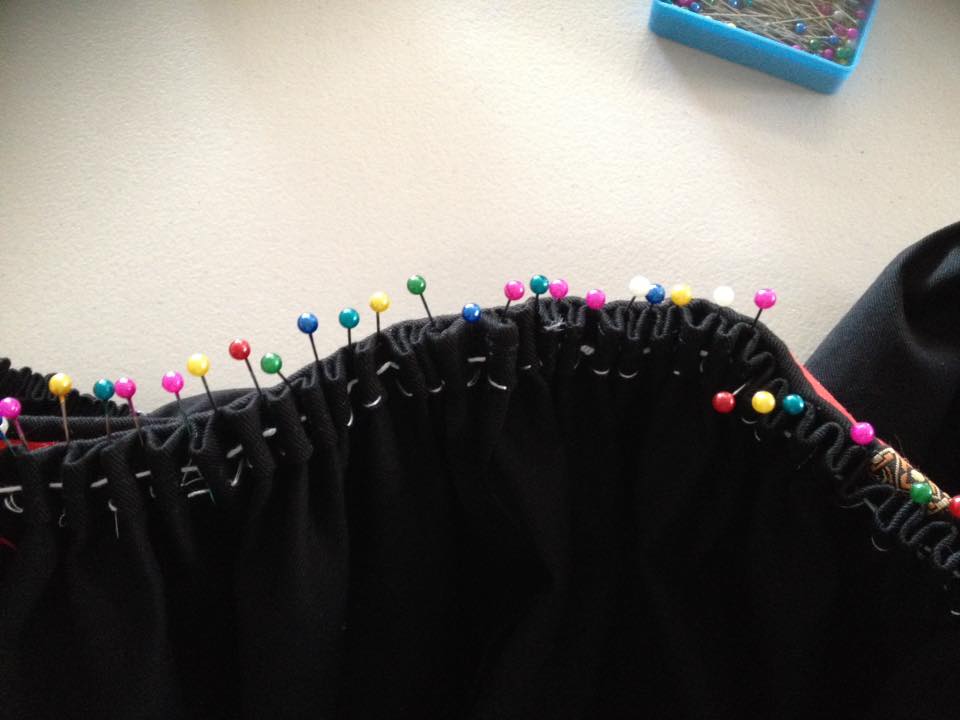
I pleated the skirt on by turning the top edge under and then marking out regular dots along the skirt top edge. I ran a heavy thread through to draw the skirt up into cartridge pleats. Normally you would use a double row of thread to do this, but I cheated and only did one. The risks with one thread are that it may break and you will have to start all over again, and that the pleats may be slightly uneven if you are not very careful with your dot marking and needle placement. I usually do a two-part line of pleating; on a front opening gown, I run one line of pleating thread from centre-back to centre- front on one side, and do the same on the other. I find that it makes adjusting the pleats more manageable, especially if the skirt is very full and bulky.
Ones the lines of pleating thread are in, I put safety pins in to mark the centre-back and centre-sides of the skirt panel. I line the safty pins up with the corresponding side seams, centre-back point and centre-front point of the bodice. Then I carefully draw up my pleating thread, adjusting the pleats to sit evenly in their quarter. Then I adjust a quarter at a time to make sure the pleats are all evenly spread out and looking nice. A quarter panel at a time, I use heavy thread to sew each pleat onto the bottom edge of the bodice. I usually use four strands of sewing thread that has been waxed for strength. I also knot the thread off unobtrusively at about every 10 cm point, so that if I were to rip some pleats out by accident when wearing the dress, the whole skirt will not fall off.
Once the skirt is on, I cut the pleating thread. This is optional; if you want defined cartridge pleats, leave it in. I prefer less defined pleats so I cut the thread on mine. I hand finish the front opening gap of the gown and add a buttonhole bar at the bottom of the skirt opening for extra strength. I did not add hooks and eyes on the opening of this gown - I left a bit of extra fabric at the front of the dress that I could pin shut and would be adjustable. I then let the gown hang for several more days to let the skirt drop if necessary and to let the pleats fall properly.
I had help from my dear Mum with the hemming, and I added some ribbon trim around the bottom when hemmed as well.
Finally, I used some scraps from gown construction and another project to make the pouffy sleeve heads that I like so much. I sewed strips of fabric together to make a panel approximately 2.5 times the size of the sleeve cap pattern that I drafted as a base. I pinned the puffs into place by eye, until I got roughly the look I was going for. This is a tedious task, but I can't think of a better way to do it. Once pinned, I hand sewed down all the puff pieces in sections to keep it secure. Then I make all the bulky fabric puffs point to the centre of the sleeve cap and then put the lining piece on top and machine sew most of the way around (without catching any of the puffs in the seam.) Then I trimmed the seams, turned the puff the right way out and hand sewed the gap shut. I also hand sewed around the edge of the entire puff to stop the bulky puff section moving or turning in. It is important to have a stable base for these puffs or they move around and stick up.
I added some lucet ties underneath so I can wear the dress with removable sleeves.
The dress was reasonably cool, but I unfortunately made the bodice a smidge too long and wide, so there is some wrinkling that I am not happy with. I will make the next one a bit shorter so it sits better and I wont have to worry about my sash riding up or down. This one needs taking up so it sits better.
 |
| I spent a good proportion of the day adjusting my sash because the bodice is too long |