Showing posts with label embroidered partlet. Show all posts

Friday, November 26, 2021

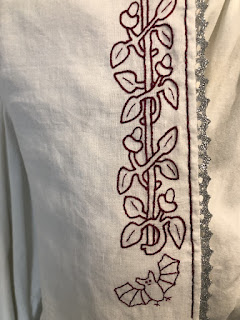
Partlet Embroidered with Acorns

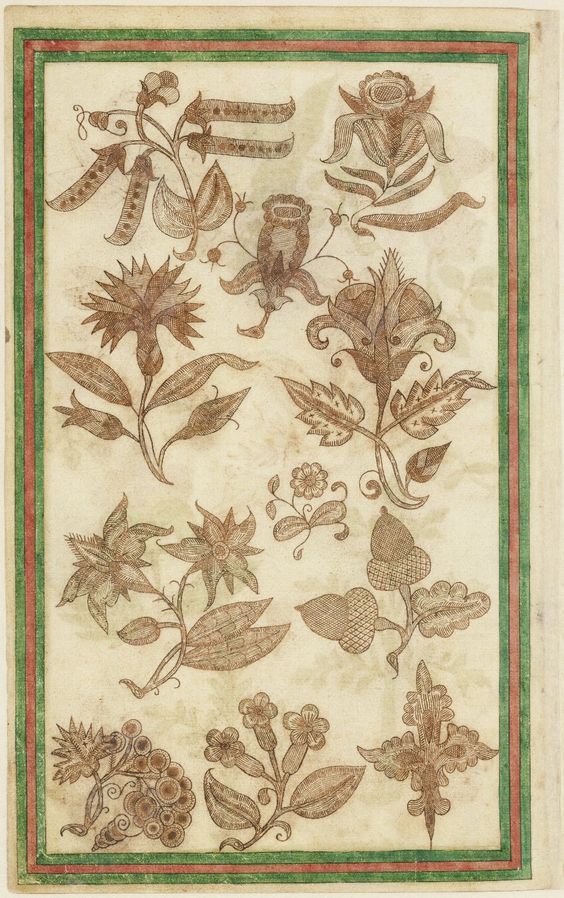
This Italian style partlet is a piece that I finished in September. The design is adapted from a sixteenth century modelbuch pattern (which I will post later).

The embroidery is worked in split and double running stitches on a linen base fabric and the thread used was Madeira silk.

The partlet has machine sewn French seams on the side and shoulder seam, with all other stitching done by hand. The lace is commercially produced gilt lace.

The partlet style has closed side seams for ease of dressing without help and to ensure it sits flat under the bodice. An alternative and common style of partlet in period had ties at the side, as seen in this image:

Women on a Terrace Fresco by Alessandro Allori
Image from: http://www.museumsinflorence.com/musei/Pitti_apartments.html


This is the style of sixteenth century Italian partlet that my piece is based on:

Portrait of a Woman  by an Anonymous Painter circa 1550

from: http://starlightmasquerade.com/PortraitGallery/Ladder-Laced-Venetian/inspiration-pages/openbodice23.htm

Monday, October 11, 2021

Work In Progress: Purple Pomegranite and Flower Embroidered Partlet

Some months ago I challenged members of my local SCA group to create an embroidered piece with the theme of  'Something New'. It could be a new item of clothing, something in a new style, something using a new stitch or technique, etc.

My aim with this challenge was to make a budget friendly partlet using items only from my stash. I also wanted to utilise some of the stitches I planned to teach in my Introduction to Embroidery class at the 'Herman’s Hnefetafl' SCA event.

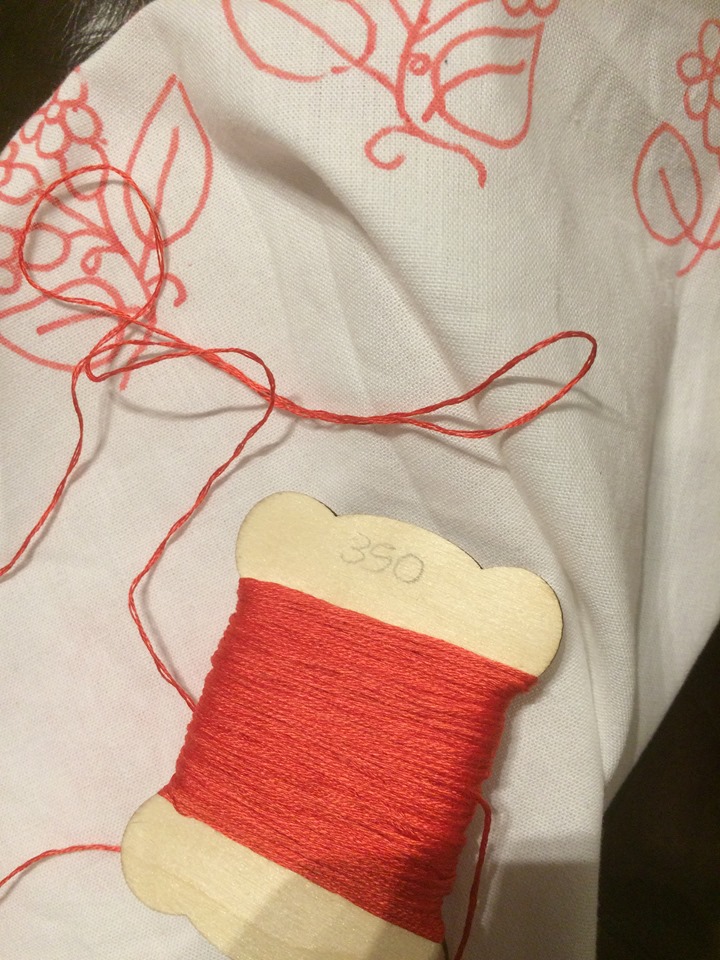
My embroidery pattern is adapted from Matthias Mignerak's "La pratique de l'aiguille industrieus" dated 1605. Lotz 140. (https://gallica.bnf.fr/ark:/12148/btv1b10526079n/f1.item)

I absolutely love the lace designs in this book; it is a wealth of pretty floral and fruit designs. I have another design underway as well, and plan to adapt many more for non-counted embroidery.

So far I have used split stitch and double running stitch, which can be seen on extant embroideries from places that my persona would be influenced by (sixteenth century Italy and England). The design is from a book dated slightly out of period, but I have seen similar designs in earlier pattern books. In a time before intellectual property laws and copyright, designs were unashamedly lifted and reproduced – often down to mistakes in the pattern being reproduced!


I chose a palette of purple for the design. The design is adapted from a needle lace design. It is quite common for modelbuchs and embroidery pattern books of the sixteenth century to be labelled or advertised as for embroiderers, needleworkers, goldsmiths, artists etc, suggesting that the publishers were aware that  their designs would be used in a variety of art forms.

The design and the colour palette remind me of a late 16th century, purple embroidered Italian camicia held at the Met Museum. I am tempted to add some gilt thread to my partlet, although it will make it itchy to wear. That will be a decision for later on.

Analysis of this camicia can also be found in Patterns of Fashion 4 by Janet Arnold.

The base fabric that I have used for the partlet is cotton, because I am on a tight budget and I had it in my stash. Cotton was less commonly used in the sixteenth century for middle and upper class undergarments than linen, but of course is much more readily available and cheaper in modern times.

Here is an extant embroidered petticoat worked on a cotton-linen blend base which is held at the Museum of London:

Image from: https://collections.museumoflondon.org.uk/online/object/79216.html, ID 59.77b 

I have similarly used DMC cotton threads for the embroidery, when silk would have been used in period. This choice is due to budget and availability.

Another modern adaptation that I have used is marking the design out in heat-removable Frixion marker. A range of options for marking out were used in the sixteenth century, including ink(!) but I really like the modern Frixion marker. I drew out my design in black texta on tracing paper and stuck it to a sliding door to act as a sort of light box for marking out the design.

I have a range of laces in my stash that I can use to edge the partlet when the embroidery is completed. Plain and gilt bobbin lace as well as needle laces can be seen edging camicia, partlets, coifs etc. in sixteenth century portraiture and extant examples. Since I am not likely to have time to learn how to make bobbin lace by the end of this challenge, commercially produced alternatives will have to do.

I am also likely to add some sort of embroidered edging near the centre front hem of the partlet, as this is commonly seen in sixteenth century undergarment examples which have embroidery. I haven’t decided on a design yet; I will wait until the embroidery is finished and choose something appropriate then.


Thursday, May 21, 2020

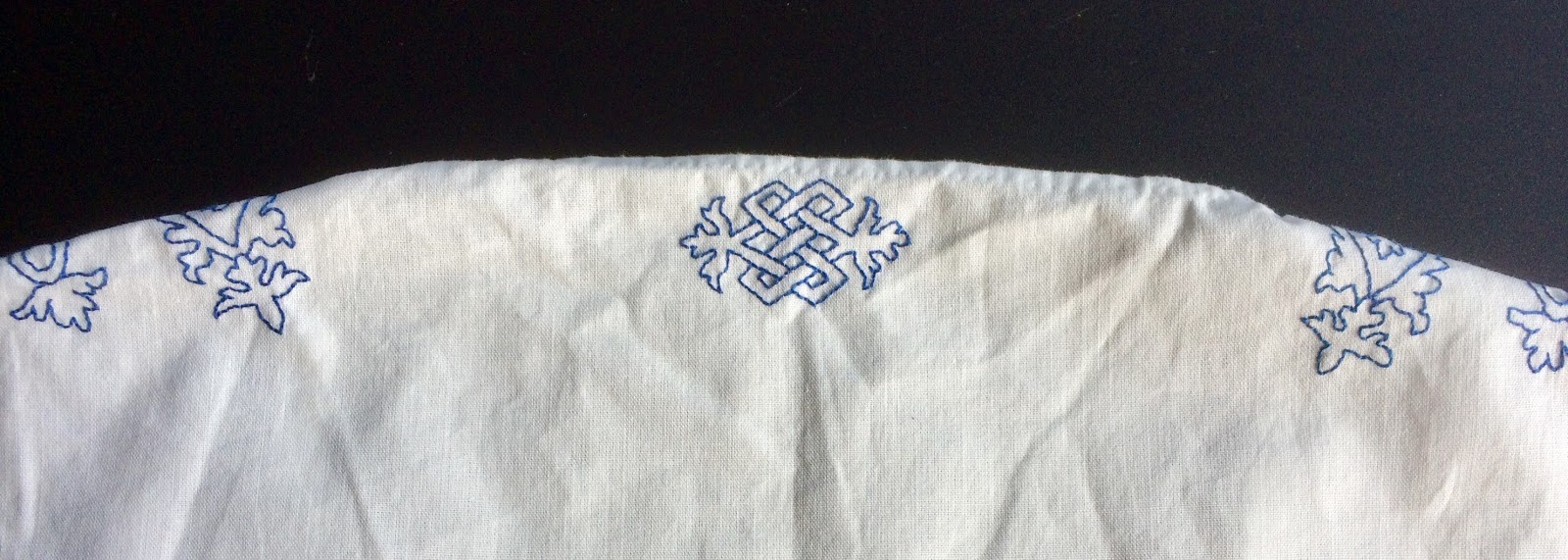
Partlet with Blue Knotted Embroidery (Complete)

I managed to get the blue knotwork partlet finished this week. This is another project which was postponed because I was not happy with how it was working out. I originally hoped that I would be able to use it as part of my suite of projects for my Heraldic Challenge work (details below) but the frettes were not as prominent as I had hoped. I also used this project as an opportunity to practice my double running stitch (Holbein stitch) and it did not turn out as smoothly as I would have liked. More practice needed!

This pattern was taken from Giovanni Ostaus' 1567 "La Vera Perfettione del Disegno" at https://www.metmuseum.org/art/collection/search/662394
Cleaned image from: https://www.facebook.com/pg/modelbuchmuse/posts/?ref=page_internal 
As always, I am indebted to Baroness Praxilla at Modelbuch Muse. Her page makes finding patterns so easy!
I think I will do some more patterns from this modelbuch in the future.

This partlet is a wide-fronted collarless partlet which was popular in Italy in the sixteenth century. Here are some progress photos on the development of the project:
All visible seams handssewn. I edge my fabric pieces with the machine before hand hemming to provide a bit of extra strength, especially as I usually machine wash my underpinnings.
I use a relatively wide hem, about 6 or 7mm.

The border edging of the embroidery on this chemise (held in the Museo del Tessuto, Prato), inspired the decorative edging at the centre front hem. Image from oocities.org via Pinterest
 Similar decorative edging can be seen on this English coif c. 1610, held in the Glasgow museum. It is linen base fabric, embroidered in silk and gilt. Number 29.130
Image: collections.glasgowmuseums.com
I was unsure as to which lace to use. In the end I chose a silver lace that I had overdyed with a blue-black dye to tone down the shade of gilt.
The base fabric on this one is cotton. Linen would be a better alternative but is expensive and hard to find where I live, whereas cotton is readily available and more affordable. Linen is MUCH nicer to embroider and sew though! Similarly, thread is cotton DMC embroidery floss; a more affordable alternative to the much nicer silk thread that I would prefer to use.

Heraldic Display Pentathlon Challenge CHALLENGE 2019-2020
Participants are challenged to create 5 (or more) items from the list below. Challenge runs from now until the 1st May 2020 (or the closest available garbed event.) Displays will be set up throughout the year to showcase the work of participants. At the end of the Challenge, the populace will vote for their favourite items and tokens will be awarded. Heraldry can be your own, or you can make something for a friend, or Guild etc. Be creative and enrich our game with your displays.
Categories:
1. Banners, flags, pennants, standards and gonfalon etc.
2. Encampment equipment, furniture, tent screens etc.
3. Personal Adornment such as jewellery, favours, tabbards and clothing etc.
4. Equipment such as needlecases, napkins, crockery, water bottles etc.
5. Items for the Barony: any item(s) decorated with the Innilgard device to be donated to the Barony
This Challenge has been extended because face-to-face Lochac events have been suspended due to the Covid-19 crisis.

Tuesday, May 12, 2020

Complete - Heraldic Seahorse Embroidered Partlet

I finally got my heraldic seahorse partlet finished, after leaving it sitting in the Naughty Corner for quite some time. I have not been happy with how the pale lilac thread looked, and I really struggled to see it. I think the below average quality of the embroidery reflects this.
When the split and running stitch embroidery was finally complete, I was disappointed with how it all looked. I added a line of split stitch along the hemline, but it didn't look complete. I added some pale gold cotton bobbin style lace and then added a line of matching gold thread to tie in the new colour.

The seahorses actually look paler than in the photo, and I felt they needed an extra motif in gold thread to tie in the bobbin lace colour and to fill in the negative space. I added the little 'sun/seed' motif found so often in Elizabethan pattern books like Shorleyker's 'A Scholehouse For The Needle'.
I am pleased with the extra motifs and the partlet turned out better than I thought it would. I'm not sure that I will ever love it, but it was a good exercise in perseverance.


Saturday, April 25, 2020

Partlet Decorated With Holly Design

I finally managed to get the hems sewn on the holly partlet, and it is ready to wear. I am pleased with how it turned out, and I would like to do another in different colours in the future.
(It is sitting a little askew on the mannikin here.)


Thursday, March 19, 2020

Isolation Embroidery Challenge

I've started a hand-embroidery challenge in my SCA group to try and help keep everyone feeling connected and motivated during the suspension of activities. The idea is that all the participants will work on one or more hand embroidery challenges over the enforced break, and share our progress on the baronial Facebook page. Then, when events resume, we display our finished items in person.

The tricky part was accommodating various levels of expertise and confidence, while still offering a theme that had something for everyone. In the end I settled on an open theme and open technique. People can work on heraldic items, UnFinished Objects (UFOs), items for upcoming competitions or largesse, or even those big projects that have been on the Wish List for some time - whatever they like. Sounds super exciting, doesn't it?

What it means in real time is that I’m faffing around deciding what to do for the Challenge (i.e. wasting time being overwhelmed by the possibilities of doing All The Things). In the mean time I decided I need to stop wasting time and that I really should try and finish this embroidered partlet I started for the baronial Heraldic Challenge.

Normally partlets are my favourite thing to embroider but I’m hating on this one because the pale lilac thread is really hard to see, so my stitching is sloppy, plus it is reinforcing how much my eyes have been impacted by medication in the last couple of years.

DMC stranded cotton seahorses done in split and double running stitch on a base of leftover cotton broadcloth due to financial limitations.

Monday, February 10, 2020

Partlet with Holly Berries

My first 'holly' project is going to be a partlet decorated with the holly design in one of Trevellyon's borders from his Miscellany. (I plan to register a heraldic badge that has holly on it, so there my be more holly themed items in the future.)

A page from Thomas Treveyllon's Miscellany from 1608
The base fabric is a lovely fine linen. The design was marked out with an iron-away Frixion marker. The berries are embroidered in two strands of red DMC 498 cotton, and the leaves and stems in two strands of green DMC 3818 cotton. I considered other colourways, but decided to go with realistic colours for this first project. In period, of course, silk would most likely have been used for this project. I have used cotton due to cost and availability issues.

The stems, leaves and berry outlines are being worked in split stitch, and the line across each berry is done in double running (Holbein) stitch.

When making partlets, I often do what is not recommended, and make up the garment first. I use a small hand-sewn hem on my Italian partlets, and I find having the centre front hem completed can be useful in ensuring that the design is perfectly aligned with the centre front edge of the partlet. If you decide to do it this way, you should be careful to ensure that the edges of the garment do not get stretched and warped by your hoop. I use a very small hoop and move it often, being careful not to stretch the linen base fabric.


Sunday, December 1, 2019

Embroidery Designs

I've been unwell again of late and so haven't been as productive as  I would have liked. One thing that I have enjoyed though, is doing some blackwork designs. I really enjoy the design process, and love looking at portraits and extant pieces and drawing up designs based on what I have seen. I recently drew up a coif design (that I absolutely adore!) for a friend, as well as a couple of partlet designs and some Elizabethan coif designs. I find it very soothing. (Tracing the design out - not so much! But a gift of a lightboard has made that part of the process a bit smoother too.)


Friday, August 2, 2019

Partlet with Embroidered Flower and Bee Motifs

Partlets (also called bavari and gorguera) are an element of sixteenth century clothing which were commonly worn by both high and lower class ladies, although ladies of nobility tended to wear more elaborately decorated versions which often had lace and/or embroidery on them.

I have been embroidering a partlet. My partlet with bees and flowers was inspired by the chemise and partlet set worn by the sitter in the Portrait of Helena von Snakenborg by the British School circa 1569-

Image from: Wikipedia https://upload.wikimedia.org/wikipedia/commons/thumb/8/8a/British_School_16th_century_-_A_Young_Lady_Aged_21%2C_Possibly_Helena_Snakenborg_-_Google_Art_Project.jpg/547px-British_School_16th_century_-_A_Young_Lady_Aged_21%2C_Possibly_Helena_Snakenborg_-_Google_Art_Project.jpg

The top edge of the chemise can be clearly seen under the edges of the partlet, which suggest that this is a set of garments rather than a high necked smock (although both styles were worn in the sixteenth century). The garments have a boldly coloured floral decoration, which may be painted but is more likely to have been embroidered. I did not have the time to do a completely filled embroidered motif, but also prefer a more subtle design for most of my clothing. My persona has ties to both the English and Italian courts, and I wear both styles of clothing, but Italian is my favourite.

This Italian allegorical portrait by Francesco Melzi shows Flora wearing a chemise embroidered with motifs
Image from: https://en.wikipedia.org/wiki/Flora_(Francesco_Melzi)

The design on this extant 16th century camicia held by the Met museum was also an inspiration in choosing my design-
 Image from Pinterest: https://www.pinterest.com.au/pin/366058275939624940/

Many examples of portraits of noble ladies of both the Italian and Elizabethan courts show exquisitely embroidered partlets. Monochrome and polychrome embroidery became increasingly popular from the 1510s to the end of the sixteenth century as a way of displaying wealth and rank. Portraits from artists as diverse and geographically widespread as Anthonis Mor, Hans Holbein, Guillim Scrots, Moroni and Veneto show sitters with lavishly decorated embroidered garments. Portrait evidence shows a great deal of versatility; some ensembles have the partlet matching another costume element such as sleeves, ruff or stomacher, and others show a partlet decorated in a completely different style to the sleeves. The underlying desire seems to have been to display wealth and show off beautiful garments.

Monochrome and polychrome embroidery was popular on chemises and smocks, partlets, collars and cuffs, ruffs, coifs and caps and other linens. It was executed in counted form (usually in running stitch or double running stitch) or in non-counted form, in stitches such as stem, braid, chain, speckling, feather stitch, backstitch, long and short stitch, herringbone stitch and split stitch. Extant items can be seen with all these stitches. Addition of spangles, gold or silver threads, plain or metallic lace, and pearls and beads all added to the lavish effect.

Portrait of Lady Dacre by Hans Eworth (1540) shows the sitter wearing an elaborately embroidered (monochrome) partlet and smock. This is an English style.
Image from http://www.wga.hu/frames-e.html?/html/e/eworth/l_dacre.html

 In contrast, the images below show Italian styles:
Tintoretto’s Portrait of a Lady (1570s) from http://realmofvenus.renaissanceitaly.net/wardrobe/JTintorettoPOALady.jpg

Veronese’s Portrait of a Woman (1570s) from http://realmofvenus.renaissanceitaly.net/wardrobe/VeronesePOAVenetianWomanBarnes.jpg

Bernadino Licinio’s c1550 Portrait of a Family from
http://realmofvenus.renaissanceitaly.net/wardrobe/LicinioPOAFamily2.jpg

I have created a collarless partlet in the Italian style (shown above) as this style is very comfortable, is not restrictive, and matches the style of Italian gown I prefer. The three pattern pieces were sewn together with enclosed seams by machine, and then the seams were sewn flat by hand. A small folded hem was sewn by hand on all raw edges. I decided to embroider the partlet after it was sewn together to ensure accurate design placement, although this does make it more difficult to embroider.


Floral designs were very popular for embroidery in the sixteenth century, due in part to the proliferation of printed pattern-books and the discovery of the strange flora of foreign lands and the New World. Designs were often copied from pattern-books, as well as bestiaries and herbals. Other designs such as geometric designs, grotesques and allegorical emblems were very popular and can be seen in portraits from across Europe. There was no notion of or way of enforcing copyright during this time, so designs were lifted and adapted, and versions of the same designs can be seen in design model books from the 1530s and into the seventeenth century. The same designs crop up in books published in England as well as in Europe.

The flower design that I have used comes from the 1608 Trevellyon Miscellanny-
Image from Pinterest: https://www.pinterest.com.au/pin/384283780703543752/

A similar version of the same motif is also seen in Shorleyker’s 1603 (and reprints) publication of “A Scholehouse for the Needle”-

The bee design also comes from “A Scholehouse for the Needle” from 1608

Image from Pinterest: https://www.pinterest.com.au/pin/515099276116821937/
(This image is a reproduction of a page of the 1632 reprint)

but there are many bee designs as well as extant examples from the late sixteenth century, mainly due to the popularity of bugs and flower designs in Elizabethan embroidery (such as the piece below)

Textile of block-printed linen, England, 1600-1649. Museum Number T.174B
Image from Pinterest: https://www.pinterest.com.au/pin/6262886952240249/

The design was traced out in removable pen and worked predominantly in split stitch and double running stitch in orange DMC cotton floss with two threads, and some running stitch with a single thread (bees). In period, silk floss would most likely have been used for embroidery but I can’t afford silk. The background fabric is cotton linen blend. Linen was mostly commonly used for undergarments in the sixteenth century, as it was widely available (being produced from flax plants) and easy to launder. There are many extant examples of linens for use as underwear (both embroidered and plain) in museums and textile collections worldwide. Linen was relatively easy to launder in our time period; un-embroidered linen bleaches easily in the sun and becomes softer with wear, wicks away sweat and is long lasting. Linen blends offer some of these benefits, but are more in line with my budget than pure linen, as well as being more readily available.


Polychrome embroidery and decoration on a late sixteenth century extant linen shirt held by the Met Museum showing the use of bold colours in Italian embroidery, Accession Number 10.124.1 from https://www.metmuseum.org/art/collection/search/83861

I have not yet finished the embroidery, but I plan to add more decorative elements when I have. I am considering adding some smaller motifs along the front edge, and I think some bobbin or needle lace in orange and white threads will finish the piece off nicely. Some of my inspiration pieces are below:

Extant 16thC Camicia held by the Met Museum
Image from: https://www.pinterest.com.au/pin/532269249682155573/

Extant 16thC Camicia held in Prato, Museo Del Tessuto
Image from Pinterest: https://www.pinterest.com.au/pin/567594359271816517/

The pattern of the partlet I made differs from those used in period ; I wear a 'dickie' style that I can get into by myself as I don't have anyone to help me dress. The side seams under the arms are sewn rather than being loose and having the partlet tied on. Patterns for and images of partlets from the sixteenth century mainly seem to involve pinning or tying them in place under gowns (although some are pinned on over gowns also).

Partlets (with ties) hanging on the line in this scene painted by Allori in the Palazzo Pitti (c. 1598)
Image from  https://www.uffizi.it/en/artworks/loggetta-dell-allori


Extant Spanish partlet which has ties:
Extant sixteenth century partlet held by Instituto Valencia de Don Juan
Image from Pinterest: https://www.pinterest.com.au/pin/513410426253249839/

An Italian style of partlet (which would be pinned on), from Elisabetta Parasole's book of partlets (bavari) patterns from 1604 “Ornamento nobile per ogni gentil matrona, dove si contiene bavari , frisi d'infinita bellezza, lavori, per linzuoli traverse, e facuoli” at https://gallica.bnf.fr/ark:/12148/btv1b10526091w/f10.item
Reproduced at https://www.facebook.com/modelbuchmuse/


Bibliography
Arnold, J. 1988, Queen Elizabeth’s Wardrobe Unlock’d, W S Maney and Son Ltd, London.
Arnold, J; Tiramani, J; and Levey, S. 2008, Patterns of Fashion 4, Pan Macmillan Ltd, London.
Compleat Anachronist 115: Wrought with flowers of Black Silk, Prudence Catesby
Compleat Anachronist 31: An introduction to Blackwork, Shoshonnah Jehanne ferch Emrys
Dress at the Court of King Henry VIII, Maria Hayward (2007, Maney Publishing, UK).
The Encyclopedia of Embroidery Techniques, Pauline Brown (1994, Simon and Schuster, Australia).
Geddes, E and McNeill, M. 1976, Blackwork Embroidery, Dover Publications, New York.
Mikhaila, N and Malcom-Davies, J. 2006, The Tudor Tailor, B T Batsford Ltd, London.
Orsi Landini, R and  Niccoli, B. 2005,  La Moda a Firenze 1540-1580, Pagliai Polistampa, Florence.
Synge, L. 1982, Antique Needlework, Blandford Press, New York.


With many thanks to Modelbuch Muse for inspiration and for conveniently posting images in one place so I don’t need to search through my books for designs -  https://www.facebook.com/modelbuchmuse/