Showing posts with label Italian style partlet. Show all posts

Monday, April 8, 2024

Broderie Anglaise Partlet

I found a broderie anglaise skirt at the Op Shop (Thrift Store) for $2 and thought how pretty it would be as a partlet. I wasn't sure if there would be enough fabric, but I thought that it was worth the risk for $2.

Now, I know that broderie anglaise is a more modern style of embroidered decoration, and that this was made by machine, but I thought it probably wouldn't be too obviously modern if trimmed as a partlet. After all, cutwork and pulled work were done in the sixteenth century. 

I used my trusty collarless partlet pattern and cut the pieces out. As usual, I french seamed the sides and shoulder seams, and hand finished them. I did a narrow zigzag around all the edges, but the cut outs in the embroidery meant that there were shaggy edges even after finishing. I was disheartened, and put the piece aside for (mumble, mumble,) an unspecified amount of time.

Then last year I started working on my WIPs and UFOs again and pulled the partlet out. I decided to use a faux silk (polyester) bias binding to trim the edges. I machined the outer seam and hand sewed everything else.

I liked the way the binding tidied up the edges, but it just looked too shiny in outside light. So I went through my stash looking for some lace that could go over the bias to tone down the shiny and add a bit more to the piece. When I found a suitable cotton lace, I hand sewed it on.

I toyed with the idea of embroidering along the front of the lace with embroidery floss but didn't like the way it looked. It feels like it needs a little something to elevate it a bit, but I'm not sure what. I have some gilt cord, but it is not especially durable and I throw my partlets in the washing machine after wearing. I'll stew on it a bit and see if anything jumps out at me next time I am rummaging through my stash.


Friday, November 26, 2021

Partlet Embroidered with Acorns

This Italian style partlet is a piece that I finished in September. The design is adapted from a sixteenth century modelbuch pattern (which I will post later).

The embroidery is worked in split and double running stitches on a linen base fabric and the thread used was Madeira silk.

The partlet has machine sewn French seams on the side and shoulder seam, with all other stitching done by hand. The lace is commercially produced gilt lace.

The partlet style has closed side seams for ease of dressing without help and to ensure it sits flat under the bodice. An alternative and common style of partlet in period had ties at the side, as seen in this image:

Women on a Terrace Fresco by Alessandro Allori
Image from: http://www.museumsinflorence.com/musei/Pitti_apartments.html


This is the style of sixteenth century Italian partlet that my piece is based on:

Portrait of a Woman  by an Anonymous Painter circa 1550

from: http://starlightmasquerade.com/PortraitGallery/Ladder-Laced-Venetian/inspiration-pages/openbodice23.htm

Monday, October 11, 2021

Work In Progress: Purple Pomegranite and Flower Embroidered Partlet

Some months ago I challenged members of my local SCA group to create an embroidered piece with the theme of  'Something New'. It could be a new item of clothing, something in a new style, something using a new stitch or technique, etc.

My aim with this challenge was to make a budget friendly partlet using items only from my stash. I also wanted to utilise some of the stitches I planned to teach in my Introduction to Embroidery class at the 'Herman’s Hnefetafl' SCA event.

My embroidery pattern is adapted from Matthias Mignerak's "La pratique de l'aiguille industrieus" dated 1605. Lotz 140. (https://gallica.bnf.fr/ark:/12148/btv1b10526079n/f1.item)

I absolutely love the lace designs in this book; it is a wealth of pretty floral and fruit designs. I have another design underway as well, and plan to adapt many more for non-counted embroidery.

So far I have used split stitch and double running stitch, which can be seen on extant embroideries from places that my persona would be influenced by (sixteenth century Italy and England). The design is from a book dated slightly out of period, but I have seen similar designs in earlier pattern books. In a time before intellectual property laws and copyright, designs were unashamedly lifted and reproduced – often down to mistakes in the pattern being reproduced!


I chose a palette of purple for the design. The design is adapted from a needle lace design. It is quite common for modelbuchs and embroidery pattern books of the sixteenth century to be labelled or advertised as for embroiderers, needleworkers, goldsmiths, artists etc, suggesting that the publishers were aware that  their designs would be used in a variety of art forms.

The design and the colour palette remind me of a late 16th century, purple embroidered Italian camicia held at the Met Museum. I am tempted to add some gilt thread to my partlet, although it will make it itchy to wear. That will be a decision for later on.

Analysis of this camicia can also be found in Patterns of Fashion 4 by Janet Arnold.

The base fabric that I have used for the partlet is cotton, because I am on a tight budget and I had it in my stash. Cotton was less commonly used in the sixteenth century for middle and upper class undergarments than linen, but of course is much more readily available and cheaper in modern times.

Here is an extant embroidered petticoat worked on a cotton-linen blend base which is held at the Museum of London:

Image from: https://collections.museumoflondon.org.uk/online/object/79216.html, ID 59.77b 

I have similarly used DMC cotton threads for the embroidery, when silk would have been used in period. This choice is due to budget and availability.

Another modern adaptation that I have used is marking the design out in heat-removable Frixion marker. A range of options for marking out were used in the sixteenth century, including ink(!) but I really like the modern Frixion marker. I drew out my design in black texta on tracing paper and stuck it to a sliding door to act as a sort of light box for marking out the design.

I have a range of laces in my stash that I can use to edge the partlet when the embroidery is completed. Plain and gilt bobbin lace as well as needle laces can be seen edging camicia, partlets, coifs etc. in sixteenth century portraiture and extant examples. Since I am not likely to have time to learn how to make bobbin lace by the end of this challenge, commercially produced alternatives will have to do.

I am also likely to add some sort of embroidered edging near the centre front hem of the partlet, as this is commonly seen in sixteenth century undergarment examples which have embroidery. I haven’t decided on a design yet; I will wait until the embroidery is finished and choose something appropriate then.


Wednesday, January 27, 2021

Calontir Clothing Challenge - December Update


Once again, the month got away from me and I didn't achieve what I had planned. I didn't beat myself up about it too much because December is always a crazy month with festive preparations, and time seems to go extra fast in the lead up to Christmas.

I cut out my camicia panels and marked out a design for the sleeves. This motif is taken from Richard Shorleyker's 'A Scholehouse for the Needle' published in 1608 and 1624. Several pages from this English pattern book can be found reproduced on Pinterest and more information is available here https://trc-leiden.nl/trc-needles/texts-films-customs-and-event/designs-and-design-books/schole-house-for-the-needle

Similar designs can be seen on extant Italian undergarments, as well as paintings from the region. My real problem was deciding on the colour of the embroidery; red, black and blue were very popular colours, and there are extant examples of gold, purple, pink and green as well as polychrome. In the end, I decided on classic black, and started working the motifs in split and double running stitch.

I experimented with a partlet made out of silver grey ribbons. I used an existing rectangular partlet as my guide. The inspiration portrait has diagonal ribbons or knotwork, and I already have a partlet like that in the works, so this one is set with the ribbon going horizontally and vertically. It is tedious work.

In amongst all the other projects, I painted some faux blackwork on masks for an event. It was predicted to be a warm day, and I didn't want to have to add a fourth layer to account for the embroidery holes, so I tried painting the designs. I did not have my good paint bushes at the time, so had to use a very poor quality craft brush that was much too big for the task. Considering that, I think they turned out alright. (The paint was acrylic mixed with fabric painting medium.)

I made some beaded necklaces for gifts and made a blue and white one for me, to wear with this outfit. It has 4g seed beads on tigertail wire.
I also got a small amount of sewing done on my underskirt.


Thursday, May 21, 2020

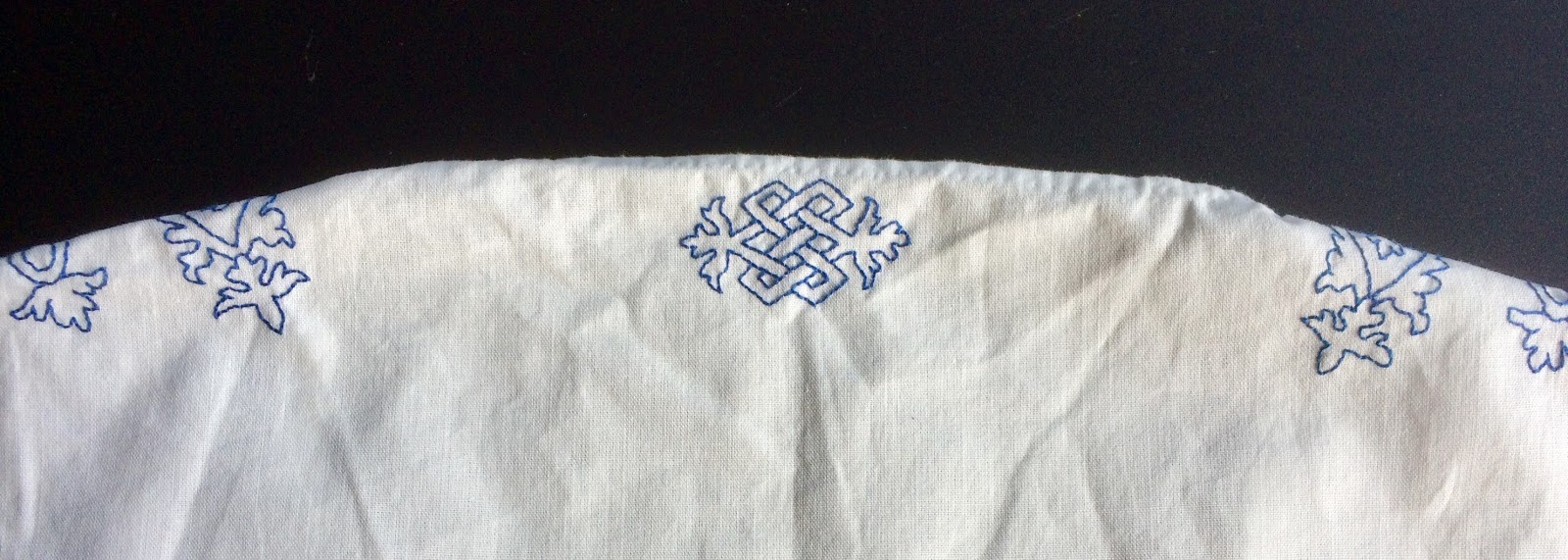
Partlet with Blue Knotted Embroidery (Complete)

I managed to get the blue knotwork partlet finished this week. This is another project which was postponed because I was not happy with how it was working out. I originally hoped that I would be able to use it as part of my suite of projects for my Heraldic Challenge work (details below) but the frettes were not as prominent as I had hoped. I also used this project as an opportunity to practice my double running stitch (Holbein stitch) and it did not turn out as smoothly as I would have liked. More practice needed!

This pattern was taken from Giovanni Ostaus' 1567 "La Vera Perfettione del Disegno" at https://www.metmuseum.org/art/collection/search/662394
Cleaned image from: https://www.facebook.com/pg/modelbuchmuse/posts/?ref=page_internal 
As always, I am indebted to Baroness Praxilla at Modelbuch Muse. Her page makes finding patterns so easy!
I think I will do some more patterns from this modelbuch in the future.

This partlet is a wide-fronted collarless partlet which was popular in Italy in the sixteenth century. Here are some progress photos on the development of the project:
All visible seams handssewn. I edge my fabric pieces with the machine before hand hemming to provide a bit of extra strength, especially as I usually machine wash my underpinnings.
I use a relatively wide hem, about 6 or 7mm.

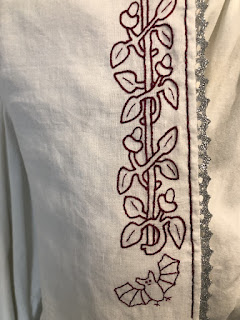
The border edging of the embroidery on this chemise (held in the Museo del Tessuto, Prato), inspired the decorative edging at the centre front hem. Image from oocities.org via Pinterest
 Similar decorative edging can be seen on this English coif c. 1610, held in the Glasgow museum. It is linen base fabric, embroidered in silk and gilt. Number 29.130
Image: collections.glasgowmuseums.com
I was unsure as to which lace to use. In the end I chose a silver lace that I had overdyed with a blue-black dye to tone down the shade of gilt.
The base fabric on this one is cotton. Linen would be a better alternative but is expensive and hard to find where I live, whereas cotton is readily available and more affordable. Linen is MUCH nicer to embroider and sew though! Similarly, thread is cotton DMC embroidery floss; a more affordable alternative to the much nicer silk thread that I would prefer to use.

Heraldic Display Pentathlon Challenge CHALLENGE 2019-2020
Participants are challenged to create 5 (or more) items from the list below. Challenge runs from now until the 1st May 2020 (or the closest available garbed event.) Displays will be set up throughout the year to showcase the work of participants. At the end of the Challenge, the populace will vote for their favourite items and tokens will be awarded. Heraldry can be your own, or you can make something for a friend, or Guild etc. Be creative and enrich our game with your displays.
Categories:
1. Banners, flags, pennants, standards and gonfalon etc.
2. Encampment equipment, furniture, tent screens etc.
3. Personal Adornment such as jewellery, favours, tabbards and clothing etc.
4. Equipment such as needlecases, napkins, crockery, water bottles etc.
5. Items for the Barony: any item(s) decorated with the Innilgard device to be donated to the Barony
This Challenge has been extended because face-to-face Lochac events have been suspended due to the Covid-19 crisis.