Showing posts with label sixteenth century Modelbuch. Show all posts

Monday, October 11, 2021

Work In Progress: Purple Pomegranite and Flower Embroidered Partlet

Some months ago I challenged members of my local SCA group to create an embroidered piece with the theme of  'Something New'. It could be a new item of clothing, something in a new style, something using a new stitch or technique, etc.

My aim with this challenge was to make a budget friendly partlet using items only from my stash. I also wanted to utilise some of the stitches I planned to teach in my Introduction to Embroidery class at the 'Herman’s Hnefetafl' SCA event.

My embroidery pattern is adapted from Matthias Mignerak's "La pratique de l'aiguille industrieus" dated 1605. Lotz 140. (https://gallica.bnf.fr/ark:/12148/btv1b10526079n/f1.item)

I absolutely love the lace designs in this book; it is a wealth of pretty floral and fruit designs. I have another design underway as well, and plan to adapt many more for non-counted embroidery.

So far I have used split stitch and double running stitch, which can be seen on extant embroideries from places that my persona would be influenced by (sixteenth century Italy and England). The design is from a book dated slightly out of period, but I have seen similar designs in earlier pattern books. In a time before intellectual property laws and copyright, designs were unashamedly lifted and reproduced – often down to mistakes in the pattern being reproduced!


I chose a palette of purple for the design. The design is adapted from a needle lace design. It is quite common for modelbuchs and embroidery pattern books of the sixteenth century to be labelled or advertised as for embroiderers, needleworkers, goldsmiths, artists etc, suggesting that the publishers were aware that  their designs would be used in a variety of art forms.

The design and the colour palette remind me of a late 16th century, purple embroidered Italian camicia held at the Met Museum. I am tempted to add some gilt thread to my partlet, although it will make it itchy to wear. That will be a decision for later on.

Analysis of this camicia can also be found in Patterns of Fashion 4 by Janet Arnold.

The base fabric that I have used for the partlet is cotton, because I am on a tight budget and I had it in my stash. Cotton was less commonly used in the sixteenth century for middle and upper class undergarments than linen, but of course is much more readily available and cheaper in modern times.

Here is an extant embroidered petticoat worked on a cotton-linen blend base which is held at the Museum of London:

Image from: https://collections.museumoflondon.org.uk/online/object/79216.html, ID 59.77b 

I have similarly used DMC cotton threads for the embroidery, when silk would have been used in period. This choice is due to budget and availability.

Another modern adaptation that I have used is marking the design out in heat-removable Frixion marker. A range of options for marking out were used in the sixteenth century, including ink(!) but I really like the modern Frixion marker. I drew out my design in black texta on tracing paper and stuck it to a sliding door to act as a sort of light box for marking out the design.

I have a range of laces in my stash that I can use to edge the partlet when the embroidery is completed. Plain and gilt bobbin lace as well as needle laces can be seen edging camicia, partlets, coifs etc. in sixteenth century portraiture and extant examples. Since I am not likely to have time to learn how to make bobbin lace by the end of this challenge, commercially produced alternatives will have to do.

I am also likely to add some sort of embroidered edging near the centre front hem of the partlet, as this is commonly seen in sixteenth century undergarment examples which have embroidery. I haven’t decided on a design yet; I will wait until the embroidery is finished and choose something appropriate then.


Friday, March 27, 2020

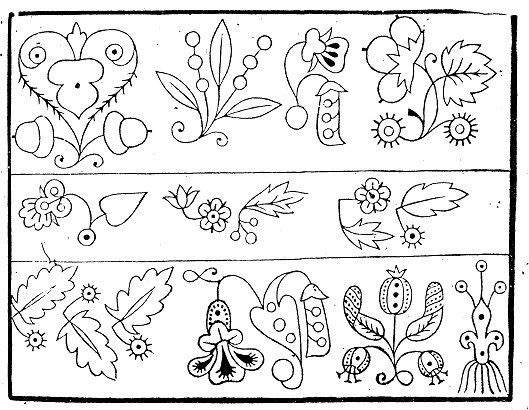
Embroidery Designs - Acorns

I hope all of you are well and taking care of yourselves. Enjoy these acorn designs.
From The Needle's Excellency (Boler) - 1634 held at the British Museum https://www.britishmuseum.org/  available at Modelbuch Muse https://www.facebook.com/modelbuchmuse/

From The Trevellyon Miscellany (1608) available on Pinterest. More information can be found here:

From A Scholehouse for the Needle (1632),  individual pages reproduced on Pinterest

From A Scholehouse for the Needle (1632),  individual pages reproduced on Pinterest

From A Scholehouse for the Needle (1632),  individual pages reproduced on Pinterest

From Lotz 106 by Jean Le Maistre (1564) at 


Pattern from _Lucidario di Recami_ by Iseppo Foresto, published by Jeronimo Calepino, dated 1564. https://www.metmuseum.org/art/collection/search/349914 reproduced at Modelbuch Muse https://www.facebook.com/modelbuchmuse/

Thursday, January 30, 2020

Embroidery Designs - Holly Berries

I was recently reflecting on embroidery designs and decided that I would like to have more items decorated with my heraldry and with holly. Luckily, holly berries (or, at least, berries that could be holly) seem to have been quite a popular sixteenth century motif and I didn't have any trouble finding several designs.

From The Trevellyon Miscellany (1608) available on Pinterest

From The Trevellyon Miscellany available on Pinterest

From The Trevellyon Miscellany available on Pinterest

From The Trevellyon Miscellany (1608) available on Pinterest
  
From A Scholehouse for the Needle (1632),  individual pages reproduced on Pinterest
           

From A Scholehouse for the Needle, individual pages reproduced on Pinterest

An extant coif c. 1590 held in the V&A Museum, London


Embroidered panel c. 1600 available at Pinterest and held by the V&A Museum 


Coif decorated with currants or holly held by the Embroiderer's Guild London and reproduced in Elizabethan Stitches by Jacqui Carey ISBN 978-0-9523225-8-0, p. 84

Design from 'Ein New Kunstlich Modelbuch' by Peter Quentel c.1544, page 13r
Available at The Metropolitan Museum https://www.metmuseum.org/