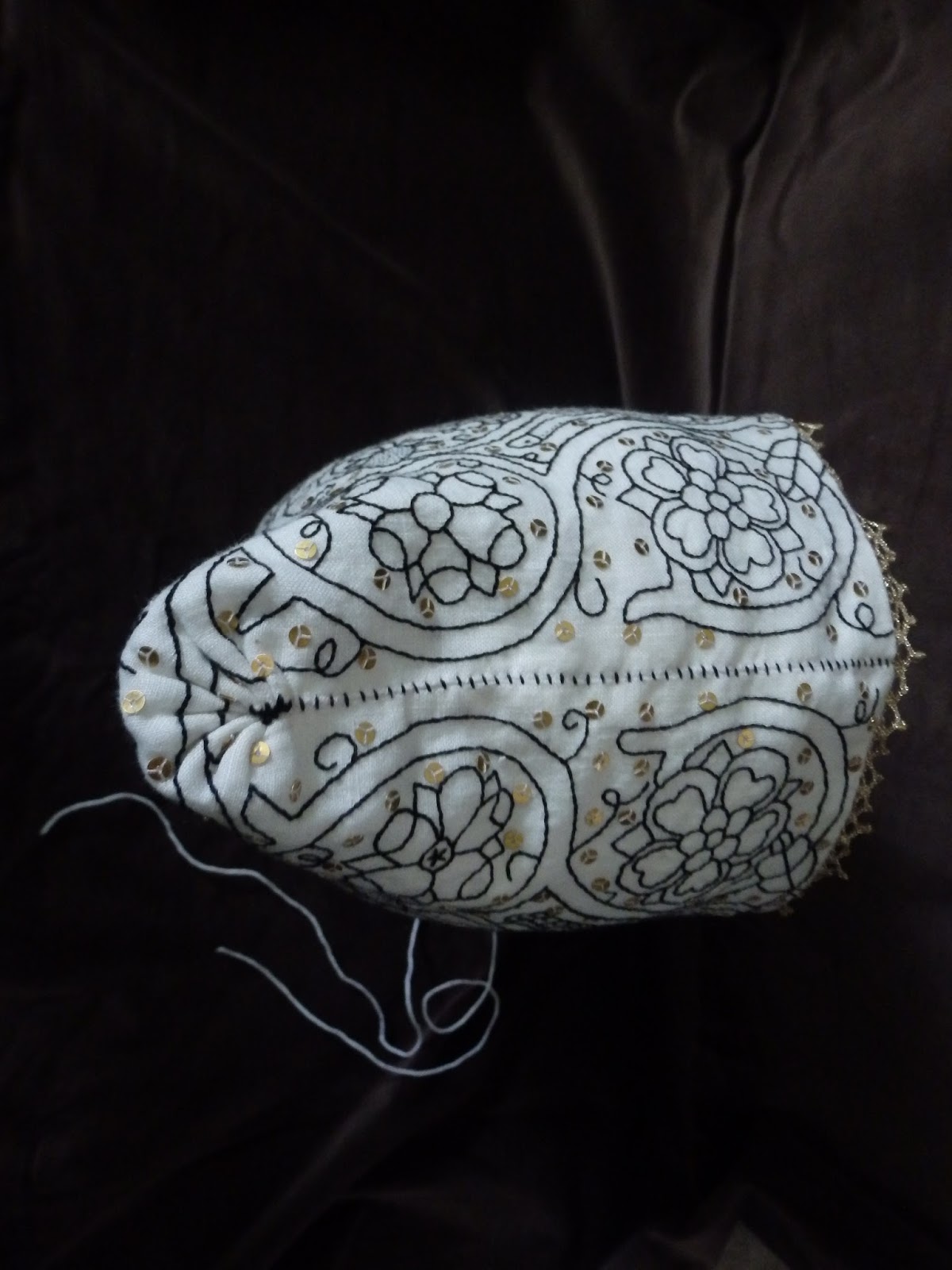
Some pictures of the new bonnet with one of my embroidered coifs. (My actual head is a lot bigger than this foam hat form, so the bonnet and coif sit better.)
Elizabethan, Tudor and Renaissance inspired embroidery, clothing and accessories - historical costuming, embroidery and re-creation
Showing posts with label Elizabethan coif. Show all posts
Thursday, May 27, 2021
Bonnet and Coif
Some pictures of the new bonnet with one of my embroidered coifs. (My actual head is a lot bigger than this foam hat form, so the bonnet and coif sit better.)
Thursday, January 30, 2020
Embroidery Designs - Holly Berries
I was recently reflecting on embroidery designs and decided that I would like to have more items decorated with my heraldry and with holly. Luckily, holly berries (or, at least, berries that could be holly) seem to have been quite a popular sixteenth century motif and I didn't have any trouble finding several designs.
From The Trevellyon Miscellany (1608) available on Pinterest
From The Trevellyon Miscellany available on Pinterest
From The Trevellyon Miscellany (1608) available on Pinterest
From A Scholehouse for the Needle (1632), individual pages reproduced on Pinterest
From A Scholehouse for the Needle, individual pages reproduced on Pinterest
An extant coif c. 1590 held in the V&A Museum, London
Available on Pinterest and at http://collections.vam.ac.uk/item/O364617/womens-coif-unknown/
Embroidered panel c. 1600 available at Pinterest and held by the V&A Museum
Coif decorated with currants or holly held by the Embroiderer's Guild London and reproduced in Elizabethan Stitches by Jacqui Carey ISBN 978-0-9523225-8-0, p. 84
Design from 'Ein New Kunstlich Modelbuch' by Peter Quentel c.1544, page 13r
Available at The Metropolitan Museum https://www.metmuseum.org/
Friday, March 8, 2019
Blue Elizabethan Monochrome Coif
There are many extant coifs in museums and textile collections to give a guide to the shape of the pattern used for the piece. In terms of the embroidery design, I chose the traditional coiling foliage design which is so common in Elizabethan coifs. I prefer to design original patterns, but use motifs taken from extant pieces and Elizabethan portraits. On this project I used bird, flower and insect motifs.
Once I had sketched the design, I traced the pattern and design onto tracing paper with a permanent marker. Using tracing paper or greaseproof paper allows the light to shine through, and the permanent marker makes the design easier to see. The design can be traced using a light box or by taping the foundation fabric over the pattern on a large glass window or door.
Extant examples indicate that in period, ink was often used to mark designs onto white foundation fabric. I used 100% linen for this piece, and chose to use a modern alternative to ink: the Frixion pen. This type of pen irons away, is widely available where I live, comes in a range of colours and is available as a pen or marker. Very convenient for the modern embroiderer, and much more forgiving of unsteady hands than dip pen and ink.
The salamander design above, dating from around 1600, shows that ink was used to mark out embroidery designs (V&A Collection, T.88-1925, Arnold {QEWU} p. 272).
This piece is embroidered in blue cotton floss (DMC 824), in one or two strands (depending on the motif). Silk is a more authentic option and was used in period but cotton floss is affordable and easily available.
1A variety of period stitches were used on this piece, including stem stitch, double running stitch and speckling/seeding stitch. Combining different stitches on this project made the end result texturally more interesting, makes working the embroidery more interesting, and is also entirely period. I used hoop because it is more portable than a frame. I omitted spangles (even though they were a decorative feature on coifs) as they can sometimes be uncomfortable if worn under headwear such as a coronet.
Once the embroidery was complete, I ironed away any traces of the pen, and cut out the piece. I edged the coif panel with zigzag stitch for extra strength. I cut a linen lining and sewed the two panels together. This lining hides the spangle threads and protects the embroidery from hair oils and pins.
The cord channel was hand sewn as was the top seam which runs over the top of the head. Only the first two thirds of the seam was sewn up; the last third was gathered with very small stitches to produce tiny cartridge pleats. The pleats were drawn up to gather the back of the coif into a circle and the pleats were secured with buttonhole bars. This pleating rounds off the back of the coif and makes a space for the hair underneath.
I sewed a channel around the bottom of the coif and used commercially produced cord to gather it. I also sewed commercially produced lace around the front edge.
This image shows the way that the coif is gathered at the back of the head – from Plate 52B (Patterns Of Fashion 4).
Bibliography
Arnold, J. 1988, Queen Elizabeth’s Wardrobe Unlock’d, W S Maney and Son Ltd, London.
Arnold, J; Tiramani, J; and Levey, S. 2008, Patterns of Fashion 4, Pan Macmillan Ltd, London.
Compleat Anachronist 115: Wrought with flowers of Black Silk, Prudence Catesby
Compleat Anachronist 31: An introduction to Blackwork, Shoshonnah Jehanne ferch Emrys
Dress at the Court of King Henry VIII, Maria Hayward (2007, Maney Publishing, UK).
The Encyclopedia of Embroidery Techniques, Pauline Brown (1994, Simon and Schuster, Australia).
Geddes, E and McNeill, M. 1976, Blackwork Embroidery, Dover Publications, New York.
Mikhaila, N and Malcom-Davies, J. 2006, The Tudor Tailor, B T Batsford Ltd, London.
Orsi Landini, R and Niccoli, B. 2005, La Moda a Firenze 1540-1580, Pagliai Polistampa, Florence.
Synge, L. 1982, Antique Needlework, Blandford Press, New York.
Once I had sketched the design, I traced the pattern and design onto tracing paper with a permanent marker. Using tracing paper or greaseproof paper allows the light to shine through, and the permanent marker makes the design easier to see. The design can be traced using a light box or by taping the foundation fabric over the pattern on a large glass window or door.
Extant examples indicate that in period, ink was often used to mark designs onto white foundation fabric. I used 100% linen for this piece, and chose to use a modern alternative to ink: the Frixion pen. This type of pen irons away, is widely available where I live, comes in a range of colours and is available as a pen or marker. Very convenient for the modern embroiderer, and much more forgiving of unsteady hands than dip pen and ink.
The salamander design above, dating from around 1600, shows that ink was used to mark out embroidery designs (V&A Collection, T.88-1925, Arnold {QEWU} p. 272).
This piece is embroidered in blue cotton floss (DMC 824), in one or two strands (depending on the motif). Silk is a more authentic option and was used in period but cotton floss is affordable and easily available.
1A variety of period stitches were used on this piece, including stem stitch, double running stitch and speckling/seeding stitch. Combining different stitches on this project made the end result texturally more interesting, makes working the embroidery more interesting, and is also entirely period. I used hoop because it is more portable than a frame. I omitted spangles (even though they were a decorative feature on coifs) as they can sometimes be uncomfortable if worn under headwear such as a coronet.
Once the embroidery was complete, I ironed away any traces of the pen, and cut out the piece. I edged the coif panel with zigzag stitch for extra strength. I cut a linen lining and sewed the two panels together. This lining hides the spangle threads and protects the embroidery from hair oils and pins.
The cord channel was hand sewn as was the top seam which runs over the top of the head. Only the first two thirds of the seam was sewn up; the last third was gathered with very small stitches to produce tiny cartridge pleats. The pleats were drawn up to gather the back of the coif into a circle and the pleats were secured with buttonhole bars. This pleating rounds off the back of the coif and makes a space for the hair underneath.
I sewed a channel around the bottom of the coif and used commercially produced cord to gather it. I also sewed commercially produced lace around the front edge.
This image shows the way that the coif is gathered at the back of the head – from Plate 52B (Patterns Of Fashion 4).
Bibliography
Arnold, J. 1988, Queen Elizabeth’s Wardrobe Unlock’d, W S Maney and Son Ltd, London.
Arnold, J; Tiramani, J; and Levey, S. 2008, Patterns of Fashion 4, Pan Macmillan Ltd, London.
Compleat Anachronist 115: Wrought with flowers of Black Silk, Prudence Catesby
Compleat Anachronist 31: An introduction to Blackwork, Shoshonnah Jehanne ferch Emrys
Dress at the Court of King Henry VIII, Maria Hayward (2007, Maney Publishing, UK).
The Encyclopedia of Embroidery Techniques, Pauline Brown (1994, Simon and Schuster, Australia).
Geddes, E and McNeill, M. 1976, Blackwork Embroidery, Dover Publications, New York.
Mikhaila, N and Malcom-Davies, J. 2006, The Tudor Tailor, B T Batsford Ltd, London.
Orsi Landini, R and Niccoli, B. 2005, La Moda a Firenze 1540-1580, Pagliai Polistampa, Florence.
Synge, L. 1982, Antique Needlework, Blandford Press, New York.
Wednesday, April 19, 2017
Elizabethan Coif Presentation
Last year I was honoured to be accepted as a volunteer to create an embroidered coif for the Queen. The item was to be a gift for the outgoing Queen on behalf of the Worshipful Company of Broiderers (the SCA Lochac embroidery guild).
The lovely Megan supplied me with a coif pattern to suit Queen Branwen. This is very important when designing a coif, as not all styles suit all faces, and the amount/thickness of hair a lady has also affects how the coif will sit. Megan used an existing coif as a pattern so that we would know the new coif would be the correct style and shape, and then sent me the pattern so I could start.
Once I had the correct basic shape, I could settle down to create the design. I chose the traditional coiling foliage design which is so common in Elizabethan coifs. I prefer to design original patterns, but use motifs taken from extant pieces and Elizabethan portraits. Roses were an essential inclusion for a Queen. I used flower and insect motifs.
Some extant pieces can be found on my earlier post: http://broidermebethan.blogspot.com.au/2014/11/elizabethan-whitework-coif.html
and
http://broidermebethan.blogspot.com.au/2013/05/new-world-elizabethan-coif.html
Once I had sketched the design, I traced the pattern and design onto tracing paper with a permanent marker. Using tracing paper or greaseproof paper allows the light to shine through, and the permanent marker makes the design easier to see. The design can be traced using a light box or by taping the foundation fabric over the pattern on a large glass window or door.
In period, ink was often used to mark designs onto white foundation fabric. I used 100% linen for this piece, and chose to use a modern alternative to ink: the Frixion pen. This type of pen irons away, is widely available where I live, comes in a range of colours and is available as a pen or marker. Very convenient for the modern embroiderer, and much more forgiving of unsteady hands than dip pen and ink.
I began the embroidery in silk, but was unhappy with the way it was working out, so I unpicked the stitching and began again with cotton floss (DMC 310). Silk is a more authentic option (as it was used in period) but the cotton worked better for this project as well as being more affordable and easily available.
I edged the coif panel with zigzag stitch for extra strength. This is a modern option and one I personally prefer to add because I am quite hard on my clothes. I have whipped the edges by hand in the past, but time was of the essence on this particular project, so I didn't feel guilty about using a modern 'cheat'. I cut a linen lining and sewed the two panels together. This lining hides the spangle threads and protects the embroidery from hair oils and pins.
The cord channel was hand sewn as was the top seam which runs over the top of the head. Only the first two thirds of the seam was sewn up; the last third was gathered with very small stitches to produce tiny cartridge pleats. The pleats were drawn up to gather the back of the coif into a circle and the pleats were secured with buttonhole bars. My earlier coif article below shows an extant example of how the back of the coif is gathered:
http://broidermebethan.blogspot.com.au/2012/01/article-on-red-striped-coif.html
This pleating rounds off the back of the coif and makes a space for the hair underneath. I added a single thread decorative stitch in embroidery floss to ornament the seam.
I did a small whip stitch around the edge of the coif to stop the lining moving about. I threaded lucet cord (made by the talented Heather Carter) through the casing. I hand-stitched some commercially made gilt metal lace along the face edge.
The coif was presented on the weekend just gone and I heard that the recipient was very pleased with it.
The lovely Megan supplied me with a coif pattern to suit Queen Branwen. This is very important when designing a coif, as not all styles suit all faces, and the amount/thickness of hair a lady has also affects how the coif will sit. Megan used an existing coif as a pattern so that we would know the new coif would be the correct style and shape, and then sent me the pattern so I could start.
Once I had the correct basic shape, I could settle down to create the design. I chose the traditional coiling foliage design which is so common in Elizabethan coifs. I prefer to design original patterns, but use motifs taken from extant pieces and Elizabethan portraits. Roses were an essential inclusion for a Queen. I used flower and insect motifs.
Some extant pieces can be found on my earlier post: http://broidermebethan.blogspot.com.au/2014/11/elizabethan-whitework-coif.html
and
http://broidermebethan.blogspot.com.au/2013/05/new-world-elizabethan-coif.html
Once I had sketched the design, I traced the pattern and design onto tracing paper with a permanent marker. Using tracing paper or greaseproof paper allows the light to shine through, and the permanent marker makes the design easier to see. The design can be traced using a light box or by taping the foundation fabric over the pattern on a large glass window or door.
In period, ink was often used to mark designs onto white foundation fabric. I used 100% linen for this piece, and chose to use a modern alternative to ink: the Frixion pen. This type of pen irons away, is widely available where I live, comes in a range of colours and is available as a pen or marker. Very convenient for the modern embroiderer, and much more forgiving of unsteady hands than dip pen and ink.
I began the embroidery in silk, but was unhappy with the way it was working out, so I unpicked the stitching and began again with cotton floss (DMC 310). Silk is a more authentic option (as it was used in period) but the cotton worked better for this project as well as being more affordable and easily available.
A variety of period stitches were used including stem stitch and double running stitch. I like combining different stitches on this type of project. It makes the finished product texturally more interesting, makes working the embroidery more interesting, and is also entirely period. I used a double thread for the main motifs, and I used a hoop because it is more portable than a frame.
Once all the stitching was complete, I ironed the design to remove any traces of the Frixion pen. Then I gently hand washed the piece in wool wash, rinsed, dried and ironed it again.
The next step was sewing down pressed metal spangles. I used three stitches of single thread to secure the spangles, and knotted each one off after securing. Once the spangles were sewn on, I ironed the coif again and cut it out from the foundation fabric.
The cord channel was hand sewn as was the top seam which runs over the top of the head. Only the first two thirds of the seam was sewn up; the last third was gathered with very small stitches to produce tiny cartridge pleats. The pleats were drawn up to gather the back of the coif into a circle and the pleats were secured with buttonhole bars. My earlier coif article below shows an extant example of how the back of the coif is gathered:
http://broidermebethan.blogspot.com.au/2012/01/article-on-red-striped-coif.html
This pleating rounds off the back of the coif and makes a space for the hair underneath. I added a single thread decorative stitch in embroidery floss to ornament the seam.
I did a small whip stitch around the edge of the coif to stop the lining moving about. I threaded lucet cord (made by the talented Heather Carter) through the casing. I hand-stitched some commercially made gilt metal lace along the face edge.
The coif was presented on the weekend just gone and I heard that the recipient was very pleased with it.
Subscribe to:
Posts (Atom)