Showing posts with label Italian Renaissance Costuming Challenge. Show all posts

Friday, December 15, 2023

RHCC: Layer One (Detachable Sleeves) - Complete

 The first official layer - Accessories - of my entry into the River Haven Clothing Challenge is complete.

Two pairs of tie-on sleeves down; one undergarment layer and one outer layer still to go.

Sunday, December 10, 2023

RHCC: Layer One (Detachable Sleeves) - Blue Sleeves

I used my existing sleeve pattern and cut the blue fabric and cotton lining. I machine zig zag stitched the edges and then sewed up the seam that runs down the back of the arm on both the blue fashion fabric and the lining. I stab stitched the arm back sleeve open on lining and fashion layers.

I put the right sides of the lining and fashion fabric tubes together (with a lot of double checking to make sure I was sewing the correct pieces) and machine stitched around the top of the armscye. I then clipped the curves to make sure the top of the sleeve would sit nicely and not be bulky, and then I turned it all right side out. I whip stitched around the top edge of the sleeve to make sure that the lining didn't roll out at any stage. I embroidered an 'L' inside the left sleeve to make dressing in a hurry easier.


I marked 1.5cm seam allowance on the fashion fabric and turned the hem under at the wrist and stab stitched it down. (I also stab stitched my finger a couple of times.)

I turned the lining hem up inside the sleeve slightly more (around 1.75cm) and whip stitched that into place. There were a couple of spots where I clipped a little triangle where the fabric was a bit tight and pulling. I used to sew the hem and lining together in one step, but I found that often the lining and fashion fabric would stretch at different rates and sometimes the lining would start to poke out a bit, so now I hem the two layers seperately.
  
The final step after pressing the hem with an iron was to mark and sew five eyelets in each sleeve head. I opened the fabric up with an awl, went around the hole with a double running stitch and then enclosed the hole with a ring of satin stitch.
I think this fabric might be digitally printed. I have never worked with fabric like this before. I noticed that a part of the design seems to have lifted where a pin stuck it.


Wednesday, December 6, 2023

RHCC: Layer One (Detachable Sleeves) - Cream Sleeves

If you have been following me for any length of time, you would know that I love Renaissance accessories, and I love the flexibility that tie-on sleeves provide. It won't come as a shock that I have been working on the 'Accessories' layer of the River Haven Clothing Challenge.

I'd love to do all accessories, but my plan is to start with two pairs of detachable sleeves.

My sleeve fabric

I used my trusty old sleeve pattern and cut into the cream fabric first. I also cut the cotton lining. I zig zag stitched by machine around all the edges and then sewed up the seam that runs down the back of the arm on both the fashion fabric and the lining.
  
I trimmed one side of the seam overhang on the fashion fabric main seam and tucked the other side under and sewed it down to enclose the raw edges. I also stab stitched the seams of the lining flat to reduce bulk.

  
I put the right sides of the lining and fashion fabric tubes together (with a lot of double checking to make sure I was sewing the correct pieces) and machine stitched around the top of the armscye. I then clipped the curves to make sure the top of the sleeve would sit nicely and not be bulky, and then I turned it all right side out. I whip stitched around the top edge of the sleeve to make sure that the lining didn't roll out at any stage.

At this point I quickly embroidered an 'L' inside the left sleeve on the lining to help save time when lacing on sleeves on busy event days.


I marked 1.5cm seam allowance on the fashion fabric and turned the hem under at the wrist and stab stitched it down. Then I turned the lining hem up inside the sleeve slightly more (around 1.75cm) and whip stitched that into place. There were a couple of spots where I clipped a little triangle where the fabric was a bit tight and pulling. I once used to sew the hem and lining together in one step, but I found that often the lining and fashion fabric would stretch at different rates and sometimes the lining would start to poke out a bit.

The final step after pressing the hem with an iron was to mark and sew five eyelets in each sleeve head. I opened the fabric up with an awl, went around the hole with a double running stitch and then enclosed the hole with a ring of satin stitch.

This sleeve pattern is nice and roomy. I have seen slightly more narrow sleeves as well as wider ones in portraits from the 1530s-1550s, so there does seem some leeway in designs.


Image from: mid-1530s Paris Bordone - Portrait of a Lady with... (tumblr.com)

I love this portrait of Lady with a Boy by Paris Bordogne. 
The dress is the style I like to wear and her sleeves are beautiful; I'd love the whole outfit. I do wonder if a single fastening on that cut-away style of sleeve is practical for someone who doesn't have a maid to do her lifting and carrying, however. (It may also just be artistic licence on the part of Bordogne.) Hopefully I will have time in the future to play around with my pattern and possibly modify it slightly to try and achieve the general look of that sleeve, but with a stronger attachment point.


Monday, April 6, 2015

Italian Padded Roll with Seed Beads

I really enjoy making garb-related accessories, because they provide such impact for an outfit, and are usually relatively fast to make (well, compared to gowns, anyway!) So when the Italian Renaissance headwear mini-challenge a few months ago was announced, I was very pleased. I decided to make a padded roll style hat to go with my earlier Italian gowns. I have a balzo, but it is quite big and heavy, so I thought a padded roll would be better for warmer weather.
I found this image on Pinterest. Unfortunately, I couldn't trace the source of the image. The hat is blue with white beads.

I found a damask table runner on special for $2, and decided that this would be the basis of my hat. 

I trimmed it to a rectangle in a size to fit my head, and sewed it into a tube. I then turned the fabric right side out and stuffed it with polyfill. In period, stufffing options would probably have included down, bombast, sawdust, wool or rags/fabric offcuts. I like the polyfill because it is light, cheap and easy to obtain.
I joined the ends of the tube together, adjusting the polyfill inside as I went, and adding a little more near the end. (A big knitting needle is a great tool for this step.)
When the roll was sewn up, it needed to be rolled around and adjusted to improve the shape.
found that I hadn't made it quite big enough for my head, so I stretched it for a few days on a bucket.
I roughly measured and chalked where I wanted the lines of beads to go, and then started stringing. I used 4mm glass seed beads in white on a double strand of strong thread. I anchored one end of the thread, put all the beads on my string, and then sewed the other end into place. Then I came back through the centres of the beads with my thread again, anchoring it down with a stitch where I started. Then I went through and secured the main thread down between all the beads with a small stitch. I didn't extend the lines of beads all the way around because I find that my hair tends to catch and pull on beads.
The next step was to add the beads in the centre of the lines. I decided on three lots in each space, and three beads in each motif. I sewed each bead into place individually.
Checking the hat against the inspiration!
The finished product!
And views of the inside of the roll.
It is a very comfortable hat!


Wednesday, April 1, 2015

Italian Renaissance Costuming Challenge 5

Today is the first day of the Italian Renaissance Costuming Challenge for 2015. I have entered for the last couple of years, although I have never completed a full outfit in the allocated time (mainly due to my health issues.) That doesn't worry me at all. For me, the challenge is about developing my skills, and (hopefully) finishing a couple of items. I really enjoy seeing what the other participants do; it is a fabulous and fun way to learn new things and find new ways of seeing things.

I am at a point with my SCA garb where a lot of things are wearing out. I particularly need some new smocks and chemises, so this will be a priority during the challenge. I have lots of one and two metre pieces of fabric in my stash, so I am going to try and piece a chemise together from them. I also plan to make a new tourney dress and a coat.

More information on the challenge can be found at: http://realmofvenus.renaissanceitaly.net/challenges/IRCC2015/IRCC5-2015-Entrants.htm

Wednesday, May 28, 2014

Op-shop Fabric Score

My computer and my sewing machine broke down recently. On the way to pick my machine up from the shop yesterday, I stopped into an op-shop and picked up some wool for a coat and a roll of heavy fabric for interlining bodices and corsets.


Plus, I have my machine fixed and back in time for the Italian Renaissance Costuming Challenge 4!
http://realmofvenus.renaissanceitaly.net/challenges/IRCC2014/IRCC4-2014-Entrants.htm

Monday, March 3, 2014

New Manizza/Muff


Muffs known as Manizzas in Italy and Snoskyns in England, were a handy way of keeping hands warm as well as a status symbol and sign of conspicuous consumption in the sixteenth century. The fur pelts, fine fabrics and craftsmanship all reflected that the wearer was someone who could afford luxury and was aware of fashion

Queen Elizabeth I had several muffs (also called countenances) and there is a record of Amyas Paulet purchasing a muff on her behalf in Paris in 1579 (Queen Elizabeth's Wardrobe Unlocked by Janet Arnold, p. 97). Ladies posed with manizzas or zibellini ('flea furs') are common in both Italian and English portraiture from the sixteenth century. Some of the portraits that I found inspiring can be seen on my earlier blog post about my earlier attempt at making a manizza or muff: http://broidermebethan.blogspot.com.au/2012/06/new-manizza-or-snoskyn.html

In January and February 2014, I was part of the Italian Renaissance Costuming Min-Challenge - "Fabulously Fashionable Fur (http://realmofvenus.renaissanceitaly.net/challenges/IRCMC-Jan2014.htm).
The weather here in South Australia was the hottest in recorded history, so it was not a good time to be sweating and working with fur. The competition's organiser Lady Bella graciously extended the challenge to allow for the weather. As usual, I went into the challenge with high hopes and huge plans. The more portraits I looked at, the more I wanted to make. I started with a muff because I had a small rabbit pelt that a friend had given me after finishing a pair of fur lined sleeves. (I do not support the fur industry in any way, but I do believe that if an animal is killed humanely for food then we should do our best not to waste anything. I have no issue with re-using or recycling vintage furs or the skins of animals slaughtered for food.)


All the materials that I used, I had in stash or had purchased for other projects. I made this muff quite small because the last muff that I made was quite a bit larger and can be a bit heavy and unwieldy. Also, I saw a gentlewoman at an SCA event last year with a small one hanging from her girdle, and I thought it looked very elegant.

My first step was to assemble materials and then make a rectangular paper pattern that would fit my hands and accommodate the pelt that I had.


The upholstery fabric that I had was a nice pattern but prone to thread separation. This would make it tricky to sew later on.

I am not a keen sewer, so my favourite part of any sewing process (apart from wearing the resulting pretty item!) is playing with trim and fabric options and dreaming of possibilities.


After trimming my fabric and pelt to size, I edged the fabric, pinned the fabric (wrong side out) and pelt (skin side out) together and sewed around the edges, leaving a small area unsewn for turning.


Once the pelt and fabric were sewn together, I had the tricky task of turning the 'bag' right side out.

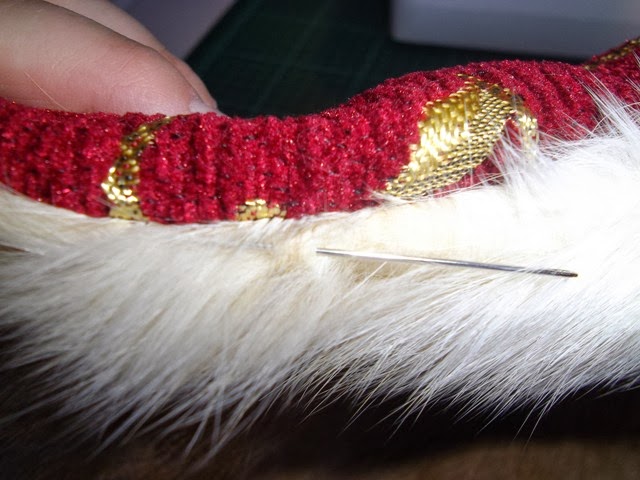
Once the manizza or muff was the right side out, I made sure that all the seams were pushed out and the hair pulled out of the seams before sewing on some maroon satin ribbon.


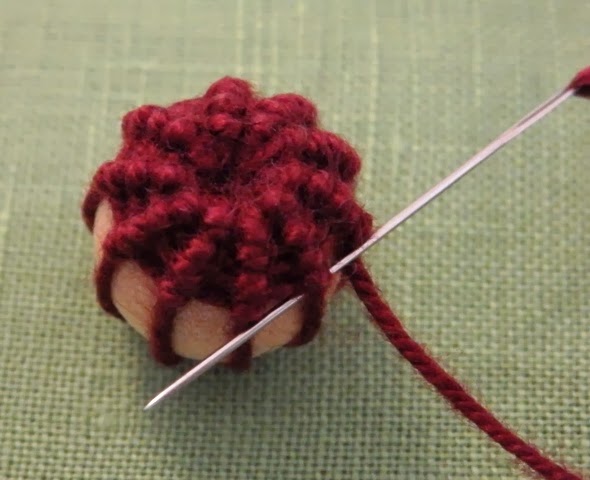
The next thing I decided to work on was the woven buttons. You can see the tutorial on how I did it here: http://broidermebethan.blogspot.com.au/2014/01/woven-button-tutorial-back-stitched.html
I added loops of gold DMC floss to the completed buttons and a decorative little knotted lump in the middle at the top. Next time I will use a bead, because I was not very happy with how this element worked out.
I made five of these buttons and stitched them to one side of the manizza.


I liked the way the ribbon looked by itself, but wanted to try out some trims. The plain gold upholstery trim was too much, but I had a small amount of maroon and gold trim that was purchased for the edge of a French hood. It looked pretty good on the ribbon, so I sewed it down in the centre of the satin ribbon.


I had some lovely little gold accents that I bought for a Tudor bodice from http://dragonsbloodcreations.com.au/
I thought that they looked nice, and would be a good way of hiding the join in the trim.


The last task was to make buttonhole loops for the button closures and to make an anchor point to hook my girdle chain to. I made a couple of loops of crochet cotton and then button hole stitched all around them before anchoring the thread and knotting off. This was a tedious task because the hairs from the fur kept getting stuck in the loops and pulling through with the thread. Also the fabric was quite loosely woven, so I had to be careful how hard I pulled the thread. Next time I will try lucet cord loops sewn into the seams because I found that the crochet cotton stretched quite a bit.


Once the loops were finished, I joined some lobster clasps and a key chain ring to a length of chain so I can hang the manizza from my girdle.


Although I didn't get all the other items that I had planned done (as usual!) I am satisfied with what I achieved in the challenge. I have a pretty accessory and I plan to make another for a friend at some later date.


I found these pages after I had finished my manizza, when I was looking for supporting pictures. I would recommend them to readers:
https://thepragmaticcostumer.wordpress.com/tag/album-amicorum/
http://webspace.webring.com/people/lo/oonaghsown/curves/muff_in_sixteenth_century_dress.htm
http://jeannedepompadour.blogspot.com.au/2012_03_01_archive.html
The ‘Portrait of Anna Radziwell’ 1583 shows what looks like a fur capelet. Hmmmm…. Ideas for the future!


Here is the link to see what the other entrants in the challenge have created:
http://realmofvenus.renaissanceitaly.net/challenges/IRCMC-Jan2014-Results.htm

Many thanks to Lady Bella  of Realm of Venus (http://realmofvenus.renaissanceitaly.net/) for organising this fun challenge.