Showing posts with label costume. Show all posts

Wednesday, September 5, 2012

Blue dress update


I have done most of the hand sewing of the blue dress bodice. I stab stitched the bodice pieces together and then whipped the edges. I also stab stitched and reinforced the seams. I have one armhole to finish and then I will post photos.

Now I am ready to make the bias binding to decorate the bodice, and decide on what I am going to do about the lacing.

My inspiration portraits have hidden lacing.

       
St Ursula (also known as Woman with a book) by Carpaccio- denverartmuseum.org            


Portrait of a Lady by Carpaccio c. 1495 - wikipaintings.org


But I have a large bust, so I am thinking that I might be better served by eyelet holes for extra strength. I do have some lovely lacing rings for a front opening bodice, but I am not sure they will be strong enough.

There are many examples of front lacing dresses from Italy and surrounds that would work:

Portrait of a a Girl With Cherries by Circle of Leonardo c.1491-95 - paintingall.com
(See also http://www.metmuseum.org/toah/works-of-art/91.26.5)

Ghirlandaio's Portrait of a Lady - en.wikipedia.org
Portrait of Constanza Caetani by Fra  Bartolomeo c. 1489-90 from


http://www.angelfire.com/zine/kiarapanther/garb/gamurra.html
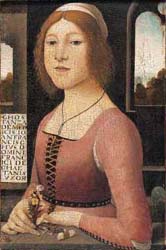
Portrait of a Woman, by Domenico Ghirlandaio
Ghirlandaio's Portrait of A Woman - artcyclopedia.com


I am thinking that this type of lacing (below) will add strength and be unobtrusive. I hope the horizontal lines won't ruin the look of the gold bias decoration.
Portrait of a Young Woman by Ghirlandaio c 14885 -  
http://commons.wikimedia.org/wiki/File:Domenico_Ghirlandaio_078.gif 

Portrait of a Girl by Ghirlandaio c. 1490 - from wikipaintings.org

Portrait of Giovanna Tornabuoni by Ghirlandaio-    from wikipedia.org

Monday, September 3, 2012

Blue dress update


I haven't made any progress this week on the blue dress but I did play around with adapting a sleeve pattern. This is a completely new style to me, so I have no idea how it will work...


Thursday, August 16, 2012

TAFE Student Costume Display

While walking through Adelaide Arcade (in Adelaide) recently, I saw this display of costumes by TAFE students.


Thursday, March 22, 2012

Dress Ideas


I am hoping to make it to Midwinter Coronation in July. Now I need to plan for what I will wear......

I have a real dilemma- there are so many dresses I would like!

Heading into winter, I try not to plan anything big because my health problems are always much worse during the colder months. In a normal year, I am lucky if my health problems allow me to make two or three big garments like coats or dresses.


If I went for something like the dress below, I wouldn't really have to modify any of my existing dress patterns much. But I always feel more confident in slightly later styles. Plus, so many of my dresses look the same.
Lorenzo Costa's Portrait of A Lady with A Lap-Dog


I really like Bianca Cappello's style. I love most of her outfits. The only thing is that I tend to get really hot because of my health issues, so these layers might be too much. Plus the ruff may not be the most practical accessory for a busy day and night.


Lavinia Fontana (1552-1614) Portrait of Bianca Cappello (1548-1587) - 1590- 
bjws.blogspot.com
 

I really love the coat below, and I have some very similar fabric to this in my stash. But I don't think I will be able to make the coat and underdress in time. One day I will own this ensemble though. I guess I had better add 'learn reticella lace making' to my long-term plan...


File:Alessandro Allori - Portrait of Grand Duchess Bianca Capello de Medici.jpg 


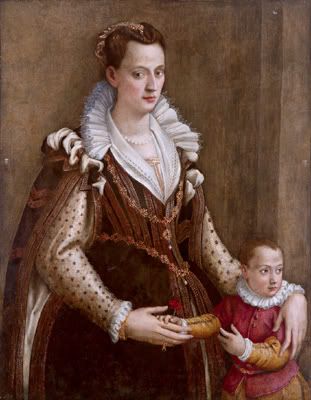
Now, this one would look much better on me in a darker colour. I like the sleeves just as they are. The only problem is that I think this style would not hide my belly as much as I would like. Also, I certainly couldn't get those sleeves done in time. There seems to be some intricate decoration in the white sleeve panes. Embroidery? Maybe one day this will grace my wardrobe!


  Possibly Isabella de Medici and her son by Allori (1574 )-http://aneafiles.webs.com/eleonoraditoledo.html 


Here is a different version of the same picture (from the same site).  


I like the 1530's big sleeve/big hat combo, and I think it looks OK on me, but I won't have time to do this sort of ornamentation. I probably won't have time to make a new balzo either. Plus, I did this style last year.


Lucretia by Lorenzo Lotto - lucyvivante.net 

Bordone's Portrait of A Woman with a Child (1530s) - kunst-fuer-alle.de
 

One day I will own a version of the two dresses below. 


Bernardino Licinio's Portrait of A Woman - terminartors.com

 
Another 'Portrait of A Woman' by Licinio - terminartors.com


I love this dress too, but the decorative features would take far too long to make it achievable this year. 


Bronzino's Portrait of A Young Girl With A Prayer Book - allpaintings.org


Finally, I think this is probably the most realistic Italian style for me, given all the limitations that are restricting the project. I could add an overgown for the feast in the evening. I really like the parti-coloured dress, but not for this event. I won't do a reproduction; I prefer to use a portrait as a reference and an inspiration but to change colours and decorative elements to suit my personal taste, style and budget.


http://habanera-nonblog.blogspot.com.au/2008/09/un-agosto-bologna-2.html 


I haven't put in any images of loose Elizabethan coats; that was the other option. I have several loose underkirtles and many accessories ready to go. The only thing that was putting me off about that option was the fact that I really need to wear a hoop skirt to make the Elizabethan 'frocks' or loose coats look nice, and I think it will be a crowded event.

I will have to think about it a bit more....


Friday, January 20, 2012

Orange-red Geometric Band Partlet


Today's post is a picture of one of my early monochrome embroidered partlets. It is embroidered in two strands of an orange-red DMC cotton floss. In period, silk would probably have been used. I used cotton fabric for the body of the garment, whereas in the sixteenth century linen was a much more commonly used fabric. Both these substitutions were made for financial reasons. The garment is hand sewn and was completed in early 2007.


Stitches include stem stitch, running stitch and an ornamental buttonhole stitch.

I rely very heavily on reprints of sixteenth century pattern books to source my embroidery designs and gain inspiration. This partlet embroidery design is a direct copy of a popular sixteenth century band design that crops up in several pattern books. 

Here is a book that I use very often  

Monday, January 16, 2012

Grey flower motif chemise

I finished this chemise a few years ago. It is made of light cotton gathered into a bias binding neckline. The sleeves are decorated with flower designs inspired 'A Scholehouse for the Needle' and by the Warwick shirt.  'A Scholehouse' was a pattern book drawn by Richard Shorleyker (1632.) It contains many designs that exist in pattern books printed at various times in the sixteenth century. The Warwick shirt is an extant example of Elizabethan monochrome embroidery* (done in red). It It has some beautiful designs on it, and can be seen here:
http://www.warwickshire.gov.uk/web/corporate/pages.nsf/links/aa47f702d5996adc80257149002da95e


The shirt is part of the collection of the Warwickshire Museum: 
http://www.warwickshire.gov.uk/museum


You can see a very interesting article, including some designs from the shirt, here:
http://knol.google.com/k/elizabethan-blackwork-embroidery#

The sleeves on my chemise are very big and are designed to be puffy enough to allow them to be pulled out through slits in split sleeves. When worn without an oversleeve, they flow over my hands:


As with most of my clothes, the chemise is used for both Italian styles and under my Elizabethan loose gowns. The designs are worked in grey DMC cotton in a range of stitches, including buttonhole stitch, seeding stitch, stem stitch and double running stitch. All visible seams were handsewn, except for the hem.

The sleeve laid out before sewing (the white tiles underneath are showing through the thin fabric.)


* also called as 'linear blackwork' or 'single-colour, non-counted blackwork'