Showing posts with label split stitch. Show all posts

Tuesday, June 3, 2025

Mer-folk Embroidered Band

I made this embroidered band last year thinking I might use it on the front of a chemise. I had a big SCA event recently, and I decided to use it as a decorative band on a stomacher to cover my pair of bodies. I actually ended up wearing a different stomacher to the event, but I am glad to have another one in my wardrobe.
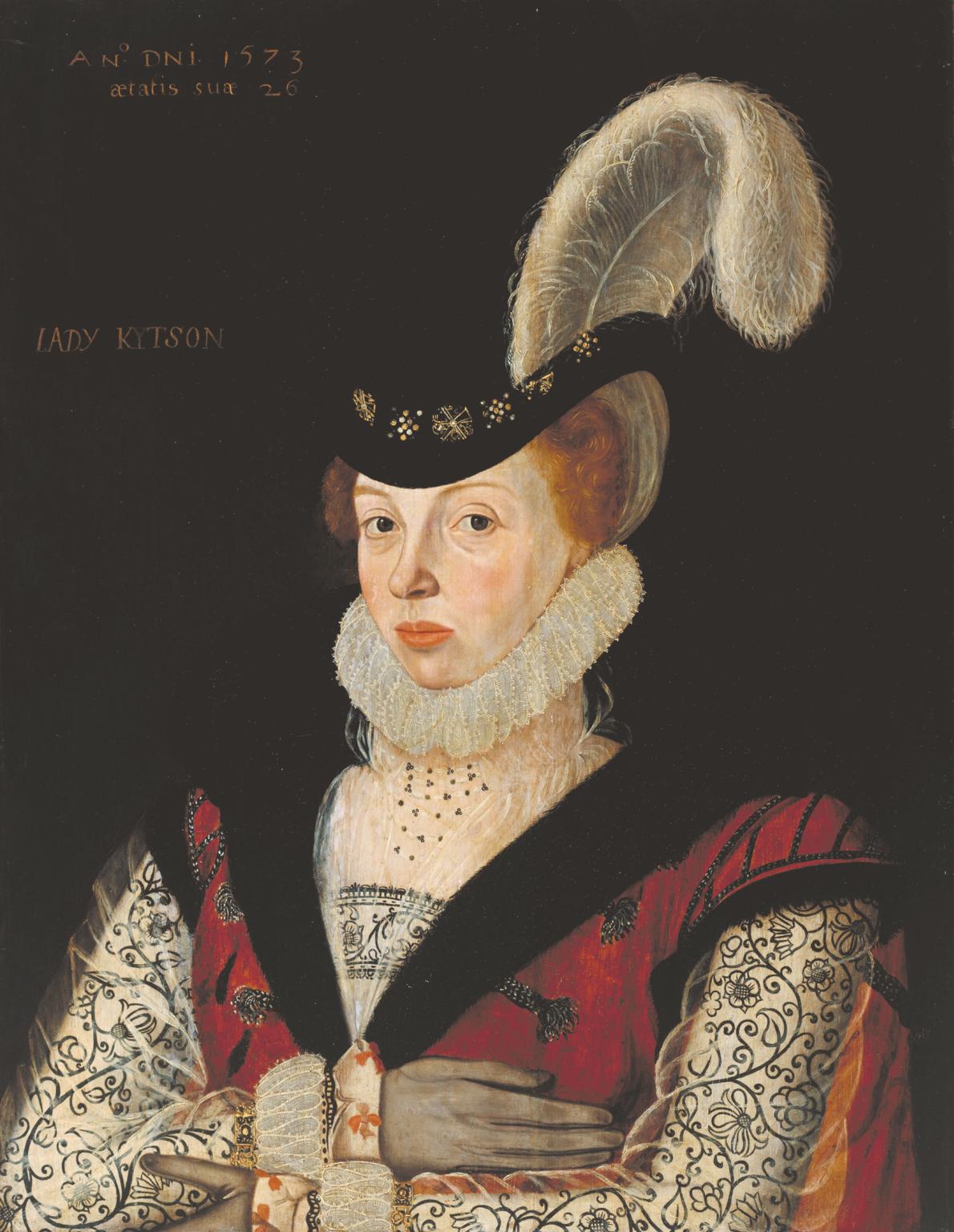

I have admired the clothing in this Portrait of Lady Kytson by George Gower held by the Tate Gallery for a long time, and her chemise band is what inspired this piece. (Image from‘Lady Kytson‘, George Gower, 1573 | Tate) One day I'd love to have time to work a pair of sleeves like this too. 

The base fabric is linen and the embroidery is worked in black DMC floss. The project was created entirely from stash items. I worked out my design and then marked it on tracing paper and traced it onto the fabric with crayola washable marker using a light board. Stitches used are split and double running stitch and knots.

I sewed the band onto a panel of stash cotton fabric, ironed it and bagged it out with another panel of cotton. 'Bagging out' means sewing your lining edge to your fashion fabric edge right sides together. Then you trim, grade or notch (if necessary) and turn right side out. The seam allowance ends up on the inside and you have a finished edge that needs no other treatment. You just need to handsew the opening shut. My understanding is that this is a modern method which is predominantly used with a sewing machine. It is a quick and easy way of sewing squares and rectangles together.

I feel like the top edge needs a little something extra; maybe some tufts or black needlelace similar to the smock/chemise in the portrait.

The finished band

The back of the work

My little helper

My pattern is taken from the Modelbuch 'Splendore Della Virtuose Giovanni' by Iseppo Foresto, published in Venice in 1564 and held by the Met Museum, available here: //www.metmuseum.org/art/collection/search/349915. I have seen many variations on this design in period modelbucher, usually with mer-people (often mermaids) holding something between them and foliate designs around them. (Maestra Praxilla Taurina has put together a useful list of Modelbuch to drool over, which can be found here: Is that an Apres?: Modelbuch List (daughterofthebull.blogspot.com) )
My adjusted design based on the Iseppo Foresto pattern


Tuesday, May 23, 2023

Embroidered German-style Brustfleck - Eagle Design

I recently had the opportunity to help make an embroidered German-style brustfleck for His Majesty. The talented Sir Eva designed and traced out the complex design as well as supplying the materials.

The designed was traced out in Frixion pen and embroidered with DMC floss in one, two or three strands (depending on the area of the design). The main part of the embroidery was done in split stitch, but there are also elements that have satin stitch, backstitch and double running stitch.


Once the embroidery was finished, it was cut out and adhesive was added on the back. I fused the bird to the silk background for extra stability and stitched the panel edge down with tiny stitches. Then I couched down over the edges with silver cord.
The completed panel was then given back to Sir Eva for points to be added. Many thanks to Sir Eva for doing all the hard work in a very limited time frame!


Thursday, July 7, 2022

Embroidered Heraldic Patches

 I recently finished the second of two heraldic patches for a Championship cloak. I wasn't super pleased with how this one turned out, but it was my third try, so it was time to quit and accept it for how it worked out. The embroidery is done in silk thread in split and chain stitch.


The seahorse was done in cotton floss in split stitch.


Saturday, June 26, 2021

Birds and Flowers Green Embroidered Caul

I recently finished this long term project. I have worked on this and a couple of other pieces every year at one of our Medieval Faire demos. I was trying to work out how long I have been working on them - probably one day a year for ten years! It is nice to have it finally finished. It is a record of how my skills have developed over that time.

The embroidery is worked in DMC embroidery floss on linen ground fabric, and the spangles are metal.


The fabric circle is gathered into a band which is decorated with green ribbon, I have added a metal comb inside the band to help keep the caul in place, and a couple of little buttonhole rings to slide bobby pins through.

This link to a previous post gives more information on the construction process: http://broidermebethan.blogspot.com/2014/05/purple-velvet-caul.html

Friday, March 5, 2021

Embroidered Heraldic Banner Device

 A new family member has been keeping me very busy the last several weeks, and bringing that special level of insanity that only a puppy can add! Completed projects seem to be few and far between, and there is so much cleaning to be done. But I did manage to get a banner device done for my local device banner.

The device banner project is a group project which records local SCA heraldic registrations in chronological order, with heraldic devices sewn onto a series of banners.

The banners look great, record the history of our group, and enable a fun guessing game at events. We have six banners so far, with registrations sewn under the devices of the Baron and Baroness of the time.

                                            Banners 2, 3 and 4 on display at an event pre-Covid.

One of the locals didn't have time to complete their device so I offered to help them out. The device is made of felt with applique and embroidery.


Split stitch was the main stitch used, with a little bit of whip stitch and couching. Crochet cotton and DMC embroidery floss were used also.


Thursday, November 26, 2020

Grey Linen Blend Tunic with Mammen Style Embroidery

 Here is another of the tunics I made for a friend. This one is intended to be an over tunic, as it has embroidery around the hem and arms which I'd like to be seen, and is slightly shorter in length.

(Here it is worn over the light grey undertunic.)

It is constructed in the t-tunic style per request from the recipient. The seams were enclosed (where possible, by hand,) to make the tunic more durable. All hemming was done by hand.


The embroidery is based on the acanthus design on the textile in the 10th C Mammen find (Denmark).


Image from: http://heatherrosejones.com/mammen/index.html

The textile finds came from a grave site at Bjerringhøj, in Mammen parish, Middelsom herred, in northern Denmark. More information can be found here:http://heatherrosejones.com/mammen/index.html

 I did it as an outline, rather than filled as in the original, but used split stitch like the original embroiderer. The embroidery was worked in crochet cottons gifted to me by Viscountess Ingerith Ryzka in split stitch.

I used the same design for the sleeves and hem, but the sleeves have the design reduced in size.


Monday, November 9, 2020

Blue T-Tunic with Knotwork Embroidery

Here is another t-tunic from the suite I mentioned in  the last post. It is a blue cotton base fabric with white and green embroidery incorporating  the recipient's heraldic elements.
The majority of the stitching is done in split stitch with a small amount of double running (Holbein) stitch.
The stitching was traced out using a chalk sheet and worked in DMC floss.

I started the embroidery on the weekend that my dog got sick - I got the phone call to say that she had been admitted while I was working on it. I originally planned to do the embroidery on a smaller scale around the arms as well, but working the design had so many sad emotions associated with it that I did an alternative decoration.

The tunic had big seams sewn by machine, with all the hems and necklines sewn by hand. I try and (at least) finish everything by hand, even if I don't have time to entirely sew everything by hand.

I like to draw marks on my fingers to help me get the stitches even when I do running stitch as a hem decoration.

I tried a green running stitch on top of the bias decoration on the arms, but didn't like it.
The blue tunic worn over another grey undertunic that I made. The tunics were all designed to be interchangeable wardrobe pieces and many can be layered.

Friday, March 15, 2019

Wulsthaube Schleier or Steuchlein with Embroidered Foliate Pattern (and Bunnies)

Last year I wanted to make an embroidered wulsthaube veil for a friend who has a German persona in the 15th and 16th Century styles. The images below give an idea of the look I was going for.

Master of the Housebook [German Northern Renaissance Painter, 15th Century]
(Also known as: Master of Hausbuch, Meister des Hausbuches)
Image from: https://marinni.dreamwidth.org/345746.html

Basel, Universitätsbibliothek, AN II 3, p. 121r – Matriculation Register of the Rectorate of the University of Basel, Volume 1 (1460-1567) Coat of arms for Adam von Müllenberg, SS 1509
available at: https://www.pinterest.com.au/pin/22447698115940777/

16th century (1509-1510?) Switzerland - Basel               Basel, Universitätsbibliothek 
AN II 3: Matriculation Register of the Rectorate of the University of Basel, Volume 1 (1460-1567) 
fol. 123v                      http://www.e-codices.unifr.ch/en/list/one/ubb/AN-II-0003
Image fromhttp://illumanu.tumblr.com/post/22895009700/16th-century-1509-1510-switzerland-basel

I have an inordinately large head(!) so I had to turn to friends for advice on sizing. Many thanks to Mistress Rowan and Mistress Ursula (Lochac) who provided advice and sizing information.

The pattern is basically an extended half circle, or a rectangle with a small half circle on the end. I used 100% linen, which is a dream to work with. I hand sewed a small hem around all the edges, and then looked at the embroidery I wanted to do.

In a large number of period examples of this sort of headwear, counted designs (most likely executed in silk thread) are very popular. I struggle with counted work, and prefer non-counted so I had a look at appropriate designs. I was lucky enough last year to obtain a copy of  "German Modelbucher 1524-1556" compiled by Marion McNeally, so I had lots of designs to choose from.

I would also recommend Modelbuch Muse on Facebook as an amazing online resource of all sorts of embroidery and lace designs: https://www.facebook.com/modelbuchmuse/

I chose this one; it was appropriate for the region and time period, and I liked it (third one down).

I decided to modify it a little and add a border and some bunnies to personalise it for the recipient. I worked the design in split stitch in a lovely wine coloured thread which would work well with the colours favoured by the wearer.

I traced the design out with my trusty Frixion (iron out) marker. With these old woodcut designs, I always have the dilemma of whether to alter them to make them more even and symmetrical. I used to always alter them, but now I am working on being able to directly transfer them and not worry to much about the little irregularities. (They still bother me!)


I was pleased with how the design turned out. It doesn't look like much of a garment when flat, but it looks great when worn. (To be honest, the recipient could wear a paper bag on her head and make it look stylish...... but I'm still pretty happy with how it turned out!)