Showing posts with label early period tunic. Show all posts

Thursday, November 26, 2020

Grey Linen Blend Tunic with Mammen Style Embroidery

 Here is another of the tunics I made for a friend. This one is intended to be an over tunic, as it has embroidery around the hem and arms which I'd like to be seen, and is slightly shorter in length.

(Here it is worn over the light grey undertunic.)

It is constructed in the t-tunic style per request from the recipient. The seams were enclosed (where possible, by hand,) to make the tunic more durable. All hemming was done by hand.


The embroidery is based on the acanthus design on the textile in the 10th C Mammen find (Denmark).


Image from: http://heatherrosejones.com/mammen/index.html

The textile finds came from a grave site at Bjerringhøj, in Mammen parish, Middelsom herred, in northern Denmark. More information can be found here:http://heatherrosejones.com/mammen/index.html

 I did it as an outline, rather than filled as in the original, but used split stitch like the original embroiderer. The embroidery was worked in crochet cottons gifted to me by Viscountess Ingerith Ryzka in split stitch.

I used the same design for the sleeves and hem, but the sleeves have the design reduced in size.


Friday, November 13, 2020

Plaid Undertunic

 Here is another tunic from the suite I made in 2018 and 2019 for a friend. This one is a nice soft flannel, perfect for a winter tunic or undertunic. 

It was made per request as a traditional t-tunic. Seams were machine sewn and hand finished. Hems and neckline were hand sewn. Commercial trim was hand sewn on the arms. 

 I tried this one on and it is very cosy. It looks nice with a short-sleeved, plain  tunic over the top as well.


Thursday, November 5, 2020

Grey Linen Blend T-Tunic

This is one of the suite of tunics I made for a friend in 2018 and 2019. My friend wanted a traditional t-tunic design, which was a bit challenging because I usually like to add a gusset under the arm. The fabric was cotton linen blend. I made a pattern based on his measurements.

The seams were all machine sewn and hand finished. The neckline and hems were hand turned and hand sewed. The trim was commercially produced. The aim was to end up with comfortable tunics that could be worn mix and match style, layered if needed, and thrown in the washing machine.

Deciding on how to trim the neckline.
Hand sewn hems and trim.
The first finished tunic.

Sunday, December 30, 2018

Blue Plaid Tunic

This over tunic was also completed in October. It is designed to co-ordinate with the black flanelette undertunic posted about below. It is made of a light cotton with a plaid pattern which was chosen by the recipient.

As with the undertunic, it is made to a t-tunic design. I tried to enclose seams and hand sew wherever possible.

Commercial braid has been added over the joins where the sleeves were pieced, and blue bias strips have been added to the neckline and sleeves for decoration. A running stitch in cotton was added on top of the bias strips for extra decoration.

Seeing it on the hanger doesn't do it justice; it looks very nice on the recipient.


Saturday, December 29, 2018

Black Flannelette Undertunic

As you may remember, I have been working on a suite of simple tunics for a friend. I finished this undertunic back in October.

My friend requested the traditional SCA style t-tunic as it is what he is used to and likes. I still wanted to try and use techniques that I use on more authentic styles of clothing, so I enclosed seams, hand sewed exposed seams down and used rolled hems where possible. The long seams which wouldn't be seen were machine-sewn and the rest of the sewing was done by hand.

The undertunic is made of cotton flannel, chosen because it is very soft and preferred by the recipient.

Image result for t-tunic
SCA style T-Tunics
Image from http://allcraftsblogs.com/clothes_sewing_patterns/t_shirt_tunic/t_shirt_tunic.html

Rolling the neck hem

Measuring the bottom hem in preparation for turning under again. The raw edges were zigzagged where possible to make the garment more durable

Here you can see where the internal seams have been hand-sewed down. The recipient is very tall and has long arms so I needed to piece the sleeves to achieve the required length

I hand-sewed cotton bias strips for a bit of decoration

The completed undertunic with one of the over tunics on top. It looks much nicer on and belted, and with co-ordinating trews

Friday, June 8, 2018

Tunics, tunics, tunics!

I've been sick again this week, but where possible I have been working on the suite of tunics for the Baron.

It is also getting quite chilly here, so I am thinking about cold weather clothing. I often have a low grade fever, so I don't have a large amount of warm weather clothing. Since coming off of one of my medications about eighteen months ago I have been almost continuously sick with infections -including chest infections. So a cloak or shoulder cloak with a nice fur collar seems like a sensible item to have in the wardrobe.

Last year I experimented with dyeing an old blanket. The plan was to achieve some blue wool, but I ended up with a pale purpley-grey colour. I cut out a short circle cloak from it and lined it in some very bright pink linen, and left it to hang.
It has been hanging for a looong time! Time to finish it off so I can use it for winter wear. It will be nice to finish off some UFOs that have been hanging around for far too long!

Wednesday, April 18, 2018

A Plan for A Suite of T- Tunics for a Friend

A friend needed a suite of under tunics and over-tunics so I offered to help. He provided the fabric and I offered to sew and decorate them. It has been a long process; not because the design was difficult or the fabric hard to work with, but because I have been having ongoing sewing machine issues for the last six months or so and my health worse than usual.

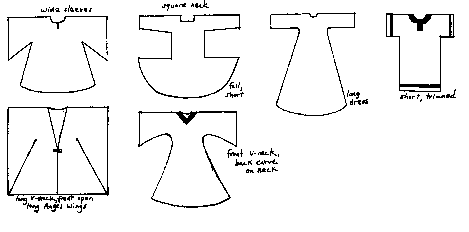
The recipient specifically requested traditional SCA-type t-tunics - no gores or gussets, and just  the simple t-shaped design that so many SCA participants start out with like the one shown in the image below.
Image from: https://www.pinterest.com.au/pin/570901690249020212/
He is a tall guy, so the waste of fabric usually associated with this style of tunic was not really a problem as the sleeves are wide and comfortable and I used the 'waste'side pieces to extend the length of the arms. Fittings and checks happened last year to make sure the design would fit and be comfortable and to meet the recipient's needs. My furry helper also inspected all the fabric (as usual) and deemed it acceptable.


I cut out about six tunics in a variety of fabrics provided by the recipient. There was quite a lot of piecing involved in the sleeve areas. I expect these garments to be heavily hand washed so I enclosed the seams to make them last longer and prevent fraying.

On a more historically accurate tunic (designed with gores) such as the one below
Tunic pattern from: https://www.pinterest.com.au/pin/460282024388882275/
I machine sew the seams and then turn each side of the seam fabric under and hand sew it down.
It is a time consuming process, but makes for neat seams and long-wearing garments. It is also easy because all the shapes are triangles and squares and rectangles with nice straight lines to work with. I couldn't bear to leave the edges zigzagged on these tunics, so I have been sewing the seam excess under. I find this sort of hand work calming, but it really is less so than normal when felling the curve of the seam under the arm. No nice straight lines here, so it is important to allow for the fabric to move and stretch a bit by stretching it as you go and not sewing the seam too tight or using too small stitches. I don't want the seam to rip when he puts his arms up, after all.

The neckline is a simple v-shape with a small hand-sewn rolled hem. The process is essentially what I did recently for the College Newcomer tunics as shown here http://broidermebethan.blogspot.com.au/2018/04/second-newcomers-tunic.html

On most of the tunics, I am at the fun part - decorating! The recipient is an understated guy and is not the type who likes to be in the spotlight, so I have gone for darker and more muted colours. There is not much in the way of good trim available locally, so I originally planned to embroider several of the tunics. A knuckle dislocation in March and subsequent rheumatic hot spot that won't settle have slowed things down even more, so on a couple of the tunics there will be purchased trim. The recipient had some that was gifted to him by a friend, so I will use that. I also found some online that seemed appropriate.

Several of the plain coloured tunics will have embroidery. I have a nice design of interlocking knots coming along veeeery slowly, and plans for another design incorporating the recipient's heraldry. There is a lovely wool waiting to be made up also (I'm saving that until last because I am always afraid to cut expensive fabric, even after all this time!), which would look great with a design based on one of the Mammen textile designs, below
Image from: https://www.pinterest.com.au/pin/335588609710150485/  
Of course, I will post pictures when they start to get finished. You know, I still find it nerve-wracking making items for other people, even after all this time. Male garments are especially stressful, because my experience is mainly with female late period clothing and accessories. I would like to branch out in future with more complicated male clothing, but the idea is very daunting especially as I really only have made t-tunics for men before.

Thursday, August 27, 2015

Embroidered Seam Treatments

I have been helping a friend out by working some simple embroidery over the seams of one of his early period tunics. The ground fabric is wool and the embroidery is in DMC Perle cotton. The combination is very pleasant to work with, and works up easily.

Blanket stitch on edges supplemented with a couple of stitches in the middle


I like to use this trick to keep my stitches relatively even; I mark the distance between the stitches on the index finger of the hand I use to hold the piece of fabric that I am embroidering.


Little cross stitches in blue with an orange anchoring stitch worked in the centre