Showing posts with label sixteenth century costume. Show all posts

Tuesday, September 10, 2019

Black Linen Front lacing Italian Gown for Summer


This was a quick project with some modern sewing techniques used to save time. I modified one of my other gown bodice patterns to drop the waist a bit, make the shoulders a little wider and put a bit more depth into the point of the bodice. I made this gown in January 2019.

The gown bodice was an experiment with no boning. The linen was lined with heavy cotton canvas and the two pieces 'bagged out' or sewn together with the machine. I hand sewed the bottom edge of the bodice and the armholes.

The trim is just simple ribbon, sewn on by hand.

The eyelets were all done by hand with an awl and sewing thread. I decided to add some bias binding along the front edges  and slip bones in for a bit of rigidity and to stop eyelets puckering. Once I tried the completed bodice on, I felt that it needed some extra boning, so I added bias at the centre-side seams and across the back of the bodice, and put four more bones in.

The skirt is simply a series of rectangles of fabric sewn together. I let the skirt hang for a long time to let the hem drop and reduce distortion due to the weight of the fabric.

I pleated the skirt on by turning the top edge under and then marking out regular dots along the skirt top edge. I ran a heavy thread through to draw the skirt up into cartridge pleats. Normally you would use a double row of thread to do this, but I cheated and only did one. The risks with one thread is that it may break and you will have to start all over again, and that the pleats may be slightly uneven if you are not very careful with your dot marking and needle placement. I usually do a two-part line of pleating; on a front opening gown, I run one line of pleating thread from centre-back to centre-front on one side, and do the same on the other. I find that it makes adjusting the pleats more manageable.

Once the lines of pleating thread are in, I put safety pins in to mark the centre-back and centre-sides of the skirt panel. I line the safety pins up with the corresponding side seams, centre-back point and centre-front point of the bodice. Then I carefully draw up my pleating thread, adjusting the pleats to sit evenly in their quarter. Then I adjust a quarter at a time to make sure the pleats are all evenly spread out and looking nice. A quarter panel at a time, I use heavy thread to sew each pleat onto the bottom edge of the bodice. I usually use four strands of sewing thread that has been waxed for strength. I also knot the thread off unobtrusively at about every 10cm point, so that if I were to rip some pleats out by accident when wearing the dress, the whole skirt will not fall off.

Once the skirt is on, I cut the pleating thread. This is optional; if you want defined cartrdige pleats, leave it in. I prefer less defined pleats so I cut mine. I hand finish the front opening gap of the gown and add a buttonhole bar at the bottom of the skirt opening for extra strength. I did not add hooks and eyes on the opening of this gown - I left a bit of extra fabric at the front of the dress that I could pin shut and would be adjustable. I then let the gown hang for several more days to  let the skirt drop if necessary and to let the pleats fall properly.

I had help from my dear Mum with the hemming, and I added some ribbon trim around the bottom when hemmed as well.

Finally, I used some scraps from gown construction and another project to make the pouffy sleeve heads (baragoni) that I like so much. I sewed strips of fabric together too make a panel approximately 2.5 times the size of the sleeve cap pattern that I drafted as a base. I pinned the puffs into place by eye, until I got roughly the look I was going for. This is a tedious task, but I can't think of a better way to do it.


Once pinned, I hand sewed down all the puff pieces in sections to keep it secure. Usually I make all the bulky fabric puffs point to the centre of the sleeve cap and then put the lining piece on top and machine sew most of the way around (without catching any of the puffs in the seam,) Then I trimmed the seams, turned the puff the right way out and hand sewed the gap shut. I also hand sewed around the edge of the entire puff to stop the bulky puff section moving or turning in. It is important to have a stable base for these puffs or they move around and stick up.

I added some lucet ties underneath so I can wear the dress with removable sleeves.

I made and wore the dress in January when it is very hot, and it was cooler than my other garb. I think I lengthened the bodice a bit too much and I have adjusted this on the pattern for future dresses.

Saturday, September 8, 2012

Portrait of a Lady With A Dog


I'm too tired to do any constructive hand work today so I am indulging in a bit of web-surfing and drooling over sixteenth century portraits. Here is one I have never seen before with an interesting button front closure.


Portrait of a Woman with her Dog by Parrasio Micheli
from  starlightmasquerade.com

Wednesday, September 5, 2012

Blue dress update


I have done most of the hand sewing of the blue dress bodice. I stab stitched the bodice pieces together and then whipped the edges. I also stab stitched and reinforced the seams. I have one armhole to finish and then I will post photos.

Now I am ready to make the bias binding to decorate the bodice, and decide on what I am going to do about the lacing.

My inspiration portraits have hidden lacing.

       
St Ursula (also known as Woman with a book) by Carpaccio- denverartmuseum.org            


Portrait of a Lady by Carpaccio c. 1495 - wikipaintings.org


But I have a large bust, so I am thinking that I might be better served by eyelet holes for extra strength. I do have some lovely lacing rings for a front opening bodice, but I am not sure they will be strong enough.

There are many examples of front lacing dresses from Italy and surrounds that would work:

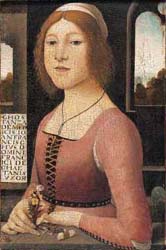
Portrait of a a Girl With Cherries by Circle of Leonardo c.1491-95 - paintingall.com
(See also http://www.metmuseum.org/toah/works-of-art/91.26.5)

Ghirlandaio's Portrait of a Lady - en.wikipedia.org
Portrait of Constanza Caetani by Fra  Bartolomeo c. 1489-90 from


http://www.angelfire.com/zine/kiarapanther/garb/gamurra.html
Portrait of a Woman, by Domenico Ghirlandaio
Ghirlandaio's Portrait of A Woman - artcyclopedia.com


I am thinking that this type of lacing (below) will add strength and be unobtrusive. I hope the horizontal lines won't ruin the look of the gold bias decoration.
Portrait of a Young Woman by Ghirlandaio c 14885 -  
http://commons.wikimedia.org/wiki/File:Domenico_Ghirlandaio_078.gif 

Portrait of a Girl by Ghirlandaio c. 1490 - from wikipaintings.org

Portrait of Giovanna Tornabuoni by Ghirlandaio-    from wikipedia.org

Thursday, March 22, 2012

Dress Ideas


I am hoping to make it to Midwinter Coronation in July. Now I need to plan for what I will wear......

I have a real dilemma- there are so many dresses I would like!

Heading into winter, I try not to plan anything big because my health problems are always much worse during the colder months. In a normal year, I am lucky if my health problems allow me to make two or three big garments like coats or dresses.


If I went for something like the dress below, I wouldn't really have to modify any of my existing dress patterns much. But I always feel more confident in slightly later styles. Plus, so many of my dresses look the same.
Lorenzo Costa's Portrait of A Lady with A Lap-Dog


I really like Bianca Cappello's style. I love most of her outfits. The only thing is that I tend to get really hot because of my health issues, so these layers might be too much. Plus the ruff may not be the most practical accessory for a busy day and night.


Lavinia Fontana (1552-1614) Portrait of Bianca Cappello (1548-1587) - 1590- 
bjws.blogspot.com
 

I really love the coat below, and I have some very similar fabric to this in my stash. But I don't think I will be able to make the coat and underdress in time. One day I will own this ensemble though. I guess I had better add 'learn reticella lace making' to my long-term plan...


File:Alessandro Allori - Portrait of Grand Duchess Bianca Capello de Medici.jpg 


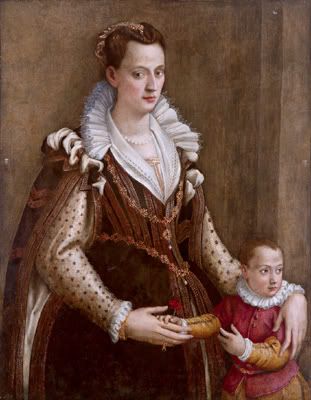
Now, this one would look much better on me in a darker colour. I like the sleeves just as they are. The only problem is that I think this style would not hide my belly as much as I would like. Also, I certainly couldn't get those sleeves done in time. There seems to be some intricate decoration in the white sleeve panes. Embroidery? Maybe one day this will grace my wardrobe!


  Possibly Isabella de Medici and her son by Allori (1574 )-http://aneafiles.webs.com/eleonoraditoledo.html 


Here is a different version of the same picture (from the same site).  


I like the 1530's big sleeve/big hat combo, and I think it looks OK on me, but I won't have time to do this sort of ornamentation. I probably won't have time to make a new balzo either. Plus, I did this style last year.


Lucretia by Lorenzo Lotto - lucyvivante.net 

Bordone's Portrait of A Woman with a Child (1530s) - kunst-fuer-alle.de
 

One day I will own a version of the two dresses below. 


Bernardino Licinio's Portrait of A Woman - terminartors.com

 
Another 'Portrait of A Woman' by Licinio - terminartors.com


I love this dress too, but the decorative features would take far too long to make it achievable this year. 


Bronzino's Portrait of A Young Girl With A Prayer Book - allpaintings.org


Finally, I think this is probably the most realistic Italian style for me, given all the limitations that are restricting the project. I could add an overgown for the feast in the evening. I really like the parti-coloured dress, but not for this event. I won't do a reproduction; I prefer to use a portrait as a reference and an inspiration but to change colours and decorative elements to suit my personal taste, style and budget.


http://habanera-nonblog.blogspot.com.au/2008/09/un-agosto-bologna-2.html 


I haven't put in any images of loose Elizabethan coats; that was the other option. I have several loose underkirtles and many accessories ready to go. The only thing that was putting me off about that option was the fact that I really need to wear a hoop skirt to make the Elizabethan 'frocks' or loose coats look nice, and I think it will be a crowded event.

I will have to think about it a bit more....


Wednesday, February 15, 2012

Collarless Partlet with Gold Embroidery


Today's pictures are of a cotton collarless partlet that I made. It was inspired by this portrait of 'A Woman with a Heron' by the Veronese School.

Circle of Veronese Portrait of a Woman with a Heron


The pattern is an adaptation of one of my favourite scrolling floral designs and is worked in DMC cotton floss. You will find variations of this design in most sixteenth century pattern books including Modelbuch Aller Art.


The design is worked mainly in stem stitch, with some seeding stitches and knots. All visible seams are handsewn, as is the purchased lace trim.


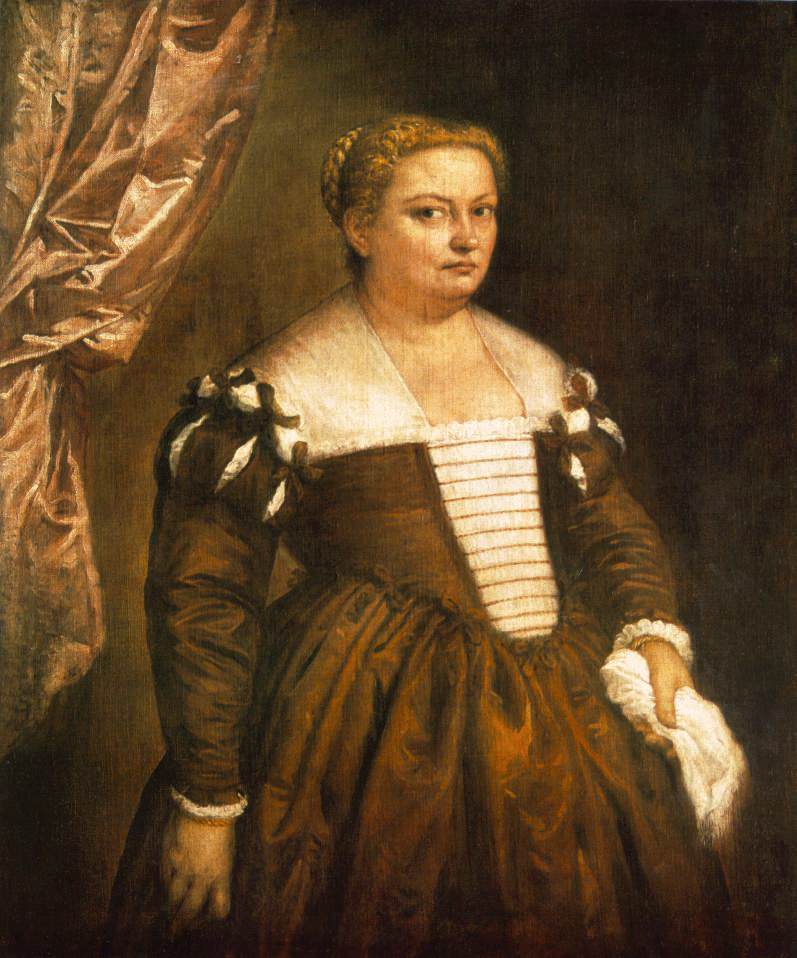
Collarless partlets and partlets with a very small collar at the back can be seen in many sixteenth century Italian portraits:
Bernardino Licinio Portrait of a Family
Portrait of a Family by Licinio


File:Bernardino Licinio - Portrait of Arrigo Licinio and His Family - WGA12984.jpg
Portrait of Arrigo Licinio and his Family by Bernardino Licinio


Portrait of a Lady in White - Titian
Portrait of a Lady in White by Titian (1555)


Portrait of a Woman by Veronese (1560s)


Titian - Portrait of Titian's Daughter Lavinia - Renaissance (High Italian, "Cinquecento") - Oil on canvas - Portrait - Alte Meister Galerie - Der Zwinger - Dresden, Germany
Portrait of Titian's daughter Lavinia by Titian


http://www.wga.hu Portrait of a Venetian Woman by Paolo Veronese 


File:Veneto, Bartolomeo - Portrait of a Lady in a Green Dress - 1530.jpg


The partlet pattern was adapted from one made many years ago at a partlet workshop held by THL Katerina da Brescia. You can see her research here: http://katerina.purplefiles.net/garb/diaries/diary%20list.html

Tuesday, February 14, 2012

Interlaced Foliage Partlet


This is a partlet that I made for a prize auction tourney in 2010. The embroidery was done in double running stitch with black linen thread. The ground fabric was also linen.


The interlaced design is taken from one of my reproduction sixteenth century modelbooks.(I love looking through my collection of modelbooks in the initial stages of a project!) I did not alter the pattern. In the sixteenth century, the embroiderer would probably have traced or drawn the design onto the base fabric with ink. I taped the linen to a window and traced the design on in water soluble pen. I find that water soluble ink is much more forgiving of any errors! I did a tacking stitch to mark out the edges of where the partlet collar piece should be cut.


The linen was stiff enough that I did not need to add interlining. The interior shoulder seams are machine sewn, but everything else was sewn by hand. Extant examples of sixteenth century clothing suggests that edges were often whip stitched, treated with sizing or wax, or left untreated. I have tested the wax and whip methods, but have found that a small machine zigzag stitch around the edges of finished garment pieces is more effective. I tend to machine-launder most of my embroidered pieces, so they need to be very durable.


The under arm seams were not joined. Images such as those found on the roof of the Pitti Palace in Italy suggest that partlet pieces were not joined under the armpits (Janet Arnold, Patterns of Fashion 4).This would allow for fluctuations in weight. For my own personal use, I have some that are, and some that are not. Since I often have no-one to help me dress, I find that the joined ones suit my needs better. However, I chose a more accurate representation for this project.


I included lucet cords made by Heather with this piece, in case the recipient wanted ties to close the partlet. I also altered some jewellery making findings into decorative pins, in case the recipient of the partlet wished to pin it closed.

During the embroidery, I often felt that I would go cross eyed! One of the disadvantages with some of the water soluble pens is that the ink has a tendency to bleed and blur the lines of the design. Once I washed the collar piece out and ironed it, I felt that the effort had been worth it, and I was very pleased with how the project turned out.

This website has some great pictures and interesting research on partlet construction- http://katerina.purplefiles.net/FlorenceFiles/FLUnderthings_Giorgeria.html

Thursday, February 9, 2012

Short-sleeved Elizabethan Smock


Today's picture post is of a sleeve that I started last year. I saw the Helen Mirren portrayal of Elizabeth I and was transfixed by the opening scene where she gets undressed for her examination by the court physician. You may have noticed that her smock sleeves are relatively short and that she has sleeve ruffs attached to her outer sleeves. I thought this would be a great idea for use under my gowns with heavy outer sleeves, so I started a (relatively) short-sleeved smock. Here is a picture of the completed first sleeve:


The embroidery motifs are worked predominantly in double running stitch in maroon cotton floss on a cotton base fabric. These varied plant and animal motifs were very popular in Elizabethan times, when exciting new botanical and animal discoveries from the New World were fashionable subjects for embroidery and decoration. A shift decorated in a similar way from about the 1630's is in the collection at the V & A Museum (http://collections.vam.ac.uk/):


As you can see, I have used several of these motifs in part or whole. The rest of the designs I used were taken from contemporary Italian or English extant embroideries, except for some of the smaller insects which  were my own creation (but inspired by extant examples.)


Fans of 16th Century historical embroidery will probably recognise motifs from 'A Scholehouse for the Needle' as well as designs from some of the garments in Janet Arnold's 'Patterns of Fashion 4'.

From extant sixteenth century embroideries, it is evident that many embroiderers did not use knots on their work, preferring to weave the threads back into the back of the design. I wash my smocks and chemises in the washing machine, so I use knots and weave the thread ends in for greater durability.

Here you can see the back of the sleeve embroidery


The back of the chameleon

Many of my personal embroideries have the same motifs showing up in one form or another; most notably the heartsease (pansy/viola), strawberries and snails. I am now also a big fan of this chameleon, butterfly and  bird:


Although I wouldn't rule out using him again, I do find that owl kind of creepy!


I will reverse the design for the other sleeve. I probably will not decorate the whole body of the smock, but may add some designs in the upper torso area.