Showing posts with label blackwork. Show all posts

Wednesday, February 8, 2017

A Brief Introduction to Non-Counted Monochrome Embroidery (Blackwork)

Monochrome Non Counted Embroidery

These are some notes I made as part of an introductory embroidery class I taught at Great Southern Gathering last year.

Blackwork’ was a popular style of embroidery in the later part of the SCA period, although the
term ‘blackwork’ is misleading as it implies that the embroidery was only done in black thread.

Classic black on crisp white is certainly striking and was very popular in the sixteenth century,
but extant monochrome embroideries  in red, green (Carew-Pole nightcap),

blue (1610 waistcoat, V&A: 179-1900), purple and pink (1630s woman’s smock at  http://costume.dm.net/va/smocks.html) still exist.


English smock embroidered in pink silk - V&A museum

Image from: http://collections.vam.ac.uk/item/O110103/smock-unknown/


English smock (c.1615) worked in pink silk

Image from: http://collections.vam.ac.uk/item/O78791/smock-unknown/


Linear monochrome embroidery (often worked in double running stitch) was popular throughout Europe during the sixteenth century. In fact, this type of stitchery is so common in Holbein portraits from that time that the double-running stitch is often called ‘Holbein stitch’.

Hans Holbein the Younger - Jane Seymour, Queen of England - Google Art Project.jpg

Portrait of Jane Seymour by Hans Holbein, showing beautiful embroidered cuffs

Image from: https://en.wikipedia.org/wiki/Jane_Seymour

 Monochrome embroidery (‘blackwork’) is also found in earlier periods in Middle Eastern textiles, and the geometric shapes found in Tudor blackwork echo similar designs and shapes found in Middle Eastern embroideries. This fact may have contributed to the story that Katharine of Aragon brought
monochrome embroidery (‘blackwork’) to England when she arrived to marry Prince Arthur
Tudor in around 1501. It is believed that the occupation of Spanish territories by ‘the Moors’ influenced design and embroidery, and that ‘blackwork’ or ‘Spanyshe worke’ was introduced to England by Princess Katharine. Although references to this story are discussed in ‘Blackwork Embroidery’ by Geddes and McNeill, I have not found any firm documentary evidence that this story is true. I believe that it is just as likely that the Moorish styles were introduced to Europe via mercantile contact with Italy.

Examination of English portraiture from the reign of Henry VII and Henry VIII show a marked increase in blackwork embroidery on clothing during Henry VIII’s reign but we cannot know if this is due to the introduction of a new stitch technique, copying of a fashionable Royal or just a new fashion craze. After Henry’s reign, the Elizabethans took blackwork to a whole new level, with the development of polychrome counted and non-counted blackwork and the introduction of spangles, metal threads and raised elements.

Monochrome embroidery in the sixteenth Century was very popular in England, with portrait examples of blackwork being quite common. It was also popular on the Continent, with portraits from artists as diverse as Anthonis Mor, Hans Holbein, Guillim Scrots, Moroni and Veneto showing sitters with lavishly decorated embroidered garments.

Blackwork (and other colour monochrome work) was popular on chemises and smocks, partlets, collars and cuffs, ruffs, coifs and caps and other linens. It was executed in counted form (usually in running stitch or double running stitch) or in non-counted form, in stitches such as stem, braid, chain, speckling, feather stitch, back stitch, long and short stitch, herringbone stitch and split stitch.

Floral designs were very popular for English embroidery in the sixteenth century, due in part to the proliferation of printed pattern-books and the discovery of the strange flora of foreign lands and the New World. Designs were often copied from pattern-books, as well as bestiaries and herbals.


Blackwork can be done in non-counted form, or in counted form. In counted blackwork, the design is marked out on the background fabric (traditionally linen) by counting threads and working the design over a set number of threads, often filling the interior of the design in with a pattern or repeat. Non-counted blackwork is more free-flowing and involves stitching over a pre-drawn design. I prefer non-counted blackwork because I dislike counted work. Double running-stitch is the most common stitch used for blackwork because it provides an even line that (if done well) is neat and clean on both the front and the back. Non-counted designs can also be filled with counted embroidery for a richer effect. The same techniques can be used with multiple coloured threads also.


 A page from Shorleyker’s pattern book ‘A Scholehouse for the Needle’ (1597), one of many pattern books available in the late 1500s and reprints in the 1600s


Image from- https://s-media-cache-ak0.pinimg.com/236x/d9/af/8b/d9af8b08a95a3359643cec8d509115b7.jpg


Bibliography
Arnold. J (1988) 'Queen Elizabeth's wardrobe unlocked',  Maney,

Anderson, R.M.  (1979) “Hispanic Costume 1480-1530” Hispanic Society of America, New York

Beck, Thomasina (1995) “The Embroiderer's Story: Needlework from the Renaissance to the Present Day”.  Italy: David and Charles

Cavallo, Adolph (1979) “Needlework” Cooper-Hewitt Museum, Smithsonian Institution, USA

Complete Anachronist - Blackwork Embroidery No. #31 May 1987

Complete Anachronist – Wrought with Flowers of Black Silk No. 115 April 2002

Dean, Beryl (1989) “Ecclesiastical Embroidery”, The Bath Press, Avon

Digby, George Wingfield (1963) “Elizabethan Embroidery” Thomas Yoseloff, New York.

Don, S. (1990) “Traditional Embroidered Animals” A David and Charles Craft Book, Birmingham

Geddes, E & McNeill, M. (1976) “Blackwork” Dover, New York

Gostlow, M. (1977) “Blackwork” Dover, New York

King, D. & Levey, S. (1993) “The Victoria & Albert Museum’s Textile Collection: Embroidery in Britain from 1200 to 1750” Canopy Books, New York

Levy, Santina M., (1990), Lace, A History, Victoria and Albert Museum, W.S. Maney and Son Limited, Leeds.

Nourry, C. “Patterns: Embroidery-Early 16th C” An unabridged reprint of four early 16th c. French pattern books. ISBN 1-891656-13-3. available from www.lacis.com


Various reprints
 The Modelbuch, 1537 by Egenolff
 The Needles Excellency
 A booke of curious and strange inventions, called the first part of Needleworkes, William Barley, 1596
 A Schole-house for the Needle, Richard Schorleyker, 1632

 A second booke of flowers, fruicts, beasts, birds and flies exactly drawne, George Humble, 1635(?)


Some stitches Used in Non-counted Monochrome Embroidery/Blackwork


Stem Stitch


Stem stitch was often used in the pre-modern period as an outlining stitch. It could also be used as a filling stitch.
To Work Stem Stitch - Work from left to right, taking regular small stitches along the line of the design. The
thread always emerges on the left side of the previous stitch. This stitch is used for flower stems, outlines, etc.
It can also be worked as a filling stitch if worked closely together within a shape until it is completely filled.


Split Stitch

A popular stitch, split stitch was used in many forms of embroidery including Opus Anglicanum and Heraldic Embroidery. It was used for very fine work, often only using a single strand of silk thread or was done using quite thick threads, such as wool. It was used as an outlining stitch or as a filling stitch.
To Work Split Stitch - Bring the needle through at A and, following the line to be covered, take a small back stitch so that the needle comes up through the working thread, as shown in the diagram. Generally, it is easiest to work this as a two step stitch by making a small stitch, then bringing the needle up through the thread at the half way point.


Back Stitch

Bring the thread through on the stitch line and then take a small backward stitch through the fabric. Bring the needle through again a little in front of the first stitch, then take another stitch, inserting the needle at the point where it first came through. In blackwork, a single back stitch is usually worked over two threads on a single-thread even-weave. This stitch is used in both counted and free embroidery.


 Chain Stitch

To Work Chain Stitch - Bring the thread up at the top of the line and hold it down with the left thumb. Insert the needle where it last emerged and bring the point out a short distance away. Pull the thread through, keeping the working thread under the needle point.
Surface Couching

To Work Surface Couching - Lay down the thread to be couched, and with another thread catch it down with small stitches worked over the top.

 From: http://medieval.webcon.net.au/technique_stitches.html


Friday, February 24, 2012

Red Monochrome Elizabethan Coif


Today's post is about a monochrome Elizabethan coif I made in 2010.  The main inspiration for the piece came from the following extant linen, silk and metal thread example shown in Janet Arnold's 'Patterns of Fashion 4' (below).


I used the same sort of scrolling stem design, but added different motifs. I pored over Patterns of Fashion, Queen Elizabeth's Wardrobe Unlocked, and all my reproduction sixteenth century pattern books with Elizabethan-style motifs, and picked a variety of motifs that I thought went well together. I kept a reference as I drew up the pattern so that I would have a record of where the motifs were sourced from.


I traced the design out in water soluble ink. For this project, I remembered to keep a record of how long the stitching took. The picture above shows approximately fifty hours of stitching (not including pattern design, tracing out etc.)

The stitching was done predominantly in double running stitch because I need practice in that stitch.

When the embroidery was done, I washed the coif in a gentle wool wash, rinsed, and gently blocked the fabric on a clean towel.


Here is the piece ready for metallic threads and spangling


The ground fabric is a lovely mid-weight linen, and the stitching was done in red DMC cotton floss and silver metallic thread. The spangles are a silver gilt metal and were sewn on with three stitches.

The back of the piece showing knotted and woven threads


In previous posts, I have gone into a great deal of detail about construction and design of coifs in Elizabethan times. Please refer to the post on my red striped coif for more information.


As you can see, I knotted AND wove the thread ends in on the back of the piece. I was not sure how the recipient would choose to launder the coif, and I wanted it to be durable.

There are small areas of other stitches, such as seeding, speckling, satin, stem and running stitch.

The piece after metal spangles were added
Below are some close up shots of the stitching. You can see that the metallic silver thread was added in a single running stitch in the centre of the stems.


The images below are scanned from 'Patterns of Fashion 4' and show extant sixteenth and early seventeenth century English coifs.
The centre top seam is sewn and then gathered  for about a third of the distance to allow for a bun or hair taping

This picture shows the gathering stitches at the crown of one of the coifs

This image shows tapes tying the coif in place in front of the bun or hair taping
I added a lining to the coif to protect against hair oils. The lucet cord ties were hand made by Heather.

I will post more pictures of the finished article next time!


Wednesday, February 15, 2012

Collarless Partlet with Gold Embroidery


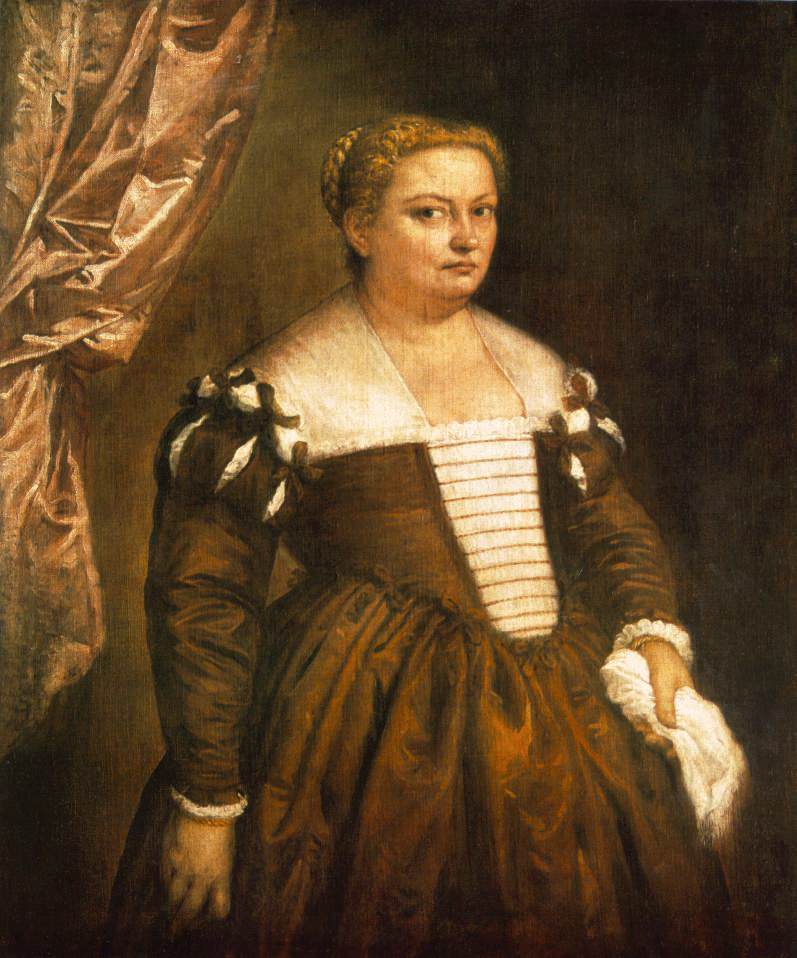
Today's pictures are of a cotton collarless partlet that I made. It was inspired by this portrait of 'A Woman with a Heron' by the Veronese School.

Circle of Veronese Portrait of a Woman with a Heron


The pattern is an adaptation of one of my favourite scrolling floral designs and is worked in DMC cotton floss. You will find variations of this design in most sixteenth century pattern books including Modelbuch Aller Art.


The design is worked mainly in stem stitch, with some seeding stitches and knots. All visible seams are handsewn, as is the purchased lace trim.


Collarless partlets and partlets with a very small collar at the back can be seen in many sixteenth century Italian portraits:
Bernardino Licinio Portrait of a Family
Portrait of a Family by Licinio


File:Bernardino Licinio - Portrait of Arrigo Licinio and His Family - WGA12984.jpg
Portrait of Arrigo Licinio and his Family by Bernardino Licinio


Portrait of a Lady in White - Titian
Portrait of a Lady in White by Titian (1555)


Portrait of a Woman by Veronese (1560s)


Titian - Portrait of Titian's Daughter Lavinia - Renaissance (High Italian, "Cinquecento") - Oil on canvas - Portrait - Alte Meister Galerie - Der Zwinger - Dresden, Germany
Portrait of Titian's daughter Lavinia by Titian


http://www.wga.hu Portrait of a Venetian Woman by Paolo Veronese 


File:Veneto, Bartolomeo - Portrait of a Lady in a Green Dress - 1530.jpg


The partlet pattern was adapted from one made many years ago at a partlet workshop held by THL Katerina da Brescia. You can see her research here: http://katerina.purplefiles.net/garb/diaries/diary%20list.html

Tuesday, February 14, 2012

Interlaced Foliage Partlet


This is a partlet that I made for a prize auction tourney in 2010. The embroidery was done in double running stitch with black linen thread. The ground fabric was also linen.


The interlaced design is taken from one of my reproduction sixteenth century modelbooks.(I love looking through my collection of modelbooks in the initial stages of a project!) I did not alter the pattern. In the sixteenth century, the embroiderer would probably have traced or drawn the design onto the base fabric with ink. I taped the linen to a window and traced the design on in water soluble pen. I find that water soluble ink is much more forgiving of any errors! I did a tacking stitch to mark out the edges of where the partlet collar piece should be cut.


The linen was stiff enough that I did not need to add interlining. The interior shoulder seams are machine sewn, but everything else was sewn by hand. Extant examples of sixteenth century clothing suggests that edges were often whip stitched, treated with sizing or wax, or left untreated. I have tested the wax and whip methods, but have found that a small machine zigzag stitch around the edges of finished garment pieces is more effective. I tend to machine-launder most of my embroidered pieces, so they need to be very durable.


The under arm seams were not joined. Images such as those found on the roof of the Pitti Palace in Italy suggest that partlet pieces were not joined under the armpits (Janet Arnold, Patterns of Fashion 4).This would allow for fluctuations in weight. For my own personal use, I have some that are, and some that are not. Since I often have no-one to help me dress, I find that the joined ones suit my needs better. However, I chose a more accurate representation for this project.


I included lucet cords made by Heather with this piece, in case the recipient wanted ties to close the partlet. I also altered some jewellery making findings into decorative pins, in case the recipient of the partlet wished to pin it closed.

During the embroidery, I often felt that I would go cross eyed! One of the disadvantages with some of the water soluble pens is that the ink has a tendency to bleed and blur the lines of the design. Once I washed the collar piece out and ironed it, I felt that the effort had been worth it, and I was very pleased with how the project turned out.

This website has some great pictures and interesting research on partlet construction- http://katerina.purplefiles.net/FlorenceFiles/FLUnderthings_Giorgeria.html

Monday, February 13, 2012

Shaped Lilac Coif

Here is another one of my early attempts at an Elizabethan shaped coif. It is embroidered in DMC cotton floss on a cotton base fabric. The embroidery is predominantly stem stitch. The spangles are silver gilt, attached with four threads. Sewing spangles on with three stitches is more common, but there are extant examples of Elizabethan embroiderers securing spangles with four stitches. I suppose that, like me, they wanted their work to stand up to lots of washing and use.

The design is my own, but the motifs are all taken from period model books and extant embroidery examples from the sixteenth century. There is a line of commercially made cotton bobbin lace around the front of the coif, ornamented by small pearls. The coif is lined to prevent hair oils from affecting the embroidery.


More detailed information about Elizabethan coifs can be found in my earlier post on the red striped coif.


Thank you to Heather for the lucet cords.

Thursday, February 9, 2012

Short-sleeved Elizabethan Smock


Today's picture post is of a sleeve that I started last year. I saw the Helen Mirren portrayal of Elizabeth I and was transfixed by the opening scene where she gets undressed for her examination by the court physician. You may have noticed that her smock sleeves are relatively short and that she has sleeve ruffs attached to her outer sleeves. I thought this would be a great idea for use under my gowns with heavy outer sleeves, so I started a (relatively) short-sleeved smock. Here is a picture of the completed first sleeve:


The embroidery motifs are worked predominantly in double running stitch in maroon cotton floss on a cotton base fabric. These varied plant and animal motifs were very popular in Elizabethan times, when exciting new botanical and animal discoveries from the New World were fashionable subjects for embroidery and decoration. A shift decorated in a similar way from about the 1630's is in the collection at the V & A Museum (http://collections.vam.ac.uk/):


As you can see, I have used several of these motifs in part or whole. The rest of the designs I used were taken from contemporary Italian or English extant embroideries, except for some of the smaller insects which  were my own creation (but inspired by extant examples.)


Fans of 16th Century historical embroidery will probably recognise motifs from 'A Scholehouse for the Needle' as well as designs from some of the garments in Janet Arnold's 'Patterns of Fashion 4'.

From extant sixteenth century embroideries, it is evident that many embroiderers did not use knots on their work, preferring to weave the threads back into the back of the design. I wash my smocks and chemises in the washing machine, so I use knots and weave the thread ends in for greater durability.

Here you can see the back of the sleeve embroidery


The back of the chameleon

Many of my personal embroideries have the same motifs showing up in one form or another; most notably the heartsease (pansy/viola), strawberries and snails. I am now also a big fan of this chameleon, butterfly and  bird:


Although I wouldn't rule out using him again, I do find that owl kind of creepy!


I will reverse the design for the other sleeve. I probably will not decorate the whole body of the smock, but may add some designs in the upper torso area.