This is an article that I wrote to accompany a coif I made in 2009.
Background
After cutting my waist-length hair short in November 2008, I realised that I needed to reassess my hair coverings for SCA events. I normally wear sixteenth century Italian and Elizabethan style clothing and I found that I didn’t have enough hair for my normal cauls to fit securely.
On Christmas Day 2008, I received my much hoped for copy of Janet Arnold’s Patterns of Fashion 4 (POF4) and subsequently spent many enjoyable hours poring over the detailed colour plates of extant items. I realised that an Elizabethan coif might be the solution to my headwear problem and decided to create one as much in keeping with period techniques as possible. Previously I have made several shaped coifs because I wanted to minimise bulk at the crown and back of the head. Having cut off my long, thick hair, bulk is no longer an issue, so I decided to make one with pleats at the back of the head.
Pattern, Materials and Techniques
Making the pattern for the garment was a case of trial and error. I played around with paper patterns in the approximate shape of the unjoined extant coifs reproduced below. There is some variety in the shape of extant coifs, probably due to personal preference on the part of the wearer. I don’t like having headwear obscure my peripheral vision, so the ear ‘flaps’ on my coif are quite small.
Having settled on the style of coif, choosing an embroidery design was the next challenge. I was very taken with the linen coif embroidered with red, green, black and ivory silks shown in POF4 on Plate 51, but took my main inspiration from Plate 50 (below). The original has lines of flowing foliate stems and flowers worked in black silk, separated with enclosed areas of silver gilt spangles. I have never tried to completely reproduce an extant piece of embroidery, preferring instead to change small details to make a piece completely ‘my own’ and allow my own creativity to shine through.
The extant piece that first inspired me to make a coif; I loved the colours and may attempt something like this in the future. (Plate 51, POF4; Linen coif embroidered in silk from around 1600 from the Museum of Costume and Textiles, Nottingham.)
My embroidery design and layout is largely inspired by this extant coif (POF, Plate 50) in the Burrell Collection, Glasgow that dates from around 1610.
Although most of the examples I have used date from around 1600, coifs were in use at least a decade earlier than that. The picture by William Peake the Elder, 1590 (below) shows Lady Catherine Constable wearing a linen coif and forehead cloth (POF4, Plate 51A), and a variety of plates in ‘the Tudor Tailor’ show similar garments. Plate 6, A portrait of an Unknown Woman 1568 (p. 10) shows a lady wearing a distinctly coif like garment. Coifs could be worn under another item of headwear, or used to cover the hair on informal occasions, such as when inside the house.
For this project, I decided to change the design from flowers to pomegranates, keeping the original scheme of geometric lines separating the coif into segments. The pomegranate motifs from the Warwick Museum’s men’s shirt inspired this choice, although I altered the shape and style of the fruit somewhat.
I chose a red monochrome colour scheme rather than black because I have several red Elizabethan style garments in various stages of construction. Red monochrome embroidery was popular in both Italy and England in the sixteenth century, with many extant examples still in existence. Red-worked smocks, shirts, chemises and coifs from England and Italy are all shown in POF4 and can be found in most museums that have clothing collections. A variety of embroidery styles is shown on these garments, but geometric and freestyle monochrome and polychrome styles are both found. A lovely red worked Italian camicia from the sixteenth century can be found in Moda a Firenze on p. 124. It and the large number of Italian and English red-worked garments in POF4 indicate the trans-continental appeal of this colour combination.
I used cotton floss rather than silk purely due to financial restrictions, but I was really happy to find a piece of unbleached pure linen in a remnant basket, and I used this for the coif itself. (Extant coifs are worked on linen but I usually can’t afford linen.)
This late sixteenth century Chalice Veil (V&A Collection as shown in Geddes et al, p. 12) is worked in red silk. The embroiderer has edged the piece in a similar way to the edging on the ‘face’ edges of my coif. Stitches used here include stem stitch, double running stitch (‘Holbein stitch’) and braid stitch.
I used stem stitch and open buttonhole/blanket stitch for the majority of the embroidery. I wanted to practice my open buttonhole/blanket stitch on this project because I am not very confident with the technique or tensioning of this type of stitch. For this reason I changed the diagonal segment edging style of the original from little triangles to lines of open buttonhole/blanket stitch, although I did keep the little triangles in the two vertical centre segments because of their aesthetic appeal.
This linen panel, known as ‘the Shepheard Buss’, dates to around 1600. Worked in black silks, lines of what look like blanket stitch are used to separate the different sections of the design. I have used this technique in the sections of the coif containing spangles. (V&A Museum, Geddes et al, p. 42.)
I have not been able to find any really detailed pictures of the original coif, so had to make educated guesses about what type of stitches the original embroiderer used. Braid, chain, stem, back and double Holbein stitches are all commonly used in Elizabethan embroidery, so I used stem stitch for the dividing segment lines and the pomegranate stems, with blanket/open buttonhole stitch for the fruit segments and leaves, and satin stitch for the circular points at the top and bottom of the fruits. The decorative triangles in the centre vertical columns are done in large double running stitches, although I suspect that the original embroiderer would have used two stitches to my one, judging from the trouble I had with the tension.
I used silver-gilt spangles of 4.0mm diameter from the Thread Studio, which appear to be slightly smaller than those used on the extant garment. Although pressed metal spangles or ‘ooes’ were used in period, I am not sure what these modern alternatives are made of. I suspect that they are a metal alloy blend as they are light, don’t seem to tarnish, don’t snap and don’t melt under the iron. I have seen examples of spangles being sewn on with four stitches (see below), but the majority of garments seem to have spangles stitched with three so I used three. The extant garment appears to have spangles sewn on with one thread, but I used a doubled cotton thread because it is likely that my coif will be machine washed, and durability is very important to me. I knotted off the thread after each spangle was secured, but did not cut the thread so the back of the work would be tidier.

A sixteenth century polychrome coif (Synge, unknown page) unusually showing spangles sewn with four stitches instead of three!
For the same reason, I have a natural cotton lawn lining waiting to be whip stitched in before I wear the garment. Although I can find very little evidence of coifs and similar headwear being lined in period, I have decided to line mine to reduce the chance of hair oils/products from soiling the linen. (I have left the lining off so that the back side of the stitching is visible.)
I have never made a coif where the embroidery goes right to the edge before; on my previous efforts the embroidery has always stopped within a centimetre or two from the edges. I don’t want to get too stuck in my ways, so decided that I would copy the designer from Plate 54 of POF4 and draw my designs all the way to the edges.
This coif from c. 1610 in the Burrell Collection (Plate 54, POF4) and this coif from c.1600 in the V&A Museum (p. 44, Geddes et al.) demonstrate the technique of taking the embroidery design all the way to edge of the garment. The V&A Coif at the right also shows (faded) small diagonal decorative stitches around the edges of the coif that frame the face.
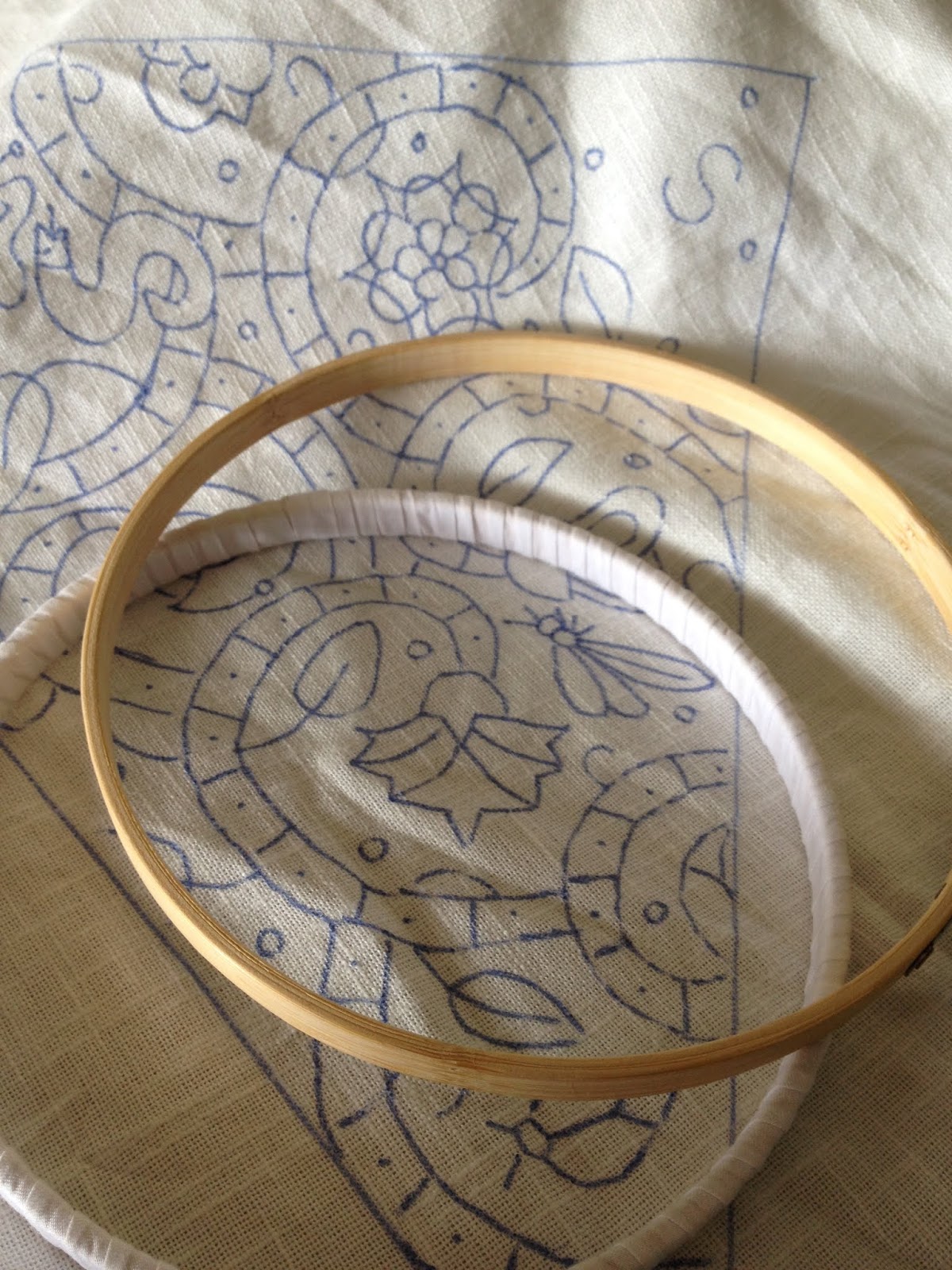
Although ink was often used in period to mark out embroidery designs, I am not confident enough about my draftsmanship to risk using ink, so I traced the design in modern water soluble ink. I taped my sketched design to a window and used the pane as a natural light box. The salamander design below, dating from around 1600, demonstrates how ink was used to mark out designs for the embroiderer to follow (V&A Collection, T.88-1925, Arnold {QEWU} p. 272).
In period, many embroiderers seemed to avoid knots and work their thread ends back into the embroidery. I have knotted my threads and then worked the thread ends back into the work, again for durability and security when the garment is machine washed.
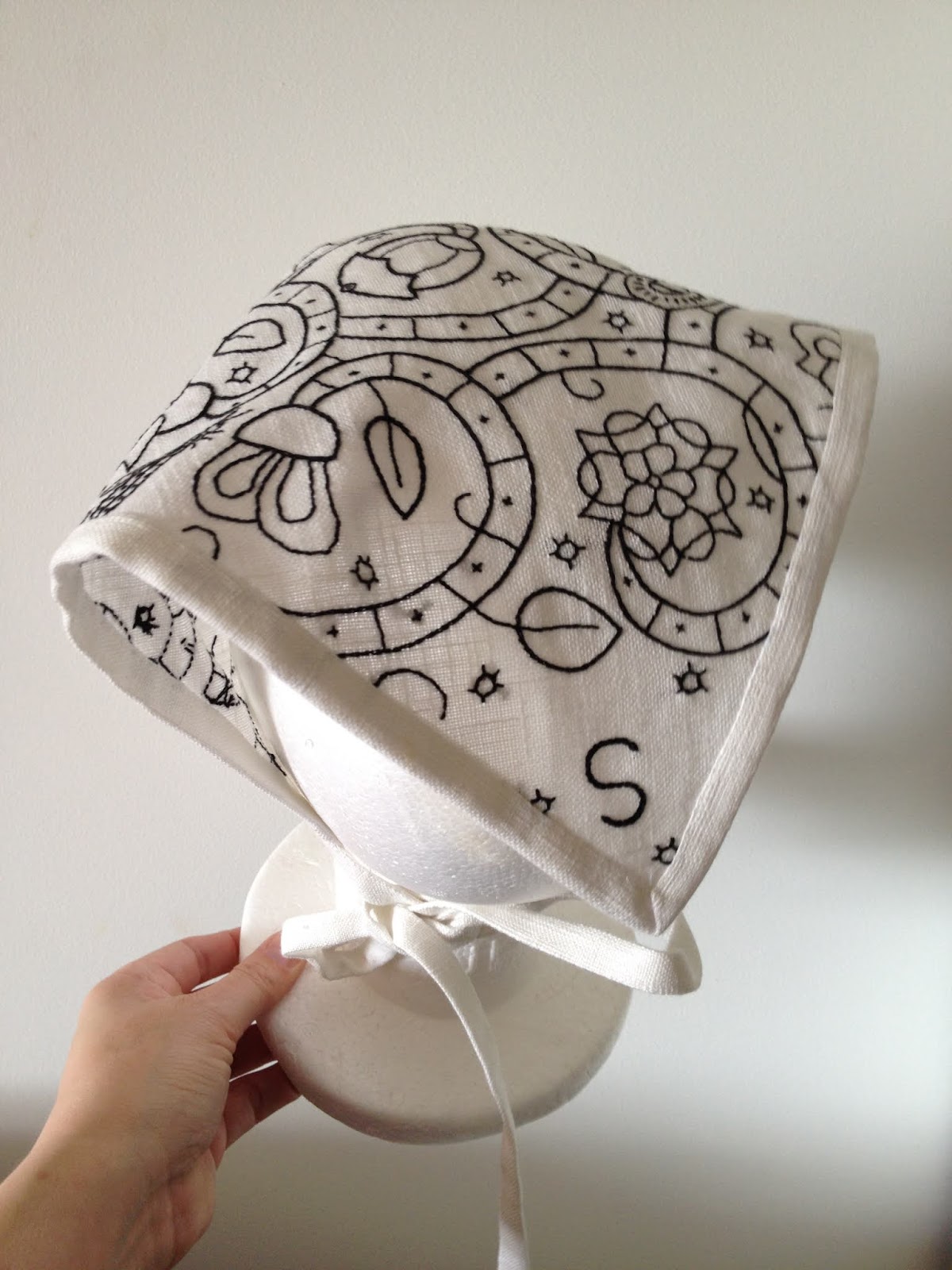
This red and gold worked coif from about 1610 shares similar attributes to mine; the colours are similar, the design goes all the way to the edges and no edging lace is used, small spangles are used, and the embroiderer seems to have anchored their stitches in places with knots. (POF4, plates 53-A.) Compare with a back view of my coif, below.

The edges of the garment were bound with natural cotton thread using a satin stitch before the garment was cut out with snips. I chose to use the snips because they were used in period, and I wanted to get a feel for the technique. I found them unwieldy, probably because I am used to modern scissors and because I was worried about making a mistake that would ruin the work. After the edges were cut, I hemmed them with natural cotton thread, and a casing was made along the lower edge for the lucet cord. The hand made cord was provided by my friend Heather Carter and was made on a wooden lucet. The side edges were ornamented with diagonal stitches. Of the coifs I have looked at, some were decorated on the edges, and some were not. Because I didn’t want to use lace on this coif, I chose to decorate the edges.
I joined the top seam with a small diagonal stitch in natural cotton, and then tried to replicate the cartridge pleats seen on the coif in Plate 52B of POF4. My pleat stitches must have been larger than those on the original because my coif has fewer pleats. Because of this, I managed to push the main part of the pleats down into the ‘hole’ created by the gathering to give a cleaner look to the area. When I copied the original in Plate 52 exactly, the result looked wrong, possibly because of the larger pleats. I secured the pleats with small stitches in natural cotton, then cut away the pleating guide stitches because they looked too big and a bit untidy. I then attempted to do the gathering cross just visible in pale green thread on Plate 52B (POF4). I used a triple securing stitch in embroidery floss, which I then buttonholed over for strength. I did the same on the smaller side arms. The extant piece seems to have a five armed knot, but the function is the same.

Plate 52B, POF4 shows a detailed picture of the top seam of a polychrome coif from around 1610, held in the Museum of Fine Arts in Boston.
Even though my pleats are larger, when I put it on, the pleats on the back of my coif do sit like this (POF4, Plate 52), detail previous page.
Reflective Notes
The coif fits, and I am quite happy with the finished product, although there are several things I would do differently if I could do it again. I am not completely happy with the tension on the blanket stitched leaves and fruit segments, and I will be interested to see how they stand up to repeated washing. I was disappointed that the diagonal lines don’t match up at the top of the coif when sewn. I thought I had been very meticulous in designing the pattern; perhaps I moved the fabric when tracing out the design on the window.
I have started a partlet with the same design in black cotton, and I have added seeding stitches inside the fruits on that project. I am glad I left the seeding off the coif- I like the clean lines. I may make a matching forehead cloth for the coif if I can match the linen fabric. Although I started researching in December 2008, I didn’t start work on the coif ‘til February 2009, so I happy to have finished it so quickly.
References
Arnold, J. 1988, Queen Elizabeth’s Wardrobe Unlock’d, W S Maney and Son Ltd, London.
Arnold, J; Tiramani, J; and Levey, S. 2008, Patterns of Fashion 4, Pan Macmillan Ltd, London.
Geddes, E and McNeill, M. 1976, Blackwork Embroidery, Dover Publications, New York.
Mikhaila, N and Malcom-Davies, J. 2006, The Tudor Tailor, B T Batsford Ltd, London.
Orsi Landini, R and Niccoli, B. 2005, La Moda a Firenze 1540-1580, Pagliai Polistampa, Florence.
Synge, L. 1982, Antique Needlework, Blandford Press, New York.
Bibliography
Like many needlework enthusiasts, I have a collection of books that I like to look through to get general inspiration for a project. Here are a few that I looked through before starting this one:
- Compleat Anachronist 115: Wrought with flowers of Black Silk, Prudence Catesby
- Compleat Anachronist 31: An introduction to Blackwork, Shoshonnah Jehanne ferch Emrys
- The Encyclopedia of Embroidery Techniques, Pauline Brown (1994, Simon and Schuster, Australia).
- Dress at the Court of King Henry VIII, Maria Hayward (2007, Maney Publishing, UK).
Credits
- I also utilised the resources at the addresses below for information on stitches used in period, and these were suggested by THL Katerina da Brescia in her article “WIP – Tuscan Camicia of the 16th Century” as published in the WCoB Newsletter, Twelfth Night 2008:
- Thanks to Lady Jane of Stockton for her articles and on and motifs from the Warwick Museum’s men’s shirt as published in various WCoB newsletters and her hints on writing documentation as published in WCoB Newsletter, November Crown Tourney 2005 as ‘Research – Don’t Panic!’
- Thankyou to Heather for the lucet cord.
- Thanks also to the Lady Ysmay de la Mor who first introduced me to stem stitch and the delights of freehand monochrome embroidery at a collegium many years ago.






.JPG)


crop.JPG)
.jpg)
.JPG)


.jpg)


.JPG)


