Showing posts with label Elizabethan headwear. Show all posts

Thursday, June 18, 2015

Elizabethan Coif Refurbishment Project

I have several Elizabethan coifs which are now too big for me, so I am gradually working on cutting them down to size and making a few changes to them.

One of the coifs that needs refurbishing

The only difficult thing about Elizabethan coifs is getting the pattern right for the wearer's head. I have found it to be purely a matter of trial and error. Playing around with paper and calico mock-ups before cutting your "good"fabric or starting your complex embroidery is definitely worth the time and effort.

In that spirit, I have been playing with patterns, and decided to make a simple coif which I hope will suit my face more than the old styles I have used before.


After working out my pattern, I cut the 'test coif'out in two layers of pre-washed white cotton voile.
I zigzgged the edges to reduce fraying, and sewed the two pieces together ("bag" fashion), leaving a small section along the bottom edge unsewn.


I turned the fabric right side out and whip stitched the bottom edge shut. Then I ironed the coif. I turned about a centimetre of the bottom edge up and did a small stab stitch to hold it in place to make a channel to thread a gathering cord through.

The next step was to put the two cheek pieces together by folding the coif down the middle vertically. 
I sewed the top edge together about two thirds of the way along with a whip stitch.

The last unsewn section of the top seam was then gathered with a tacking stitch. This is to allow a bit of space for braids or a bun at the back of the coif.


I confess, at this point, I completely forgot how to proceed. I have made several of these over the years and remembered that the gathered section is sewn up and then strengthened with buttonhole bars radiating out from where the gathers start and end (where my finger is in the picture above.) I needed a bit of a refresher on where to place the bars, but I couldn't find the book I needed. In the end I did three buttonhole bars radiating out from the centre to secure the gathering.


I will have to do this step in a bright colour next time to demonstrate the technique, because you really can't see the detail in this photo.

Once the gathers at the rear were done, I added some commercial bobbin lace with small stab stitches.


After that, I went through and did a little stitch on the edge to make sure the lace was sitting nicely.


I threaded a lucet cord (made by my friend Heather) into the casing, and the project was finished. I am quite happy with the fit, although I  may make the next pattern a centimetre longer at the bottom to cover my hairline. At least now I know which direction to head in with the coif refurbishment project!


Tuesday, July 2, 2013

Elizabethan Hood and Hairstyle

As part of my outfit for the event I recently attended, I decided to make an Elizabethan Hood. For ease of wearing, I replaced the hood with a caul. I used a Tudor hood pattern that I adapted from the one in the Tudor Tailor. I was very happy with my Tudor hood except for the fact that the buckram in the 'visor' went quite limp. The fit was good and I felt that it looked good.

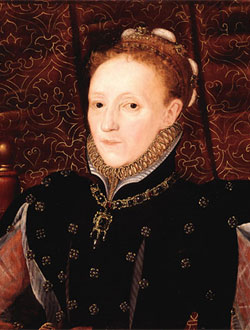
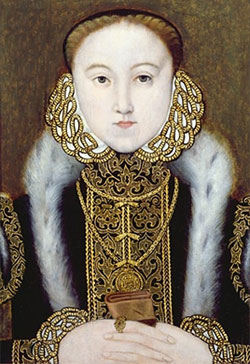
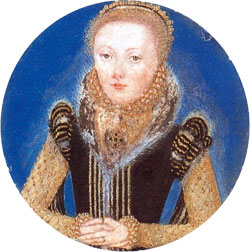
These images of Queen Elizabeth I show the sort of style I was going for, although I wanted my hood to be very understated:
Elizabeth as Princess, c. 1555.Miniature Portrait of Queen Elizabeth I c. 1565. attr. to Levina TeerlincQueen Elizabeth I, c. 1565-1570. Previously attributed to Eworth.

I cut the hood base back by about half to allow for the padded rolls of hair to be worn in front. I couldn't find my buckram, so I used two layers of stiff needlepoint canvas, a think layer of interfacing and a layer of felt. These were all stitched together and wired along the front brim. The fabric 'case' was then inserted over the top, and the caul gathered up into the back of the band. I added a billiment of beads and pearls with gold trim at the front and a piece of starched gold lace at the back. I added a wig clip inside the brim, but I didn't need to use it; the hood stayed fairly secure without it.


To do the Elizabethan rolls in front of the hat, I parted my hair horizontally just behind my ears (because my hair is very thin right now,) and barrel curled the front section. I sprayed the hair with strong hair spray and teased it. I managed to put it up over the 'hair riser' combs quite easily and smoothly. Then I pinned it behind the combs and tucked the ends into the bun that I had made with the rest of my hair. Another hefty spray of hair spray and the whole 'do' was as solid as a rock. I added a pearl drop and put on the hat. Easy.


Getting the teasing and spray out of my hair was not quite as easy. When I took the hair riser combs and pins out, my hair wanted to stay in the roll shape. I could have pinned it all back up and worn it again without the combs, it was so stiff.
Post-revel hair!

Luckily, my sister was on hand to give me some hair treatment gel that really helped. Once the hot water from the shower hit it, all the spray and tangles just eased away, and a bit of shampoo and thorough conditioning brought it all back to normal. Flat, boring, normal. I was never a fan of big, 80's hair, but I do love my Elizabethan hair!

Tools of the trade: bun clips, hair riser comb and barrel curler. Plus hairspray and pins.

One of my previous Elizabethan hair styles, done using the same techniques (just different hair accessories).

Thursday, March 15, 2012

Elizabethan Coif Pattern

Here is an embroidery design that I was playing with over the Christmas break. I know I don't actually need a new Elizabethan coif, and my 'to do/finish' pile is huge, but there is something infinitely more appealing about starting an exciting new project than working on something that has been dragging on for months! Plus, I think I like designing more than actual embroidering.

I definitely need to tweak the coif body pattern to suit my face a bit better, and you can see that there are gaps where I need to add motifs. But it has potential! I still need to decide whether to work it in monochrome or polychrome non-counted embroidery.

Friday, February 24, 2012

Red Monochrome Elizabethan Coif


Today's post is about a monochrome Elizabethan coif I made in 2010.  The main inspiration for the piece came from the following extant linen, silk and metal thread example shown in Janet Arnold's 'Patterns of Fashion 4' (below).


I used the same sort of scrolling stem design, but added different motifs. I pored over Patterns of Fashion, Queen Elizabeth's Wardrobe Unlocked, and all my reproduction sixteenth century pattern books with Elizabethan-style motifs, and picked a variety of motifs that I thought went well together. I kept a reference as I drew up the pattern so that I would have a record of where the motifs were sourced from.


I traced the design out in water soluble ink. For this project, I remembered to keep a record of how long the stitching took. The picture above shows approximately fifty hours of stitching (not including pattern design, tracing out etc.)

The stitching was done predominantly in double running stitch because I need practice in that stitch.

When the embroidery was done, I washed the coif in a gentle wool wash, rinsed, and gently blocked the fabric on a clean towel.


Here is the piece ready for metallic threads and spangling


The ground fabric is a lovely mid-weight linen, and the stitching was done in red DMC cotton floss and silver metallic thread. The spangles are a silver gilt metal and were sewn on with three stitches.

The back of the piece showing knotted and woven threads


In previous posts, I have gone into a great deal of detail about construction and design of coifs in Elizabethan times. Please refer to the post on my red striped coif for more information.


As you can see, I knotted AND wove the thread ends in on the back of the piece. I was not sure how the recipient would choose to launder the coif, and I wanted it to be durable.

There are small areas of other stitches, such as seeding, speckling, satin, stem and running stitch.

The piece after metal spangles were added
Below are some close up shots of the stitching. You can see that the metallic silver thread was added in a single running stitch in the centre of the stems.


The images below are scanned from 'Patterns of Fashion 4' and show extant sixteenth and early seventeenth century English coifs.
The centre top seam is sewn and then gathered  for about a third of the distance to allow for a bun or hair taping

This picture shows the gathering stitches at the crown of one of the coifs

This image shows tapes tying the coif in place in front of the bun or hair taping
I added a lining to the coif to protect against hair oils. The lucet cord ties were hand made by Heather.

I will post more pictures of the finished article next time!


Monday, February 13, 2012

Shaped Lilac Coif

Here is another one of my early attempts at an Elizabethan shaped coif. It is embroidered in DMC cotton floss on a cotton base fabric. The embroidery is predominantly stem stitch. The spangles are silver gilt, attached with four threads. Sewing spangles on with three stitches is more common, but there are extant examples of Elizabethan embroiderers securing spangles with four stitches. I suppose that, like me, they wanted their work to stand up to lots of washing and use.

The design is my own, but the motifs are all taken from period model books and extant embroidery examples from the sixteenth century. There is a line of commercially made cotton bobbin lace around the front of the coif, ornamented by small pearls. The coif is lined to prevent hair oils from affecting the embroidery.


More detailed information about Elizabethan coifs can be found in my earlier post on the red striped coif.


Thank you to Heather for the lucet cords.

Saturday, February 11, 2012

Red Monochrome Shaped Coif

Today's picture is another shaped coif, this time with a red monochrome design. The base fabric is a cotton/linen blend, and the design was worked in stem stitch in DMC cotton floss. The design is one of my favourites, and one that crops up again and again in sixteenth century pattern books, including Modelbuch Aller Art.


I worked a simple needle lace around the front edge of the coif. Thankyou to Heather for the hand made lucet cords.


My previous post on my Elizabethan red striped coif has much more information about Elizabethan coif use, decoration and construction. 

Friday, February 10, 2012

Blue vine shaped coif


Today's picture is of one of my very early attempts at a coif. It is a shaped coif (rather than gathered) and is made of a base fabric of cotton. It is embroidered with a simple design in DMC floss. The design is worked in stem stitch, and there is a line of running stitch through the lace.

I adapted the design from several similar designs in Modelbuch Aller Art. It is hand sewn with purchased cotton bobbin lace around the face area. Lucet cord ties were hand made by Heather. I have found shaped coifs to be very comfortable to wear over short hair that can't be hair taped.