Today I finally finished doing the seams on my ex-quilt cover, cheap test-run smock. I cut the neckline a bit wide so had to put in a couple of little pleats (which I would probably do again anyway as it sits nicely & is comfortable).
I ended up sewing the hem on the machine. I will re-do it by hand, but I need to wear it on the weekend and won't get time before then. The second hand quilt cover is nice soft fabric and feels cosy. I'm pleased with how neat the felled seams look, and I will definitely put the time and trouble in to do this again on future garments. I suspect that it will prolong the life of the garment too.
Elizabethan, Tudor and Renaissance inspired embroidery, clothing and accessories - historical costuming, embroidery and re-creation
Showing posts with label Elizabethan smock. Show all posts
Thursday, June 22, 2017
Wednesday, June 7, 2017
A&S Century Challenge - Hand finishing smocks
Two smock drafts (slightly different styles) cut out and partly sewn by machine. I need to find the time to hand finish them, so that will probably keep me busy (at least) for the next several days. Illness is making me slow and sluggish at the moment.
Tuesday, June 6, 2017
A&S Century Challenge - Budget Sixteenth Century Undergarments
I'm still sick, so everything lately has been extra challenging.
On Saturday I went to a scribes meeting and learnt about gilding manuscripts and made a start on a new scroll.
I had an inspiring & productive A&S/training on Sunday, and came home feeling exhausted (but motivated). Lots of follow up stuff to do after that one, including paperwork.
Yesterday I faffed around adapting patterns for a little while; a task I always find challenging.
Today I grabbed a couple of minutes to cut out a test run fitted smock from an old cotton quilt cover. I have always made Italian style camicias, but sometimes they can be a little bulky for more fitted styles of late period clothing. I'm always nervous when cutting fabric, but I'm not worried today because I got this quilt cover at the op shop for $3. I should get 2 undergarments from it.

I'm looking at making a modified version of (g) - smock with simple hemmed neck and sleeve.
Image from The Tudor Tailor, reproduced at https://s-media-cache-ak0.pinimg.com/564x/a6/9f/58/a69f582207ca2d77815540ae11de6988.jpg
On Saturday I went to a scribes meeting and learnt about gilding manuscripts and made a start on a new scroll.
I had an inspiring & productive A&S/training on Sunday, and came home feeling exhausted (but motivated). Lots of follow up stuff to do after that one, including paperwork.
Yesterday I faffed around adapting patterns for a little while; a task I always find challenging.
Today I grabbed a couple of minutes to cut out a test run fitted smock from an old cotton quilt cover. I have always made Italian style camicias, but sometimes they can be a little bulky for more fitted styles of late period clothing. I'm always nervous when cutting fabric, but I'm not worried today because I got this quilt cover at the op shop for $3. I should get 2 undergarments from it.

I'm looking at making a modified version of (g) - smock with simple hemmed neck and sleeve.
Image from The Tudor Tailor, reproduced at https://s-media-cache-ak0.pinimg.com/564x/a6/9f/58/a69f582207ca2d77815540ae11de6988.jpg
Thursday, February 9, 2012
Short-sleeved Elizabethan Smock
Today's picture post is of a sleeve that I started last year. I saw the Helen Mirren portrayal of Elizabeth I and was transfixed by the opening scene where she gets undressed for her examination by the court physician. You may have noticed that her smock sleeves are relatively short and that she has sleeve ruffs attached to her outer sleeves. I thought this would be a great idea for use under my gowns with heavy outer sleeves, so I started a (relatively) short-sleeved smock. Here is a picture of the completed first sleeve:
The embroidery motifs are worked predominantly in double running stitch in maroon cotton floss on a cotton base fabric. These varied plant and animal motifs were very popular in Elizabethan times, when exciting new botanical and animal discoveries from the New World were fashionable subjects for embroidery and decoration. A shift decorated in a similar way from about the 1630's is in the collection at the V & A Museum (http://collections.vam.ac.uk/):
As you can see, I have used several of these motifs in part or whole. The rest of the designs I used were taken from contemporary Italian or English extant embroideries, except for some of the smaller insects which were my own creation (but inspired by extant examples.)
Fans of 16th Century historical embroidery will probably recognise motifs from 'A Scholehouse for the Needle' as well as designs from some of the garments in Janet Arnold's 'Patterns of Fashion 4'.
From extant sixteenth century embroideries, it is evident that many embroiderers did not use knots on their work, preferring to weave the threads back into the back of the design. I wash my smocks and chemises in the washing machine, so I use knots and weave the thread ends in for greater durability.
| Here you can see the back of the sleeve embroidery |
| The back of the chameleon |
Many of my personal embroideries have the same motifs showing up in one form or another; most notably the heartsease (pansy/viola), strawberries and snails. I am now also a big fan of this chameleon, butterfly and bird:
Although I wouldn't rule out using him again, I do find that owl kind of creepy!
I will reverse the design for the other sleeve. I probably will not decorate the whole body of the smock, but may add some designs in the upper torso area.
Tuesday, January 17, 2012
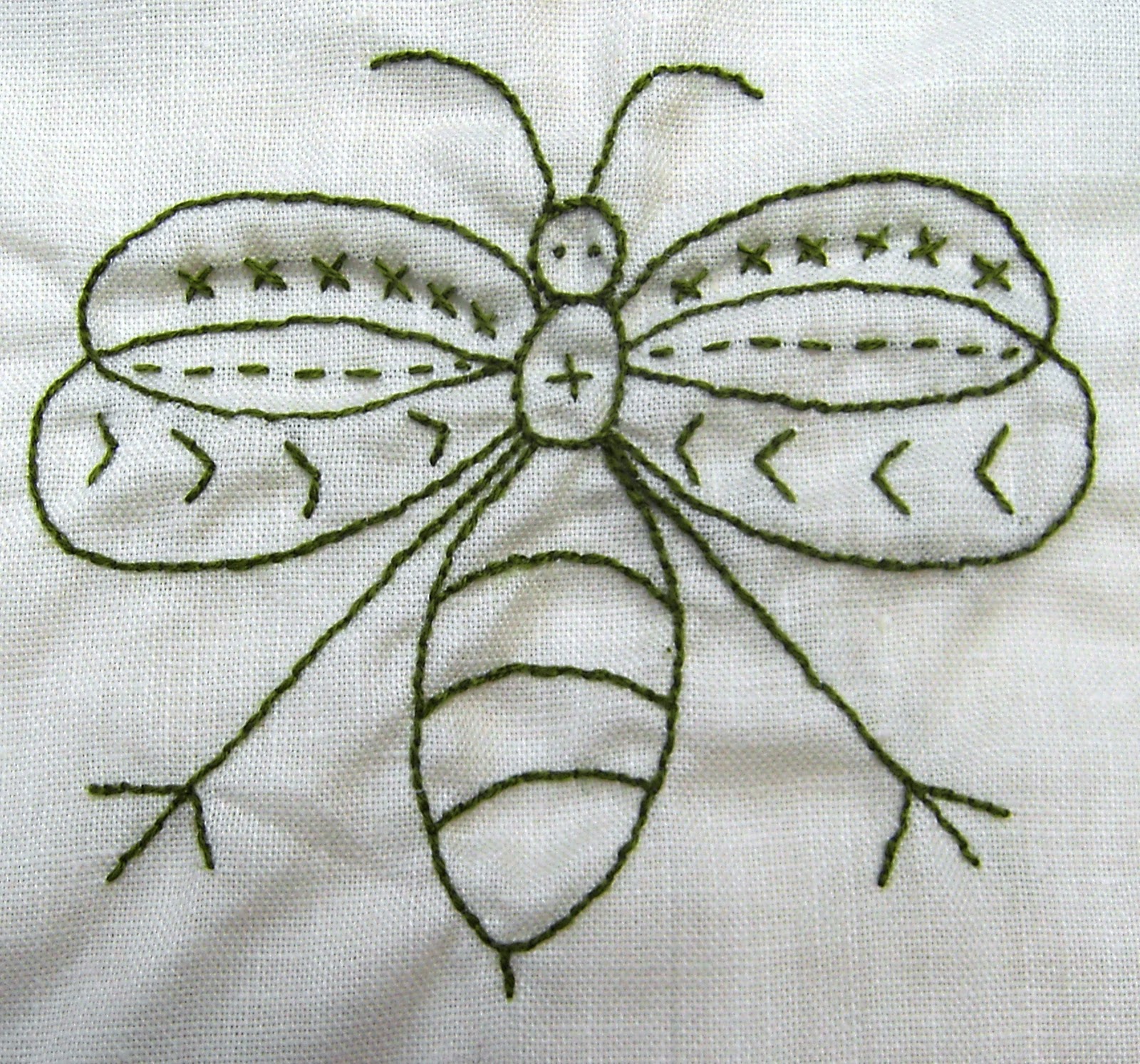
Elizabethan wasp smock
Here is another project from the to-do pile. It is a low necked Elizabethan smock, made out of rectangular and square panels of natural linen. The panels have not been assembled yet, but I plan to finish each panel separately (after the embroidery is finished) and then whip them all together.
Honestly, I had forgotten all about this project! I am glad that I wrote it up for today's entry. I will try and finish this smock this year - the little wasps make me smile.
Monday, January 16, 2012
Grey flower motif chemise
I finished this chemise a few years ago. It is made of light cotton gathered into a bias binding neckline. The sleeves are decorated with flower designs inspired 'A Scholehouse for the Needle' and by the Warwick shirt. 'A Scholehouse' was a pattern book drawn by Richard Shorleyker (1632.) It contains many designs that exist in pattern books printed at various times in the sixteenth century. The Warwick shirt is an extant example of Elizabethan monochrome embroidery* (done in red). It It has some beautiful designs on it, and can be seen here:
* also called as 'linear blackwork' or 'single-colour, non-counted blackwork'
http://www.warwickshire.gov.uk/web/corporate/pages.nsf/links/aa47f702d5996adc80257149002da95e
The shirt is part of the collection of the Warwickshire Museum:
http://www.warwickshire.gov.uk/museum
You can see a very interesting article, including some designs from the shirt, here:
http://knol.google.com/k/elizabethan-blackwork-embroidery#
The sleeves on my chemise are very big and are designed to be puffy enough to allow them to be pulled out through slits in split sleeves. When worn without an oversleeve, they flow over my hands:
As with most of my clothes, the chemise is used for both Italian styles and under my Elizabethan loose gowns. The designs are worked in grey DMC cotton in a range of stitches, including buttonhole stitch, seeding stitch, stem stitch and double running stitch. All visible seams were handsewn, except for the hem.
| The sleeve laid out before sewing (the white tiles underneath are showing through the thin fabric.) |
* also called as 'linear blackwork' or 'single-colour, non-counted blackwork'
Subscribe to:
Posts (Atom)