Thursday, January 30, 2020

Embroidery Designs - Holly Berries

I was recently reflecting on embroidery designs and decided that I would like to have more items decorated with my heraldry and with holly. Luckily, holly berries (or, at least, berries that could be holly) seem to have been quite a popular sixteenth century motif and I didn't have any trouble finding several designs.

From The Trevellyon Miscellany (1608) available on Pinterest

From The Trevellyon Miscellany available on Pinterest

From The Trevellyon Miscellany available on Pinterest

From The Trevellyon Miscellany (1608) available on Pinterest
  
From A Scholehouse for the Needle (1632),  individual pages reproduced on Pinterest
           

From A Scholehouse for the Needle, individual pages reproduced on Pinterest

An extant coif c. 1590 held in the V&A Museum, London


Embroidered panel c. 1600 available at Pinterest and held by the V&A Museum 


Coif decorated with currants or holly held by the Embroiderer's Guild London and reproduced in Elizabethan Stitches by Jacqui Carey ISBN 978-0-9523225-8-0, p. 84

Design from 'Ein New Kunstlich Modelbuch' by Peter Quentel c.1544, page 13r
Available at The Metropolitan Museum https://www.metmuseum.org/

Tuesday, January 28, 2020

Embroidered Collar and Cuffs with Pony Detail for a Knighting Gift

Last year I was honoured to attend the elevation of a friend to the Chivalry. I wanted to make a small gift as a memento of the occasion. I decided that embroidered collar and cuff panels for a shirt would be appropriate.

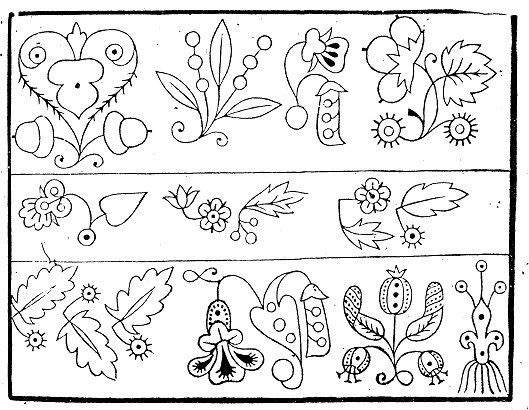
I based my design on a band from the Trevelyon Miscellany(1608); a modelbuch for artists which has a breathtaking array of designs just crying out to be embroidered. I copied the design, and simplified it as well as adding in pony's heads - an element of the recipient's heraldry. I traced the design out onto tracing paper. I photocopied the design and reduced it in size so that the same basic design was used for collar and cuffs (but smaller in size on the cuffs). I then modified the design slightly so that it would fit into the size panel required to go around the wrist.
I traced the design onto my base fabric using a window as a light source and a Frixion marker.
The base fabric is linen and the embroidery worked in Guterman silk in split stitch.
Sometimes you just need to take a break and rest the eyes and re-energise! 
The project was a little challenging as I was on a strict time deadline and I was still having issues with my wrist and hand from the injury in Nov 2018 and my underlying health problems. My stitching is not as fine or as accurate as I would like, which is disappointing. It also took at least twice as long as my usual slow pace.
I love designing embroideries, but I think my favourite moment is when the marker is ironed away and the stitches remain.
The finished piece. I left it in a single panel so that the pieces cannot be lost until it is made up into a garment, and because people make shirts slightly differently and I wanted to allow plenty of fabric for turning under. (Base fabric is zigzag stitched on the edges for durability until it is cut into panels.)

I also can't recommend Modelbuch Muse enough - it is a wonderful information base relating to Renaissance dress as well as lovely embroidery designs to try: https://www.facebook.com/modelbuchmuse/

Portrait photo credits: S.J. Taylor - many thanks!

Monday, January 20, 2020

Award Cords Completed and Sent

My first lot of award cords are finished and have been delivered. I enjoyed experimenting with different braiding styles and I will continue to work on these when I have time as I imagine that the Crown and Barons and Baronesses always require award cords.

Friday, January 17, 2020

A time of reflection...

I hope that you all had a happy and productive festive season and (hopefully) a nice break. Here in Australia, December is the end of the school and college/university year, and many businesses close over Christmas to give their employees annual leave. It can be a strange time of year if you get to enjoy the break. It also tends to be a reflective time for me; time to think about the year that has passed and to start making plans for the new one.

This particular Christmas break has been less festive than usual due to the terrible bushfires ravaging many parts of Australia. I am lucky to have only been impacted by mild smoke and this time didn't even have to pack the car in preparation to evacuate. However, many friends have lost homes and belongings. As a former wildlife carer, the knowledge of what the wildlife has suffered and the impact on ecosystems is just devastating, and events have certainly impacted the mood of most people that I know.

I have been surprisingly unproductive over the break, even for me! Last year was horrible for me in relation to my health, and my responsibilities and obligations have been weighing heavily on me of late (as well as current affairs). I did a lot of planning and researching, but not much actual sewing or crafting. It was actually good to take a break.

As usual, I have an almost never-ending list of projects that I want to start, or things that are waiting to be finished. I am prioritising things for other people, and I am very aware that there are a lot of projects waiting to be blogged.

I got some lovely Christmas gifts, which made me feel very spoiled. I collect acrylic and enamel brooches and pins, and I got some of those. I also got some books and fabric, so I was very very happy. (Honestly, just being safe and enjoying good food and friends and family would have been enough, given what so many Aussies are going through at the moment.)

I got this book for Christmas, and I am looking forward to continuing my cord making experiments during the year.


Wednesday, January 1, 2020

Happy New Year!

Wishing you all a happy and healthy year in 2020. May all your projects be speedily and satisfactorily completed!

Wednesday, December 25, 2019

Monday, December 9, 2019

Award Cord Project

Paperwork and admin has been keeping me busy lately. I haven't had much time, but I have been able to be able to continue working on the award cord project. The ones below are simple three strand braids. It is a simple technique but effective. The tension is quite tight, which results in a firm braid, and the result is nice.


Sunday, December 1, 2019

Embroidery Designs

I've been unwell again of late and so haven't been as productive as  I would have liked. One thing that I have enjoyed though, is doing some blackwork designs. I really enjoy the design process, and love looking at portraits and extant pieces and drawing up designs based on what I have seen. I recently drew up a coif design (that I absolutely adore!) for a friend, as well as a couple of partlet designs and some Elizabethan coif designs. I find it very soothing. (Tracing the design out - not so much! But a gift of a lightboard has made that part of the process a bit smoother too.)


Monday, November 18, 2019

A Woolen Tunic with Short Sleeves

Back in June when I made the long sleeve woolen tunic for a friend, I also made a short-sleeved one. The wool was lovely to work with; no fraying and beautiful to hand sew. I used the same 'pattern' as the previous tunic - basically just rectangles, squares and triangles. The main body is two rectangles. The sleeves are four rectangles. There is an underarm gusset which is a square, and triangles of fabric are added into the 'skirt' to add fullness.

I don't know the artist of this particular pattern but it is a good indicator of how the layout of my tunic looked. I didn't use a faced neckline because the wool was quite bulky, but the rest of the layout is very similar. I measured the wearer's body and added a little extra for ease of movement plus seam allowances.
I sewed the long seams by machine.
Once the seams were sewn, I whipped the seams open and down.
I added a supportive placket around the collar split so that the pressure of normal wearing wouldn't end up ripping the split at the front.
The rest of the neckline was turned down with a small hand-sewn hem to reduce bulk.


I left this tunic plain so that the recipient could sew trim on if he wanted. I have yet to get a photo of him wearing it, but it looks nice on.


Friday, November 15, 2019

Heraldic Favour

Another project that I completed recently was a heraldic favour. It is a simple sash with a representation of my device embroidered on it.
 I marked the design out by tracing it with frixion marker.
I embroidered the design with split and satin stitch. I tried to add some texture to the satin stitch. I added a shiny black bead for the eye.
 I sewed the panel into a sash and added some gold braid at the bottom.
I made the pin by adding a hat pin to a purchased heraldic seahorse pendant.

Wednesday, November 13, 2019

Indoor Heraldic Banner

As well as a silk banner, I made an indoor heraldic banner for  my friend.

I used velveteen as the base material and cotton broadcloth for the backing. I usually pre-rinse my fabric in hot water and dry and iron it before starting a project.

I enlarged the owl shapes and cut them out of felt (which I also used for the band across the top). I like using wool felt because it is easily available and doesn't fray.

I whip stitched the felt down and then embroidered over the edges. I couched a piece of gold cord across the edge of the band across the top.


 I embroidered on the details of the owls.

 I gave the owls multi-layered felt eyes to give a sense of depth.


Once all the details were done, I put the backing fabric and the embroidered velveteen panel face to face and machine sewed around most of the edges. I left a small section un-sewn. I clipped the corners to reduce bulk and then turned the banner right side out, pulling it through the un-sewn section. This technique is called 'bagging out' and is useful for sewing banners. It is important to make sure that the inside seams are sitting nicely; I run a bone turner or blunt knitting needle along the seams on the inside.

The final steps involved hand-sewing the smalls section shut and then turning a section of the top down and towards the back to make a hanging rod pocket. I whipped the section down, making sure my stitches did not show through on the front of the banner.

Finally, I sewed a section of creamy gold onto the bottom of the banner to finish it off.

Good starting points for researching medieval banners include:
https://en.wikipedia.org/wiki/Heraldic_flag
http://www.larsdatter.com/banners.htm
https://www.southerntailors.com/blog/the-origin-and-evolution-of-the-gonfalon/
https://www.theheraldrysociety.com/articles/heraldry-in-italy-during-the-middle-ages-and-renaissance/
https://www.southerntailors.com/blog/the-origin-and-evolution-of-the-gonfalon/