If you are after some out of period costuming inspiration, have a look at the Your Wardrobe Unlock'd costuming competition entries for 2013:
http://yourwardrobeunlockd.com/competition/2013-competition-entries
Thursday, February 28, 2013

Wednesday, February 27, 2013
First Attempt At Illumination
This week I finished my first try at illumination.The experience reminded me of painting on sugar plate, but the colours are much bolder.


A Dragon from a Bestiary c. 1270 (Therouanne?)
JPGM, Ms. Ludwig XV 3, folio 89
p. 90, 'Beasts' by Elizabeth Morrison, 2007, J Paul Getty Trust
I found the experience to be very enjoyable, and I learned a lot from my first attempt.
* Medieval scribes must have been very patient people with an enormous skill base, tons of patience and steady hands.
* You should not get overexcited and try to rush this type of work. (I know this from embroidery, but I'll admit that I did get overexcited and rush it!)
* Doing scribal work at the kitchen table in a busy household during the afternoon/tea time rush is not ideal.
* I need a finer paintbrush.
I used Winsor and Newton Designers Gouache as recommended by the Lochac Scribes (www.sca.org.au/scribe/ and http://www.sca.org.au/scribe/handbook/Lochac%20College%20of%20Scribes%20Handbook%202012.pdf)
I am still enthusiastic, and plan to continue practicing in my sketchbook. I love the fact that you can get such a bold and dramatic effect relatively quickly; well, compared to embroidery, anyway. I chose this particular picture because it looks like the original artist used a paintbrush to draw the black lines, and I thought that would be very good practice for me. (Plus, I liked the dragon.) I have a lot of trouble with shaky hands, but I am reasonably happy with how the lines turned out. Learning how to load the brush with an appropriate amount of paint is another thing that I need to learn.
My introduction to the scribal arts has been the very talented Honorable Lady Katerina da Brescia of the Purple Files. You can see some of her work here:
http://katerina.purplefiles.net/art&scribes/C&I.htm


A Dragon from a Bestiary c. 1270 (Therouanne?)
JPGM, Ms. Ludwig XV 3, folio 89
p. 90, 'Beasts' by Elizabeth Morrison, 2007, J Paul Getty Trust
I found the experience to be very enjoyable, and I learned a lot from my first attempt.
* Medieval scribes must have been very patient people with an enormous skill base, tons of patience and steady hands.
* You should not get overexcited and try to rush this type of work. (I know this from embroidery, but I'll admit that I did get overexcited and rush it!)
* Doing scribal work at the kitchen table in a busy household during the afternoon/tea time rush is not ideal.
* I need a finer paintbrush.
I used Winsor and Newton Designers Gouache as recommended by the Lochac Scribes (www.sca.org.au/scribe/ and http://www.sca.org.au/scribe/handbook/Lochac%20College%20of%20Scribes%20Handbook%202012.pdf)
I am still enthusiastic, and plan to continue practicing in my sketchbook. I love the fact that you can get such a bold and dramatic effect relatively quickly; well, compared to embroidery, anyway. I chose this particular picture because it looks like the original artist used a paintbrush to draw the black lines, and I thought that would be very good practice for me. (Plus, I liked the dragon.) I have a lot of trouble with shaky hands, but I am reasonably happy with how the lines turned out. Learning how to load the brush with an appropriate amount of paint is another thing that I need to learn.
My introduction to the scribal arts has been the very talented Honorable Lady Katerina da Brescia of the Purple Files. You can see some of her work here:
http://katerina.purplefiles.net/art&scribes/C&I.htm
Tuesday, February 26, 2013
New IRC Challenge Announced
Lovely Lady Bella from Realm of Venus has announced a new Italian Renaissance Costuming Challenge. Head to
http://realmofvenus.renaissanceitaly.net/challenges/IRCC2013/IRCC3-2013.htm
for more information.
I am planning on entering; I am getting organised and working out what I have in my stash - and what I need!
Friday, February 22, 2013
Plimoth Jacket Project link
Here is an interesting page on the gorgeous reproduction of the Plimoth Jacket-
http://www.winterthur.org/?p=972

One day I will make an embroidered jacket for myself.
http://www.winterthur.org/?p=972
One day I will make an embroidered jacket for myself.
Thursday, February 21, 2013
Unpicking my Italian gown and Elizabethan coat
I started two sewing projects mid to late last year; an Italian front lacing gown (in blue) and an Elizabethan coat (in grey). I worked on them yesterday but I'm afraid my fatigue and brain fog was so bad that I spent more time un-picking and re-sewing and ironing than actually achieving anything. On the plus side, I am getting very good at unpicking!
Monday, February 18, 2013
Illumination research
It was at least 100 degrees today, so no stitching for me. I have piles to do, but mundane life got in the way. I did get a chance to have a look at a couple of illumination books, but I have not yet picked something to do as a scribal exemplar.
Sunday, February 17, 2013
Scribal Meeting
I have been thinking about getting involved in my local SCA scribal group for quite a long time. Recently, the meetings were moved closer to my house, and so yesterday I took the opportunity to go to my first meeting. It was very interesting and exciting. I think that calligraphy is a bit beyond my skills at this stage, but I am excited about trying the illumination. The process seems very similar to the design process for embroideries, which I really enjoy. It was a lot of fun to really look closely at the pictures of manuscripts and enjoy the imaginations of those old scribes. This one below really took my fancy:

It illustrates the old riddle about the man trying to get his turnips, his lamb and a wolf across a river in the boat without anyone getting eaten. This is from the thirteenth century- early fourteenth century Ormesby Psalter -
http://ductus.asu.edu/Files/ductus/scriptorium/plates/D-005.html
It illustrates the old riddle about the man trying to get his turnips, his lamb and a wolf across a river in the boat without anyone getting eaten. This is from the thirteenth century- early fourteenth century Ormesby Psalter -
http://ductus.asu.edu/Files/ductus/scriptorium/plates/D-005.html
Saturday, February 16, 2013
Yummy OP shoes from American Duchess
As you know, my preferred historical re-creation period is the sixteenth century. But the luscious shoes at American Duchess regularly make me reconsider my choice of time period. Check out their new releases at the link below. (And take a peek at their to-die-for Marie Antoinette shoes while you are there!)

Friday, February 15, 2013
Making Buckram from Linen
The Tailor's Apprentice posted this on Facebook yesterday:
A fabulous tip on how to make buckram from the @Abigal's Closet group...
"BUCKRAM.............We always have people ask us about buckram, concerned that they have to have some special textile. In the 18th century buckram was used typically in men's clothing. It gave stiffness and shape especially in things like coats. Provided strength for weak places like button holes, button stand and pleat points. You can make your own buckram with ease. A variety of quality in linens were used. Typically unbleached being the least expensive linen. Get out your scrap bag or buy an extra 1/4 yard next time you get linen from us. The trick is to have a bottle of GUM TRAGACANTH in your stash. (see below link) Slather it on both sides and let it dry. Do as
many layers as you think for the stiffness you require. That's all there is to it. Good Luck!!"
This sounds like a relatively easy process, although gum tragacanth can be hard to get here in South Australia. I have a couple of metres of commercially produced buckram currently in my stash (and would prefer to use my dwindling supplies of gum tragacanth for sugarplate), but if any of the readers have tried this, please let us know your results!
A fabulous tip on how to make buckram from the @Abigal's Closet group...
"BUCKRAM.............We always have people ask us about buckram, concerned that they have to have some special textile. In the 18th century buckram was used typically in men's clothing. It gave stiffness and shape especially in things like coats. Provided strength for weak places like button holes, button stand and pleat points. You can make your own buckram with ease. A variety of quality in linens were used. Typically unbleached being the least expensive linen. Get out your scrap bag or buy an extra 1/4 yard next time you get linen from us. The trick is to have a bottle of GUM TRAGACANTH in your stash. (see below link) Slather it on both sides and let it dry. Do as
many layers as you think for the stiffness you require. That's all there is to it. Good Luck!!"
This sounds like a relatively easy process, although gum tragacanth can be hard to get here in South Australia. I have a couple of metres of commercially produced buckram currently in my stash (and would prefer to use my dwindling supplies of gum tragacanth for sugarplate), but if any of the readers have tried this, please let us know your results!
Thursday, February 14, 2013

Tuesday, February 12, 2013
Bean Boobs
For those of us without a duct-tape dress dummy, here is a great suggestion from American Duchess on how to make a standard dressmaking dummy more 'shapely' in the bust department:
http://americanduchess.blogspot.co.uk/2012/07/v185-polonaise-jacket-of-doom-and-hell.html
http://americanduchess.blogspot.co.uk/2012/07/v185-polonaise-jacket-of-doom-and-hell.html
Monday, February 11, 2013
Costume-based Movie Review Site
Here is a link to Frocktalk, an interesting costume-based movie review site:
http://frocktalk.com/?p=4406

One of Colleen Atwood's designs for the Snow White and the Hunstman Movie
taken from: http://www.100jewelers.net/fashion-advisor/colleen-atwood-designed-snow-white-and-the-huntsman-costumes
http://frocktalk.com/?p=4406
One of Colleen Atwood's designs for the Snow White and the Hunstman Movie
taken from: http://www.100jewelers.net/fashion-advisor/colleen-atwood-designed-snow-white-and-the-huntsman-costumes
Sunday, February 10, 2013
Portrait by Catena
Today I was excited to find this portrait (which I had never seen before) of a very high waisted Italian gown. The 'Portrait of a Young Woman' is by Catena (Vincenzo di Biagio) circa 1505.

from: http://theredlist.fr/wiki-2-351-861-414-398-426-view-cinquecento-profile-catena-vincenzo-di-biagio.html
Saturday, February 9, 2013
Portrait of Henry VIII
I found this portrait of Henry VIII on Pinterest recently. Not much information was given except for a tentative date of 1535. If this date is correct, it is interesting to see Henry as he looked when Anne Boleyn was in love with him.


Friday, February 8, 2013
The Restoration of Gentileschi’s David and Bathsheba
The restoration of Artemisia Gentileschi’s David and Bathsheba at
http://www.advancingwomenartists.org/unveiling-exhibitions.php

Artemisia in a self-portrait depicting herself as the Allegory of Painting
1638-39
from: http://en.wikipedia.org/wiki/File:Self-portrait_as_the_Allegory_of_Painting_by_Artemisia_Gentileschi.jpg
Thursday, February 7, 2013

Wednesday, February 6, 2013
The Fruit Seller - Must Make This!
Oh oh. Another item to add to the 'Must Make This' List. I LOVE that partlet.
And her hair-do.
And, come to think of it, I am pretty keen on that dress too!

The Fruit Seller by Vincenzo Campi - from http://ghpoetryplace.blogspot.com.au/2010/06/cherry-ripe.html
Tuesday, February 5, 2013
Richard III's remains identified
10:45AM GMT 04 Feb 2013
From: The Telegraph
http://www.telegraph.co.uk/news/uknews/9846722/Richard-III-remains-found-in-Leicester.html
"Scientists say they have found the 500-year-old remains of England's King Richard III under a parking lot in the city of Leicester.
University of Leicester researchers say tests on a battle-scarred skeleton unearthed last year prove "beyond reasonable doubt" that it is the king, who died at the Battle of Bosworth Field in 1485, and whose remains have been missing for centuries.
"Richard III, the last Plantagenet King of England," has been found," said the university's deputy registrar, Richard Taylor.
Osteologist Jo Appleby said Monday that the study of the bones provided "a highly convincing case for identification of Richard III."
And DNA from the skeleton matches a sample taken from a distant living relative of Richard's sister."

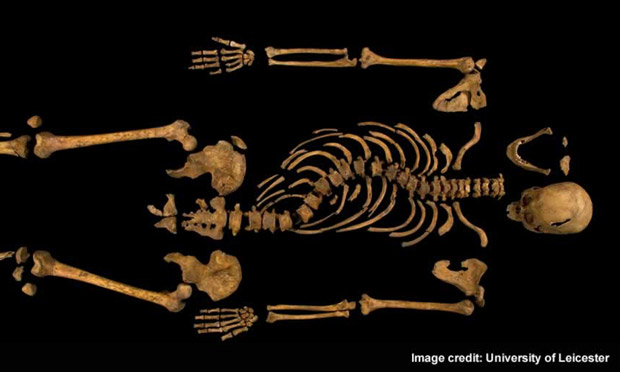
The skeleton of Richard III. Photograph: University of Leicester from http://www.guardian.co.uk site.
Find more interviews and news on the subject here:
http://www.guardian.co.uk/science/blog/2013/feb/04/richard-iii-skeleton-last-plantagenet-king-live
http://www.dailymail.co.uk/sciencetech/article-2201744/King-Richard-III-Search-body-finds-human-remains-grave-stood-1612.html
http://www.news24.com/SciTech/News/Bones-hold-clue-to-King-Richard-III-20121015
From: The Telegraph
http://www.telegraph.co.uk/news/uknews/9846722/Richard-III-remains-found-in-Leicester.html
"Scientists say they have found the 500-year-old remains of England's King Richard III under a parking lot in the city of Leicester.
University of Leicester researchers say tests on a battle-scarred skeleton unearthed last year prove "beyond reasonable doubt" that it is the king, who died at the Battle of Bosworth Field in 1485, and whose remains have been missing for centuries.
"Richard III, the last Plantagenet King of England," has been found," said the university's deputy registrar, Richard Taylor.
Osteologist Jo Appleby said Monday that the study of the bones provided "a highly convincing case for identification of Richard III."
And DNA from the skeleton matches a sample taken from a distant living relative of Richard's sister."
Image of Richard III of England from: news.com.au
The skeleton of Richard III. Photograph: University of Leicester from http://www.guardian.co.uk site.
Find more interviews and news on the subject here:
http://www.guardian.co.uk/science/blog/2013/feb/04/richard-iii-skeleton-last-plantagenet-king-live
http://www.dailymail.co.uk/sciencetech/article-2201744/King-Richard-III-Search-body-finds-human-remains-grave-stood-1612.html
http://www.news24.com/SciTech/News/Bones-hold-clue-to-King-Richard-III-20121015
Monday, February 4, 2013
High-necked Partlet Silk Embroidered Panel
Recently I finished another collar panel. It was originally intended as a gift, but I made too many mistakes in the stitching to be content to give it away. It will probably end up going on a high necked Elizabethan partlet for me.


The piece is sewn in Guterman silk on white linen. The non-counted blackwork is worked in two strands of silk in a double-running (Holbein) stitch.
The design comes from Modelbuch Aller Art.I traced the original design onto tracing paper and then modified it to fit the panel size that I needed. Then I taped the design to a window and traced it out in dissolvable fabric marker pen. I worked the piece in a hoop.


I am considering whether to add seeding stitches to the insides of the motifs so that the embroidery has more effect.
Wednesday, January 30, 2013
'Lost' da Vinci Portrait
 From - livescience.com October 16, 2011
"Christie's auction house may have sold a priceless piece of art by Leonardo da Vinci for a little more than $21,000, according to researchers who claim to have identified the origins of the hotly debated painting.
The painting appears to have come from a 500-year-old book containing the family history of the Duke of Milan. Art historian Martin Kemp, of the University of Oxford, believes the mystery painting, which appeared in 1998, is a portrait of the duke's daughter, created by da Vinci for her wedding book."

http://www.livescience.com/16549-lost-davinci-portrait.html?fb_action_ids=10151382342652937&fb_action_types=og.recommends&fb_source=other_multiline&action_object_map=%7B%2210151382342652937%22%3A10150412944310090%7D&action_type_map=%7B%2210151382342652937%22%3A%22og.recommends%22%7D&action_ref_map=%5B%5D
Sunday, January 27, 2013
Early Modern Clothes in the GNM
An interesting site showing early modern clothes at the German National Museum
http://www.gnm.de/index.php?id=182
Images from the site are below:

Dark brown silk velvet doublet, c. 1600Images from the site are below:

Saturday, January 26, 2013
Wedding Dress of Mary of Hungary
The Tonya Mayberry website has posted detailed pictures of the wedding garments of Lajos IV and Mary of Hungary (1526). Check them out at
http://www.tonyamayberry.com/marygallery.html

One of the fantastic photos on the site. This is a close up view of the shirt cuff embroidery.
Friday, January 25, 2013
Late-period portrait at Sotheby's
Here is another interesting late-period portrait from the Sotheby's site
http://www.sothebys.com/en/auctions/ecatalogue/2013/old-master-paintings-n08952/lot.45.lotnum.html
http://www.sothebys.com/en/auctions/ecatalogue/2013/old-master-paintings-n08952/lot.45.lotnum.html
Thursday, January 24, 2013
Tintoretto at Sotheby's
Posted to Facebook by the lovely and talented Hastings Sanderson, here is a link to a portrait attributed to Tintoretto http://www.sothebys.com/en/auctions/ecatalogue/2013/old-master-paintings-n08952/lot.161.lotnum.html
(In full screen mode, notice that the sitter has a front laced dress over a dark panel. Interesting......)
(In full screen mode, notice that the sitter has a front laced dress over a dark panel. Interesting......)
Tuesday, January 22, 2013
Decorated coat ideas
I recently saw some photos of myself in garb at an event and decided that I want another outer coat. The hard part is deciding what style. At this stage, I am thinking loose and 3/4 length; possibly with hanging sleeves, and heavy on the decoration. It also needs to work with Elizabethan and Italian styles.
I put together some pictures that have inspirational trim/decoration:  |
from: bjws.blogspot.com |
 |
| from: wikipaintings.org |
 |
| from: lib-art.com |
.jpg) |
| Mary Martyn from A Who's Who of Tudor Women |
 |
| from: craftster.org |
 |
| from: lesderniersvalois.com |
 |
| Titian's La Bella from online.wsj.com |
01.jpg) |
| from: tudorplace.com.ar |
02.jpg) |
| from: tudorplace.com.ar |
Sunday, January 20, 2013
Excess dye problems
Last week, I took advantage of a great 50% off sale on cotton fabrics. I purchased enough cotton drill for the dresses that I hope to make this year, plus some lighter cotton for linings. The only trouble is that the drill and cottons that I have tried to pre-wash just will not stop leaking dye. I have tried very hot water, soaking in a salt bath, detergent, vinegar, you name it - and no success. All I am doing is wasting water and dyeing the scratches in the bath surface purple! It is very frustrating. I want to take advantage of the hot weather here at the moment and have everything washed, dried and put away before it gets cold.

The maroon cotton after ten washes.

The black drill after 12 washes in hot water, 24 hours in a salt bath and a vinegar soak. This is actually a great improvement, as the water was like black oil for the first 7 washes.
I have been searching on the internet for possible solutions. A lot of the US suppliers seems to have products that might be suitable, but will not ship to Australia.
Saturday, January 19, 2013
Mouse Guard Pouch
This week I have finished another Mouse Guard Pouch. It is made of and lined with red linen, and the mouse is made of wool felt. He has a black bead eye, and is edged in chain stitch. The tassels are made from red crochet cotton. The lucet cords were made by Heather.
The Mouse Guard Pouches are SCA tokens given to those amongst those very young subjects of Lochac that Their Majesties find have been of help to others and otherwise worthy of recognition. More information and sewing guidelines can be found here: http://broiderers.lochac.sca.org/projects/mouse

The Mouse Guard Pouches are SCA tokens given to those amongst those very young subjects of Lochac that Their Majesties find have been of help to others and otherwise worthy of recognition. More information and sewing guidelines can be found here: http://broiderers.lochac.sca.org/projects/mouse

Saturday, January 12, 2013
Dosso Dossi Paintings
Like so many historical re-creationists who are interested in Renaissance costuming I spend a lot of time looking at Renaissance portraits and paintings. These days, it is not very often that I come across a painting that I have never seen before, but I am so excited when I do! Today I cam across the Portrait of a Roman Woman (below) by Dosso Dossi.
My brief research suggests that Dosso Dossi was born in a village in Mantua in about 1490. His father worked for the Dukes of Ferrara, and by 1512 Dosso Dossi (real name Giovanni di Niccolò de Luteri) was in Mantua. He became a court painter to Duke Ercole II d'Este and Duke Alfonso I. He often worked with his brother Battista Dossi, who was trained in Raphael's workshop. Dosso Dossi died in 1542.
More information can be found at
http://en.wikipedia.org/wiki/Dosso_Dossi
http://www.artcyclopedia.com/artists/dossi_dosso.html
http://www.getty.edu/art/gettyguide/artMakerDetails?maker=1019
Here are some of his portraits:

Portrait of a Woman with a White Hairnet
by Dosso Dossi
from artclon.com
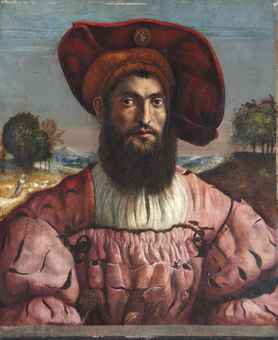
Portrait of a Man in Half-Length
by a Follower of Dosso Dossi
from Christies.org
 |
| Portrait of a Youth (Lucrezia Borgia) 1514-1516 by Dosso Dossi from wikipedia.com |
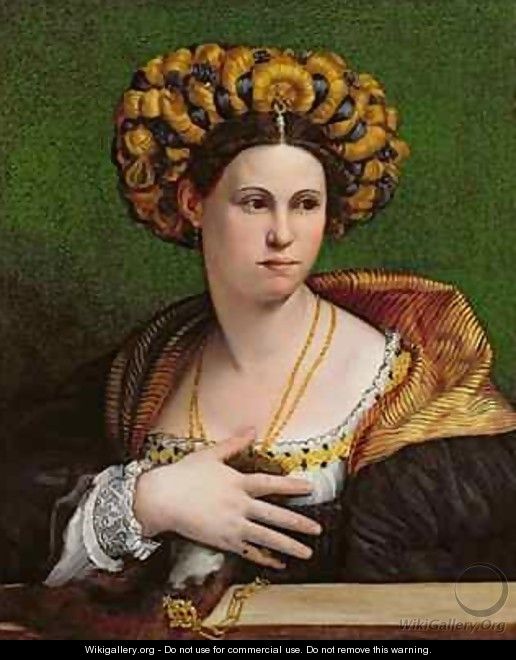
Portrait of a Roman Woman - Dosso Dossi (Giovanni di Niccolo Luteri)
from wikigallery.org

Portrait of a Warrior (1530's)
by Dosso Dossi
by Dosso Dossi
from 1st-art-gallery.com
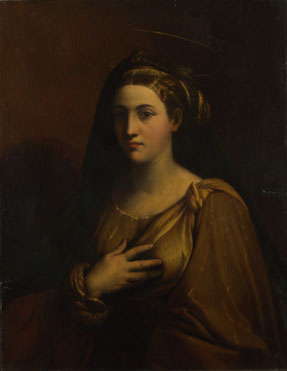
'A Female Saint' (after 1600)
in the style of Dosso Dossi
from nationalgallery.org.uk
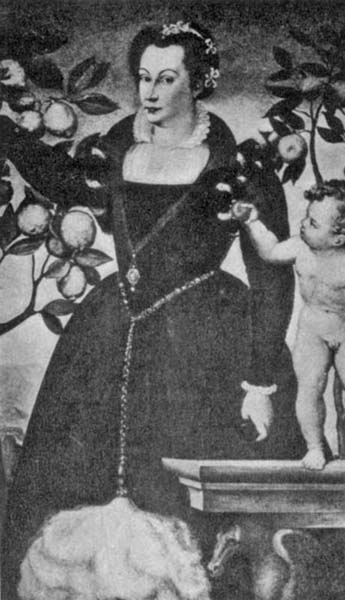
Possibly Lucrezia Borgia
Attributed to Dosso Dossi
from hellenicaworld.com
and one from brother Battista:

Portrait by Battista Dossi
from robilantvoena.com
Friday, January 11, 2013
Linen collar and cuffs in blue
Recently I have been working on some projects for friends, one of which is a set of collar and cuffs for a linen shirt.
The pattern was adapted from a design in the sixteenth century publication Modelbuch aller art.

I traced the design out on tracing paper and traced it onto the linen with water soluble pen. Ink would have been used to draw or trace out designs in the sixteenth century, but I find that many of the old patterns have inconsistencies in them (probably due to the woodcutting and printing techniques) and so water soluble pen allows for a certain amount of adjustment during the embroidery process.

I did a couple of 'test' motifs on the linen that I had to work on. The one on the left is done with two threads of DMC floss worked in a double running stitch, and the one on the right is two threads of DMC floss worked in chain stitch.

I wasn't happy with either, so I compromised with three strands of DMC floss worked in double running stitch. The centre of the flowers is satin stitch in gold DMC floss.
 |
| The back of the finished pieces |
Knots are usually avoided on the back of embroideries, but I do knot on pieces that are likely to be subjected to vigorous or machine washing.
 |
| The completed panel. You may notice that the blue of the flowers is slightly darker than the blue of the vine |
 |
| The completed pieces after ironing |
After completion, I passed the work onto a friend who used them to complete a linen shirt.


The shirt was made by Toni Abrahams, and photos of the finished shirt are courtesy of Phil Abrahams.
Subscribe to:
Posts (Atom)