Thursday, May 28, 2020

White Partlet (Complete)


Here is another project from my UnFinished Object (UFO) pile that I recently finished. It is a partlet made from a fabric that has square holes finished with machine embroidery. It reminded me of a close netting style. It is cut in the collarless Italian style that I like to wear with my 1530's-1550's gowns.
I cut the fabric out to my standard partlet pattern. I did a small zigzag stitch by machine along all the raw piece edges and then sewed the shoulder and side seams with a straight stitch on the machine. Then I turned all the edges under and sewed them down with tiny stitches by hand.
The next step was to do a hem by hand on all the raw edges. It was a lot more  tedious than my normal partlet hemming because the fabric wanted to distort where the holes were, especially if any of the edges of the hole itself were exposed.
Not my best hemming work, but acceptable. One part that I am considering re-doing is the bit that sits near my collar bone. The hem size is consistent, but because of the way the holes are positioned, the hem sticks out a bit from under the holes. I'm not sure if it will be noticeable while wearing it or not. 
I have two re-working options; unpick and re-sew, or add lace. I do have some lace that I purchased specifically for this partlet, but I am not sure it needs it. When it is time to finally get garbed up again, I will try it on with an Italian gown and decide then. Until that time, I will keep pottering along, trying to finish things, and keep trying to resist the urge to start new projects.
This meme popped up on my social media feed this week, and was too relatable!

Sunday, May 24, 2020

Heraldic Seahorse Napkin

I got the opportunity to take part in a couple of excellent online classes yesterday, and was able to practice my double running stitch. I finished embroidering my device on a napkin during the classes.


Thursday, May 21, 2020

Partlet with Blue Knotted Embroidery (Complete)

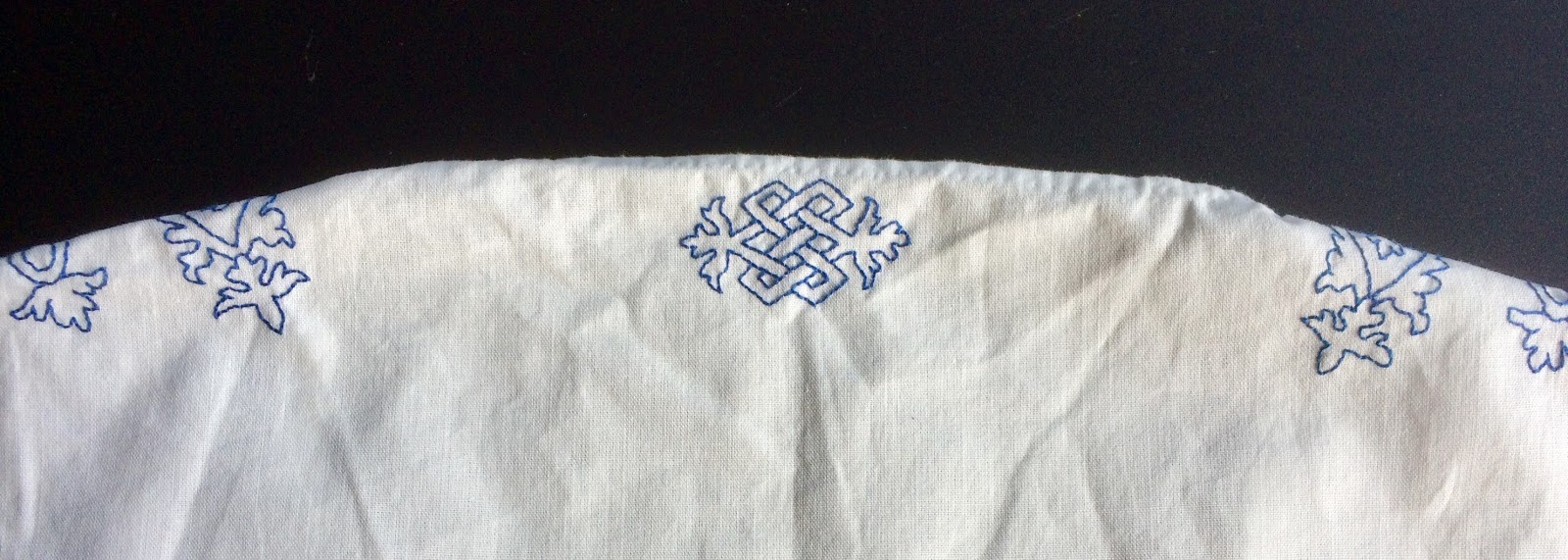
I managed to get the blue knotwork partlet finished this week. This is another project which was postponed because I was not happy with how it was working out. I originally hoped that I would be able to use it as part of my suite of projects for my Heraldic Challenge work (details below) but the frettes were not as prominent as I had hoped. I also used this project as an opportunity to practice my double running stitch (Holbein stitch) and it did not turn out as smoothly as I would have liked. More practice needed!

This pattern was taken from Giovanni Ostaus' 1567 "La Vera Perfettione del Disegno" at https://www.metmuseum.org/art/collection/search/662394
Cleaned image from: https://www.facebook.com/pg/modelbuchmuse/posts/?ref=page_internal 
As always, I am indebted to Baroness Praxilla at Modelbuch Muse. Her page makes finding patterns so easy!
I think I will do some more patterns from this modelbuch in the future.

This partlet is a wide-fronted collarless partlet which was popular in Italy in the sixteenth century. Here are some progress photos on the development of the project:
All visible seams handssewn. I edge my fabric pieces with the machine before hand hemming to provide a bit of extra strength, especially as I usually machine wash my underpinnings.
I use a relatively wide hem, about 6 or 7mm.

The border edging of the embroidery on this chemise (held in the Museo del Tessuto, Prato), inspired the decorative edging at the centre front hem. Image from oocities.org via Pinterest
 Similar decorative edging can be seen on this English coif c. 1610, held in the Glasgow museum. It is linen base fabric, embroidered in silk and gilt. Number 29.130
Image: collections.glasgowmuseums.com
I was unsure as to which lace to use. In the end I chose a silver lace that I had overdyed with a blue-black dye to tone down the shade of gilt.
The base fabric on this one is cotton. Linen would be a better alternative but is expensive and hard to find where I live, whereas cotton is readily available and more affordable. Linen is MUCH nicer to embroider and sew though! Similarly, thread is cotton DMC embroidery floss; a more affordable alternative to the much nicer silk thread that I would prefer to use.

Heraldic Display Pentathlon Challenge CHALLENGE 2019-2020
Participants are challenged to create 5 (or more) items from the list below. Challenge runs from now until the 1st May 2020 (or the closest available garbed event.) Displays will be set up throughout the year to showcase the work of participants. At the end of the Challenge, the populace will vote for their favourite items and tokens will be awarded. Heraldry can be your own, or you can make something for a friend, or Guild etc. Be creative and enrich our game with your displays.
Categories:
1. Banners, flags, pennants, standards and gonfalon etc.
2. Encampment equipment, furniture, tent screens etc.
3. Personal Adornment such as jewellery, favours, tabbards and clothing etc.
4. Equipment such as needlecases, napkins, crockery, water bottles etc.
5. Items for the Barony: any item(s) decorated with the Innilgard device to be donated to the Barony
This Challenge has been extended because face-to-face Lochac events have been suspended due to the Covid-19 crisis.

Thursday, May 14, 2020

UFOs - Sleeve Pile

One of my current challenges is to go through my UnFinished Object pile and prioritise everything,  and to start working through tasks. I still have a large pile of sleeves cut out and waiting to be sewn, so this is something I will be working on over the next several months.

Tuesday, May 12, 2020

Complete - Heraldic Seahorse Embroidered Partlet

I finally got my heraldic seahorse partlet finished, after leaving it sitting in the Naughty Corner for quite some time. I have not been happy with how the pale lilac thread looked, and I really struggled to see it. I think the below average quality of the embroidery reflects this.
When the split and running stitch embroidery was finally complete, I was disappointed with how it all looked. I added a line of split stitch along the hemline, but it didn't look complete. I added some pale gold cotton bobbin style lace and then added a line of matching gold thread to tie in the new colour.

The seahorses actually look paler than in the photo, and I felt they needed an extra motif in gold thread to tie in the bobbin lace colour and to fill in the negative space. I added the little 'sun/seed' motif found so often in Elizabethan pattern books like Shorleyker's 'A Scholehouse For The Needle'.
I am pleased with the extra motifs and the partlet turned out better than I thought it would. I'm not sure that I will ever love it, but it was a good exercise in perseverance.


Monday, May 4, 2020

Linen Partlet with Purple Flowers

Going through my piles of unfinished projects recently, I came upon this unfinished partlet in the Italian style. The embroidery has been started, but hasn't progressed far. It is worked in shades of purple and grey.
I will keep you posted!

Saturday, April 25, 2020

Partlet Decorated With Holly Design

I finally managed to get the hems sewn on the holly partlet, and it is ready to wear. I am pleased with how it turned out, and I would like to do another in different colours in the future.
(It is sitting a little askew on the mannikin here.)


Friday, April 24, 2020

ANZAC Day 2020

On 25th April (here in Australia) we commemorate the service and sacrifice of our armed services personnel. This year due to Covid-19 restrictions, there will be no public gatherings, but we will still remember them.


Tuesday, April 14, 2020

Thursday, April 9, 2020

Recipes for Candied Orange Peel

Image from: https://www.jesmondfruitbarn.com.au/product/oranges/

"A goodlye secret for to condite or confite Orenges, citrons, and all other fruites in sirrop", a recipe from Thomas Dawson, THE SECOND PART OF THE GOOD HUS-WIVES JEWELL, 1597.

"(1) Take Cytrons and cut them in peeces, taking out of them the iuice or substance, (2) then boyle them in freshe water halfe an hower untill they be tender, and when you take them out, (3) cast them into cold water, leave them there a good while, (4) then set them on the fire againe in other freshe water, (5) doo but heate it a little with a small fire, for it not seeth, but let it simper a little (6) continue thus eight daies together heating them every day inn hot water: (7) some heat the watre but one day, to the end that the citron be not too tender, but change the freshe water at night to take out the bitternesse of the pilles, the which being taken away, (8) you must take suger or Hony clarified, wherein you must the citrons put, (9) having first wel dried them from the water, & in winter you must keep them from the frost, (10) & in the Sommer you shal leave them there all night, and a day and a night in Honie, (11) then boile the Honie or Sugar by it selfe without the orenges or Citrons by the space of halfe an hower or lesse with a little fire, (12) and being colde set it againe to the fire with the Citrons, (13) continuing so two mornings: if you wil put Honnie in water and not suger, you must clarifie it two times, and straine it through a strayner: having thus warmed and clarified it you shall straine and (14) sett it againe to the fire, with Citrons onely, making them to boyle with a soft fire the space of a quarter of an houre, (15) then take it from the fire & let it rest at every time you do it, a day & a night: (16) the next morning you shall boyle it again together the space of half an hower, and (17) doo so two morninges, to the end that the Honie or Suger may be well incorporated with the Citrons. All the cumuing (sic) consisteth in the boyling of this sirrope together with the Citrons, and also the Sirrope by it selfe,and heerein heede must be takken that it take not the smoke, so that it savour not of the fire: In this manner may be drest the Peaches, or lemmons Orenges, Apples, green Malnuts, and (18) other liste being boile more or lesse, according to the nature of the fruits."
Reproduced at: http://damealys.medievalcookery.com/CandiedFruitPeel.html
A transcription of the 1596 edition of The Good Huswifes Jewell can be found here:
http://www.medievalcookery.com/notes/ghj1596.txt

This recipe comes from Le Ménagier de Paris, originally written circa 1393 and reproduced at  http://acrosstheagesblog.blogspot.com/2013/04/candied-orange-peel.html :
"To Make Candied Orange Peel, cut the peel of an orange into five pieces and scrape away the loose skin inside with a knife, then set them to soak in good fresh water for nine days and change the water daily; then boil them, letting them come once to the boil only, in fresh water, and this done, spread them on a cloth and let them dry thoroughly, then put them in a pot of honey until they be quite covered therewith, and boil on a slow fire and skim.  And when you think that the honey is cooked (to try if it be cooked, have some water in a spoon, and pour a drop of the honey into the water and if it spreads it is not done, and if the drop of honey remains in the water without spreading, then it is done), then you must take out your pieces of orange peel and set out a layer in order and sprinkle powered ginger thereon, then another layer and sprinkle, etc., usque in infinitum; and leave them for a month or more and then eat them."


Sunday, March 29, 2020

Productivity In The Time of Covid

We are living in strange and frightening times. For the last fortnight I have been in isolation except for essential medical appointments because I am especially vulnerable to infection. I am regularly house-bound because of illness, but this is something different. Usually I suffer terribly from FOMO (Fear of Missing Out) because I am isolated and sick and everyone else is out having fun. All Lochac face-to-face SCA activities have been suspended, so all my friends are now missing out too. Everyone is feeling sad and anxious. Anticipatory grief is a real thing.
My doctors are also playing around with my medication which is affecting my mood, pain levels and blood pressure. Plus a family friend died unexpectedly this week, which was a horrible shock.

I have been feeling low as well as guilty because I feel like I should be counting my blessings and making the most of this time, and I really haven't managed to get anything much done. So many talented people posting tutorials and pictures of completed items online and I am struggling to get the basic stuff like dishes and washing done.

An SCA friend sent me a meme today that really helped. It said something to the effect of "It's OK to NOT be at your most productive during a global pandemic!" Obvious stuff, when it is put like that, but I was so caught up in feeling bad about wasting time that I hadn't thought about it logically.
So if you are feeling the same, please be kind to yourself. It's only natural to be anxious and feel uncertain during a pandemic! Follow health guidelines, stay safe, and do whatever you need to do to get through this time.


With thanks to Violet for the right meme at the right time
And thanks to Cathy for the supportive words and the great title.

Friday, March 27, 2020

Embroidery Designs - Acorns

I hope all of you are well and taking care of yourselves. Enjoy these acorn designs.
From The Needle's Excellency (Boler) - 1634 held at the British Museum https://www.britishmuseum.org/  available at Modelbuch Muse https://www.facebook.com/modelbuchmuse/

From The Trevellyon Miscellany (1608) available on Pinterest. More information can be found here:

From A Scholehouse for the Needle (1632),  individual pages reproduced on Pinterest

From A Scholehouse for the Needle (1632),  individual pages reproduced on Pinterest

From A Scholehouse for the Needle (1632),  individual pages reproduced on Pinterest

From Lotz 106 by Jean Le Maistre (1564) at 


Pattern from _Lucidario di Recami_ by Iseppo Foresto, published by Jeronimo Calepino, dated 1564. https://www.metmuseum.org/art/collection/search/349914 reproduced at Modelbuch Muse https://www.facebook.com/modelbuchmuse/

Thursday, March 19, 2020

Isolation Embroidery Challenge

I've started a hand-embroidery challenge in my SCA group to try and help keep everyone feeling connected and motivated during the suspension of activities. The idea is that all the participants will work on one or more hand embroidery challenges over the enforced break, and share our progress on the baronial Facebook page. Then, when events resume, we display our finished items in person.

The tricky part was accommodating various levels of expertise and confidence, while still offering a theme that had something for everyone. In the end I settled on an open theme and open technique. People can work on heraldic items, UnFinished Objects (UFOs), items for upcoming competitions or largesse, or even those big projects that have been on the Wish List for some time - whatever they like. Sounds super exciting, doesn't it?

What it means in real time is that I’m faffing around deciding what to do for the Challenge (i.e. wasting time being overwhelmed by the possibilities of doing All The Things). In the mean time I decided I need to stop wasting time and that I really should try and finish this embroidered partlet I started for the baronial Heraldic Challenge.

Normally partlets are my favourite thing to embroider but I’m hating on this one because the pale lilac thread is really hard to see, so my stitching is sloppy, plus it is reinforcing how much my eyes have been impacted by medication in the last couple of years.

DMC stranded cotton seahorses done in split and double running stitch on a base of leftover cotton broadcloth due to financial limitations.