
Showing posts with label subtleties. Show all posts
Showing posts with label subtleties. Show all posts
Friday, December 19, 2014
Subtletie Plates
After another trawl through the thrift shops, I scored some (slightly dented and tarnished) subtletie plates-

Monday, July 1, 2013
Dancing Figures Solteltie
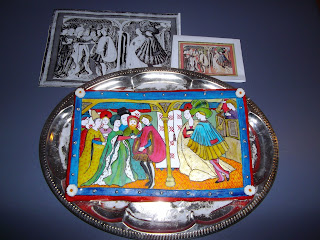
This week I have spent a lot of time creating a solteltie for a Ball and feast. The base was created from gingerbread which was then covered with commercially produced fondant icing. The figures were roughly marked out as an imprint, based on an early Renaissance image of a betrothal. I tweaked the image to make it look like people dancing, and added a tassel hanging in front of the banner of my Barony as there was to be a tassel kicking competition at the event.
I had hoped to try out my new edible ink felt tip pen, but it just collected the icing. Back to the old fashioned way- food colouring and a small paintbrush. Most of the colours were gel food colourings mixed with a little bit of vodka. I thought that they covered very well.
Decorating the icing took a long time, but I thought that the result was worth the time. The silver 'balls' are soft sugar pearls. They look like cachous but do not have that horrible tooth-cracking feeling when you bite into them. The little daisies are made of fondant.



I had hoped to try out my new edible ink felt tip pen, but it just collected the icing. Back to the old fashioned way- food colouring and a small paintbrush. Most of the colours were gel food colourings mixed with a little bit of vodka. I thought that they covered very well.
Decorating the icing took a long time, but I thought that the result was worth the time. The silver 'balls' are soft sugar pearls. They look like cachous but do not have that horrible tooth-cracking feeling when you bite into them. The little daisies are made of fondant.

The 'naked' gingerbread

The iced gingerbread

Some figures have been marked out..

Nearly completed

The piece with the inspiration images beside it

The finished piece. I added caster sugar around the edges later, to cover the platter
Wednesday, November 28, 2012
Golden Apple Subtletie
A friend of mine was running a tourney on the weekend with a mythological theme. She asked me to make a golden apple to give as the prize for the event.
We decided that fruit cake would make a tasty base for the apple, and I decided that a light fruit cake would be best as it tends to appeal to a wide range of tastes. I planned to try and cover the fruit cake 'apple' with marzipan.
As these things tend to go 'pear-shaped' (no pun intended!) I wanted to make a test apple first.
I decided to experiment with colouring the marzipan first, instead of doing my usual trick of painting the marzipan after moulding.
The pictures below show my 'test run'. I used yellow food colouring kneaded into the marzipan and lightly sprayed with edible gold shimmer paint. I think it came out too yellow.


So for the next and final apple, I left the marzipan plain and sprayed the apple with edible gold paint after the marzipan had dried a bit. It took several sprays. I used one can between the two apples.


.JPG)
We decided that fruit cake would make a tasty base for the apple, and I decided that a light fruit cake would be best as it tends to appeal to a wide range of tastes. I planned to try and cover the fruit cake 'apple' with marzipan.
As these things tend to go 'pear-shaped' (no pun intended!) I wanted to make a test apple first.
I decided to experiment with colouring the marzipan first, instead of doing my usual trick of painting the marzipan after moulding.
The pictures below show my 'test run'. I used yellow food colouring kneaded into the marzipan and lightly sprayed with edible gold shimmer paint. I think it came out too yellow.

Check out the big fingerprint in the middle. I was too eager and touched it before it was fully dry!

So for the next and final apple, I left the marzipan plain and sprayed the apple with edible gold paint after the marzipan had dried a bit. It took several sprays. I used one can between the two apples.

The apple before the leaf was added. I dusted the apple with bronze dusting powder and gold dusting powder.

I used a cutter to shape the leaf, and painted it with green food colouring.


The apple travelled fairly well in my un-airconditioned vehicle, especially considering it was a 33 degree C day.
.JPG)
The apple presented to the winner.
Thursday, July 19, 2012
Flaming Yule Log Subtletie
Recently, my Barony hosted a Coronation and the feast had a Midwinter/Yule theme. As part of the entertainment for the evening, several subtleties were presented. One of the subtleties was a flaming yule log made of fig pudding and marzipan.
Subtleties are illusion foods that are designed to provide entertainment and interest at a feast. In period, they were often made to showcase the wealth and creativity of the host, and to do honour to important guests.
I adapted a recipe for Figey from the book Pleyn Delit. I did a test-run of the redacted original recipe, and it was delicious but didn't hold it's shape very well. For the final product, I added egg as a binder and extra almond meal to firm up the mix. I baked the mixture slowly in a log tin that was 3/4 full.


The pudding was shaped and a 'branch' added. The pudding was covered in marzipan which was painted with food colouring to look like a tree. I used a toothpick to put lines and whorls along the trunk and growth lines at the 'cut' end of the log. A depression was carved on the 'trunk' to hold an eggshell, and there was room for another eggshell in the 'vee' of the trunk and branch. Warmed brandy was poured into the shell and set alight to create the illusion of a flaming yule log. The subtletie was very well received by the guests.

Subtleties are illusion foods that are designed to provide entertainment and interest at a feast. In period, they were often made to showcase the wealth and creativity of the host, and to do honour to important guests.
I adapted a recipe for Figey from the book Pleyn Delit. I did a test-run of the redacted original recipe, and it was delicious but didn't hold it's shape very well. For the final product, I added egg as a binder and extra almond meal to firm up the mix. I baked the mixture slowly in a log tin that was 3/4 full.
 |
| The mixing bowl full of spicy, fruity goodness |
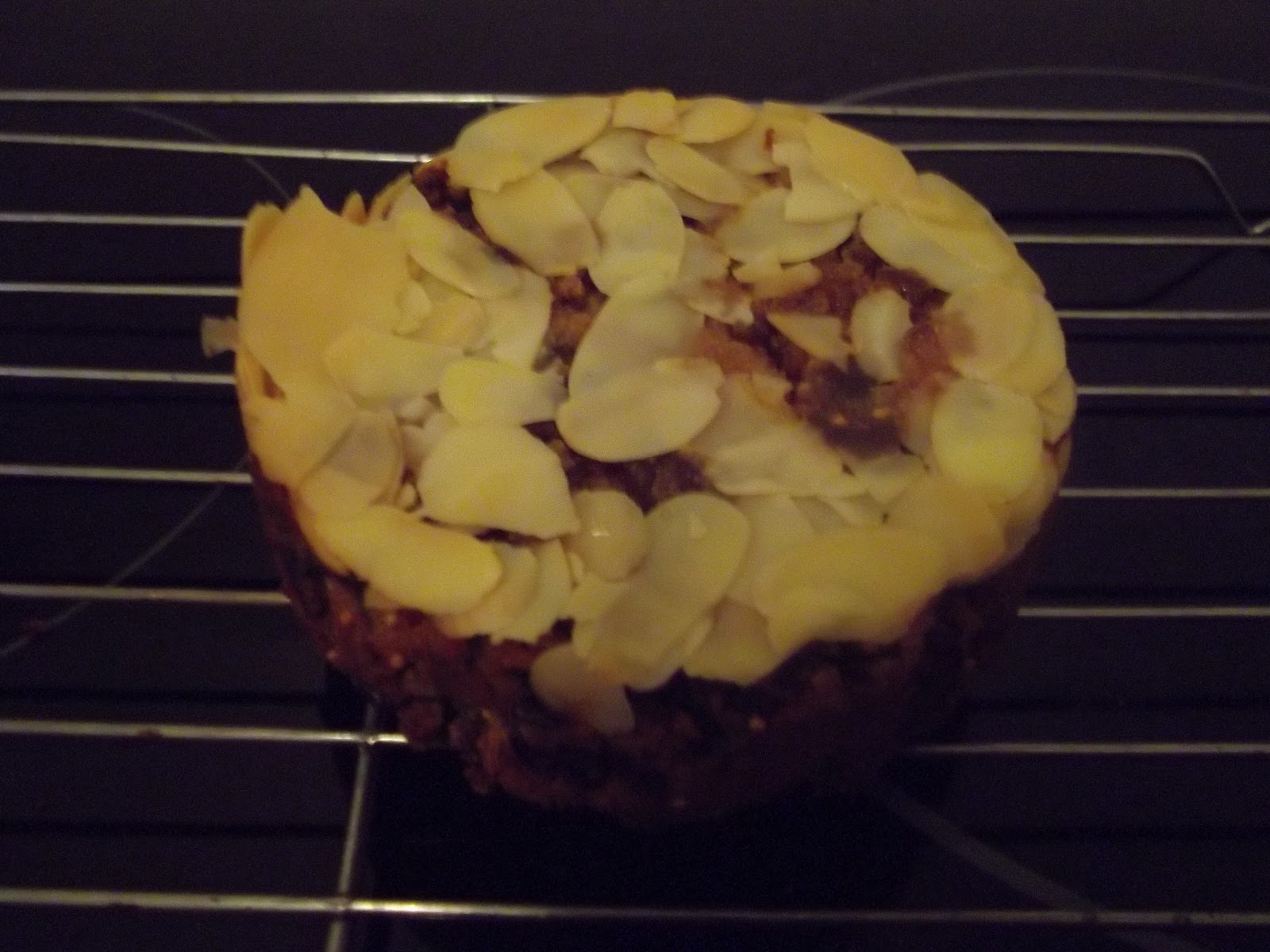 |
| I forgot to take a picture of the log as it came out of the tin, but this should give an idea of how it looked. I used the leftovers to do a 'test' pudding to make sure the taste and texture was good. The yule log itself did not have flaked almonds on it though. |


The pudding was shaped and a 'branch' added. The pudding was covered in marzipan which was painted with food colouring to look like a tree. I used a toothpick to put lines and whorls along the trunk and growth lines at the 'cut' end of the log. A depression was carved on the 'trunk' to hold an eggshell, and there was room for another eggshell in the 'vee' of the trunk and branch. Warmed brandy was poured into the shell and set alight to create the illusion of a flaming yule log. The subtletie was very well received by the guests.
 |
| The finished log before the eggshells were added |

 |
| The high table at the feast |
Sunday, July 15, 2012
Cornucopia Subtletie

Here is a cornucopia that I collaborated on as a presentation piece for the recent Midwinter Coronation. It was presented to High Table and was well received.
Another talented member of my Barony made the pastry shell of the cornucopia and pastry leaves. The cornucopia is ornamented with decorative pastry swirls.
I made marzipan fruits to spill out from the horn of plenty and supplemented them with gilded nuts.
 |
| gilded chestnuts |
 |
| gilded walnuts |
 |
| marzipan fruits dusted with sugar placed for presentation |
Thursday, February 9, 2012
Bones of the Dead Subtletie
Here is a subtletie and associated documentation that I made for a feast that my Barony held in 2011.
An Ossi dei Morti (Bones of the Dead) Subtletie

Subtleties (or sotleties) were highly ornamental table decorations used at feasts in the Middle Ages and Renaissance. They were often made of confectionery or pastry, and served to amuse guests and display the wealth and stature of the host. Some subtleties were not made to be eaten and contained dangerous ingredients such as mercury or lead; others were made of edible materials so that guests could enjoy eating the showpiece after enjoying looking at it.
I prefer to create subtleties out of safe and edible materials so that the populace can enjoy eating the creation. This subtletie is made from marzipan and sugarplate and is inspired by accounts of feasts with death themes from Roman times to the Renaissance.
Feasts with Dark Themes
The Roman Emperor Domitian was celebrated for his bloodthirsty reputation and known for his changeable nature and dangerous whims. Records indicate that Domitian held a Death-themed Feast to celebrate the soldiers who had died in a recent conflict. [‘Charlemagne’s Tablecloth’ p. 87.] The guests were served in a room draped with black fabric and lit by tomb-lamps. Gravestones were put beside each diner, and they ate black funeral foods while being entertained by boys made up to look like ghosts.
An account of an Italian Carnival Masquerade held during the lifetime of Piero di Cosimo reflects similar themes of death and darkness. A description in ‘Charlemagne’s Tablecloth’ (p. 88) describes it thus:
a masquerade which, 'through it's novelty and terror...filled the whole city with fear and marvel
together...for even as in the matter of food bitter things sometimes give marvellous delight to the human palate, so do horrible things in such pastimes, if only they be carried out with judgement and art.' Carnival hell-banquets were served in classical settings of a black-draped Hades, with devils offering food on fire-shovels and screaming wretches providing off-stage sound effects. The food and wine
was exquisite, though, even allowing for its repulsive presentation: containers made to look like toads, scorpions, spiders and lizards revealed delicious creations made out of larks and thrushes”.
My main inspiration for this subtletie was the account of noble banker Lorenzo Strozzi hosting a ‘Black Feast’ or ‘Feast Macabre’ at his house in Rome
It is interesting to note that none of the accounts of this feast that I have found refer to the reason that Strozzi decided to hold such a feast. We can only speculate as to whether he was making a comment on the decadence of Roman high society, remembering a dead friend, reminding his guests that death is always near, trying to cause a sensation, or (as one modern writer has suggested,) because he had no other way of distinguishing himself “except by his grotesqueness”. [‘History of the Papacy’]
Guendalina Mahler [‘Heavenly Banquets and Infernal Feasts in Renaissance Italy high point
Construction
I originally had planned to reproduce the Death’s Head from Lorenzo Strozzi’s 1519 Black Feast out of sugarplate and put marzipan bones inside, but I realised that such a structure would probably be difficult to transport safely. Instead, I decided to make skulls and crossbones out of sugarplate, and long bones out of marzipan. I used two types of sweets because I would like diners to be able to enjoy eating the subtletie, and many people do not like marzipan.
Both the sugarplate paste and the marzipan were modeled by hand. The sugarplate was painted with commercially available black food dye and rosewater. In period, dyes were made from fruit and vegetable juices, soot or charred materials, and sometimes real metals such as gold leaf and lead powder. I chose to use a modern dye over a period recipe using soot to make the end result more palatable and appropriate to modern notions of taste and safety.
I used lemon juice, gum tragacanth, water and rosewater with powdered sugar to make my sugarplate. I omit egg white from my recipes, even though it was often used in period for strengthening confectionery pastes, due to concerns over the remote possibility of salmonella poisoning. I used extra gum tragacanth in my mixture to make the paste more crumbly so that it would crack and craze slightly to make the skulls look more realistic. I am fortunate in being able to purchase pre-ground icing sugar, as in period it was ground by hand and was a laborious process.
I used commercially available marzipan for this project as it is extremely difficult to get almond meal to grind fine enough to make good quality paste. In the past, I have tried to grind my almond meal fine enough to match period accounts of ‘fine almond meal’ and have ended up with nut butter! Modern palates expect marzipan to be very fine and not grainy. I am not sure whether the consistency problems I have had in the past relate to the type of almonds I have been using or the kitchen equipment, or both.
There are a large number of cookbooks still available from our time period, and the plethora of recipes relating to confectionery prove that Renaissance people were just as fond of sweets as modern people. Some examples are listed below.
An example of a marzipan recipe from: Valoise Armstrong's translation of ‘Das Kuchbuch der Sabina Welserin’
In the name of the Holy Trinity I, Sabina Welserin, begin this cookbook. God grant me His holy grace and wisdom and understanding and judgment with which I through His Holy will live here in this time and with Him forever. Amen. anno 1553
22 If you would make good marzipan - First take a half pound of almonds and soak them overnight in cold well water, take them out in the morning. Next pound them well until they become oily, pour a little rose water on them and pound them further. When they become oily again, then pour a little more rose water thereon. Do this until they no longer become oily. And pound the almonds as small as possible. After that take a half pound of sugar, pound not quite all of it in, leaving a little left over. Next, when the almonds and sugar are pounded well together, put them in a bowl, take the lid from a small box, loosen the rim completely, so that it can be detached and put back on again, however leave the lid and the rim together. Take wafers and make them about as wide as a pastry shell, very round. Spread the almond paste described above with the fingers onto the wafers, moistening the fingers with rose water and dipping the almond paste into the sugar, which you have kept in reserve. After that, when you have spread it out evenly with your hands, take the sugar that you have reserved and sprinkle it through a sieve evenly over the marzipan. And take a small brush and dip it in rose water and sprinkle the marzipan overall, so that the sugar is dissolved. Then let it bake. Check it often, so that it is not burnt. It should be entirely white. The amount of a half pound is necessary, so that the oil remains.
The following recipe for a marzipan tart was taken from ‘The Medieval Kitchen Recipes From France and Italy
“Marzipan. Skin the almonds very well and pound them as finely as possible, because they will not be put through a sieve. Note that to make the almonds whiter, more flavourful, and sweeter in the mouth, they should be put to soak in fresh water for a day and a night, or even longer, so that they can be skinned by pressing between your fingers. When you pound them, dampen them with a little rose water so that they do not become oily. And if you want to make this torta good, use equal weights of sugar and almonds, that is, one libra of one and the other, or more or less as you prefer; and also use one or two oncie of good rose water; and mix all these things together thoroughly. Then take cialdonui or nevole made with sugar and first moistened with rose water; arrange them on the bottom of the pan…….”
A recipe for Ymages In Sugar from ‘Early French Cookery’:
“And if ye will make any ymages or any other thing in suger that is casten in moldys, seethe them in the same manere that the plate is, and poure it into the mouldes in the same manere that the plate is pouryde, but loketh youre mold be anoyntyd before with a littell oil of almaundes.”
Sugar Paste recipe in the ‘Good Hus-wives Jewell’ of 1596:
“To make a paste of Suger, whereof a man may make all manner of fruits and other fine things with their forme, as Plates, Dishes, Cuppes and such like things, wherewith you may furnish a Table.”
“Take Gumme and dragant as much as you will, and steep it in Rosewater til it be mollified, and for foure ounces of suger take of it the bigness of a beane, the juyce of a Lemon, a walnut shel ful, and a littke of the white of an eg. But you must first take the gumme, and beat it si much with a pestell in a brazen morter, till it be come like water, then put it to the iuce with the white of an egge, incorporating al these wel together, this done take four ounces of fine white suger wel beaten to a powder, and cast it into the morter by a little and a little, until they be turned into the form of paste, then take it out of the said morter, and bray it upon the powder of suger, as it were meale of flower, until it be like soft paste, to the end you may turn it, and fashion it which way you wil. When you have brought your paste to this fourme spread it abroad upon great or small leaves as you shal thinke it good ans so shal you form or make what things you wil, as is aforesaid, with such fine knacks as may serve a Table taking heede there stand no hotte thing nigh it. At the end of the Banket they may eat all, and breake the Platters, Dishes, Glasses, Cuppes and all other things for this paste is very delicate and saverous.”
References
Barber, A. 1973, Cooking and Recipes from Rome Allen Lane , London
Creighton, Mandell, 2010. A History of the Papacy from the Great Schism to the Sack of Rome
Dawson, T. 1596, The Good Hus-wife’s Jewell
Eleanor Scully D. and Scully, T. 1995, Early French Cookery, University of Michigan Press, Michigan
Fletcher, Nichola, 2005 Charlemagne's Tablecloth, St Martin’s Press , UK
Mahler, Guendalina, 2007. Heavenly Banquets and Infernal Feasts in Renaissance Italy
May, R. 1685, The Accomplisht Cook, Prospect Books 1994 Reprint, London
Redon O, Sabban F. and Serventi, S. 1998, The Medieval Kitchen - Recipes From France and Italy , University of Chicago Press, Chicago
Redon O, Sabban F. and Serventi, S. 1998, The Medieval Kitchen - Recipes From France and Italy , University of Chicago Press, Chicago
Further Reading
Ajmar-Wollheim, Marta, and Flora Dennis. At Home in Renaissance Italy London
Barber, A. 1973, Cooking and Recipes from Rome Allen Lane , London
Black, Christopher F. Italian Confraternities in the Sixteenth Century. Black, Maggie. The Medieval Cookbook. Thames and
Burke, Peter. The Italian Renaissance: Culture and Society in
Castiglione, Baldassare. The Book of the Courtier. Originally printed, 1528. Trans. by Leonard Eckstein Opdycke. Charles Scribner's Sons,
Cohen, Elizabeth and Thomas. Daily Life in Renaissance
Currie,
Florio, John. Queen Anna's
Frugoni, Chiara. A Day in a Medieval City.
Platt, H. 1602, Delightes for Ladies
Scully, Terence. The Art of Cookery in the Middle Ages. Boydell Press, Rochester
Scully, T. 1997, The Vivendier, Devon : Prospect Books
Scully, Terence. The Neapolitan Recipe Collection: Cuoco Napoletano. Sider, Sandra. Handbook to Life in Renaissance
Stinger, Charles. The Renaissance in Rome Indiana University Press, Bloomington IN
Strong, R. 2002, A History of Grand Eating
Reading Carnival: The Creation of a Florentine Carnival Song
http://jps.library.utoronto.ca/index.php/qua/article/viewFile/10180/7119
Andrea Gareffi. La scrittura e la festa. Teatro, festa e letteratura nellaFirenze
Andrea Gareffi. La scrittura e la festa. Teatro, festa e letteratura nella
del Rinascimento. Bologna
http://jps.library.utoronto.ca/index.php/qua/article/viewFile/10180/7119
Andrea Gareffi. La scrittura e la festa. Teatro, festa e letteratura nellaFirenze
Andrea Gareffi. La scrittura e la festa. Teatro, festa e letteratura nella
del Rinascimento. Bologna
Welserin, S 1553. Das Kuchbuch der Sabina Welserin
goodecookery.com
www.shipbrook.com/artsci/education/ alcohol/cordials/CordialPaper.html
Thursday, February 2, 2012
More subtleties
Here are some more subtletie pictures. All were made from sugarplate and were painted with edible colours and metallic dusting powders.
 |
 |
 |
Wednesday, February 1, 2012
Some completed subtleties
I will be quite busy over the next week or so, so I will go back to posting pictures of items that are already completed. Here are some photos of sugar plate and marzipan subtleties that I have made.....
 |
| A sugar plate cat that was filled with marzipan fish |
Subtleties or 'soltelties' were illusion foods designed to astonish and amuse guests. They were very popular at feasts and were a demonstration of wealth and prestige as well as a way of honouring guests. There are many accounts of amazing illusion foods being presented at feasts in the sixteenth century. I prefer to focus on sweet subtleties with components like sugar plate, marzipan, toffee and gingerbread.
 |
| Sugar plate for the Mongol Feast |
.JPG) |
| A sugar plate flower |
crop.JPG) |
| Putti plate surrounded by sugar strawberries and bay leaves |
 |
| This one suffered a bit of damage and got cracked |
crop.JPG) |
| Marzipan strawberries |
.JPG) |
| The mystical SpiderPig, made from marzipan and sugar plate |
.jpg) |
| One of my first subtleties - A 'silly bub' in syllabub for a Fool's Feast |
 |
| And for the same feast, a fruit fool in a jester's hat of marzipan |
Subscribe to:
Posts (Atom)