Showing posts with label renaissance cooking. Show all posts

Tuesday, May 4, 2021

A Beginner’s Introduction to Common Medieval and Renaissance Ingredients

This is a guide to some terms which may be confusing to cooks who are new to SCA period recipes. The list is by no means exhaustive, and terms should be taken in context of the period that the recipe is from.

Abalana/Avellana/ - Hazelnut or filbert 

Allium – garlic or leek 

Alkanet – plants whose roots produce a red dye {*potentially toxic*} 

Almandes – almonds  

Amygdala – Almonds 

Anas – a duck or drake 

Architricoes – prepared sheep testicles

Apium – celery or parsley 

Apricocks - apricots

Aqua – water 

Artemisia – the herb mugwort, motherwort or tarragon 

Astacus – crab or lobster 

Avena – a species of oat 

Avens – a herb which has a clove-like flavour, also called Herb Bennet

Barm – live yeast found on brewing (‘working’) beer and ale

Blitum  - orrage, arrack, pot herb or possibly spinach 

Bragot/braggot – a sweet, spiced or herbed ale

Brassica – cabbage or kale 

Brawn – flesh or meat, often boar or pig.

Canelle, canel – cassia. A less expensive alternative to cinnamon

Cardamomum – cardamom [not to be confused with ‘Cardamum’: cress or nasturtium]

Cheat – bread made from whole wheat with the bran removed

Cicer – chickpea 

Clapbread- a type of bread made from barley

Clowys – cloves

Coddlings, pippins – types of apple

Coffyn or coffin – a pastry crust

Comfits – sugar coated seeds used as a palate refresher and to freshen breath. Often caraway, fennel, anise etc are used.

Costmary – mint geranium; used as a vegetable, medicine and to flavour ale

Coney, conins, cunins – rabbit 

Condio – to salt or season 

Crocus – saffron 

Cubebs, Quybibes – dried black berries used as a spice; flavour is a cross between allspice and black pepper

Curcuma – turmeric 

Damascena – plum or prune (fresh or dried) from Damascus 

Dittany of Crete – a herb which is also called Wild Basil or Stone Mint. A relative of oregano, which is a good substitute.

Dulcia: sweets or confections 

Eruca – the herb family Rocket 

Faba – bean or pulse 

Far – corn or grain or grain meal [Farina: grain meal] 

Fissile – cottage cheese 

Frumentum: grain, wheat, barley 

Garum- fermented fish sauce 

Galingale – a tuber used modernly in Asian food. It has a hot, gingery flavour

Gingiber or zingiber – ginger 

Glis or glires – doormouse /dormouse

Grated bread- breadcrumbs made with fresh bread

Graynes of Paradise – grains of paradise; a warm spice. This can be difficult to find and a mix of cardamom and black pepper can be a useful substitute. 

Great raisyns – raisins of grapes

Gum Dragon – gum tragacanth; a gum derived from Middle Eastern legumes and used for stabilising and stiffening (especially in sugar plate recipes)

Holus or olus- kitchen vegetables, often cabbage 

Horse bread- a type of bread made from pea flour, bean flour or similar

Hydromeli or hydromel – rainwater and honey boiled together to form a reduction 

Hysitium or Isicium – a hash, sausage or mince 

Jus or Ius – juice, liquor, broth or sauce 

Lactua – lettuce 

Lepus – hare 

Mace or maces – a spice made from the blade between the seed coat and the husk of the nutmeg

Mallow – marshmallow, common mallow, hollyhock

Malus – fruit tree or apple tree 

Manchet – fine wheat white bread, also Pandemaine and Cocket (less fine than pandemaine)

Mel- honey 

Mentha – mint 

Mespila – medlar fruit 

Morat – a mix of mulberry juice and honey

Morus – mulberry 

Mulsum – mead or honey wine 

Muscadine – a type of sweet wine

Mustard – mustard plants produce seeds which can be used as flavouring and as a condiment, and the leaves can be used as a salad herb

Myristica – nutmeg 

Myrtus – myrtle berry [often called, and used instead of, pepper] 

Myrtus pimenta- allspice 

Napus – turnip 

Nux – hazelnut or walnut 

Offa- a lump of meat or a meat dumpling, morsel or chop or other small meat portion 

Oignions, oygnions, ongnions or similar – onion

Oleum- olive oil 

Ormentum – caul or abdominal membrane 

Orchil or archil – a colourant derived from lichen 

Oryza or Risum- rice or rice flour 

Ostrea – oyster 

Ovum – egg 

Oxalis – sorrel plant 

Oxalme – an acid pickle such as brine and vinegar 

Oxygarum – vinegar and garum sauce 

Panis – bread 

Papaver – poppy seeds 

Pastinaca – parsnip or carrot 

Persicum – peach 

Perna – ham 

Petroselinium – parsley 

Pinioles, pignions, pynots, pynes etc. – pinenuts 

Piperitis – pepperwort, Indian pepper or capsicum 

Pipio – a young bird 

Piscis – fish 

Pommes – apples

Pomum – fruit from a tree 

Porray or porray – a dish of green vegetables

Porrum – leek 

Portulaca – the plant purslane 

Poscca – an acidic drink 

Poudre (douce/forte/fine etc) – fine powdered spice mix [spices used varybetween cooks and publications] 

Poyres – pears

Ptisiana – a grain broth or gruel 

Rapa – rape or turnip 

Raysins of Corinth – currants

Raysins of the sunne, risins, confiz – raisins 

Rosatum – flavoured with roses 

Rumex – sorrel or sour dock herb 

Ruta- rue [*potentially toxic*} 


Saccharum – sugar 

Sack – a type of fortified wine

Sal – salt 

Sanders - sandalwood

Sarda – small fish like a sardine 

Saucites – sausages 

Scandius – the herb chervil 

Soused – something that is salted or brined

Strained yolkes – beaten egg yolks

Sulsum – meat that is salted or pickled 

Tourte- bread containing husks

Uva – grape 

Vermiculi – noodles, vermicelli 

Vervex – mutton or wether (sheep)

Vinum- wine 

Wastel – a type of bread of good quality


References

Brears, Peter; 1999. All The King’s Cooks, Souvenir Press, London.

Brears, Peter; 2015. Cooking and Dining in Tudor and Early Stuart England, Prospect Books, London.

Dommers Vehling, Joseph(translator); Apicius – Cookery and Dining in Imperial Rome, Dover Publications Inc, New York.

Renfrow, Cindy; 1990.  Take a Thousand Eggs Or More, Vol 1, 2nd Ed. Royal Fireworks Press, Unionville, New York.

Renfrow, Cindy; 1990.  Take a Thousand Eggs Or More, Vol 2, 2nd Ed. Royal Fireworks Press, Unionville, New York.

Scully, Terence (translator); 2010. On Cookery of Master Chiquart (1420), ACMRS, Tempe, Arizona.

https://www.medieval-recipes.com/glossary/


http://www.godecookery.com/glossary/glosss.htm has a short introduction to medieval cooking terms which may be helpful


Monday, March 2, 2020

A recipe for Hirchones or Yrchouns - Hedgehog Meatballs

This is a fun recipe that I have made many times. Kids and adults alike get a kick out of these spiky little meatballs.

The original recipe is from Two Fifteenth Century Cookbooks c 1430-1450  (Harleian MS 279)
http://www.archive.org/stream/twofifteenthcent00aust/twofifteenthcent00aust_djvu.txt
https://quod.lib.umich.edu/c/cme/CookBk?rgn=main;view=fulltext

YRCHOUNS

Take Piggis mawys, & skalde hem wel; take groundyn Porke, & knede it with Spicerye, with pouder Gyngere, & Salt & Sugre; do it on þe mawe, but fille it nowt to fulle; þen sewe hem with a fayre þrede, & putte hem in a Spete as men don piggys; take blaunchid Almaundys, & kerf hem long, smal, & scharpe, & frye hem in grece & sugre; take a litel prycke, & prykke þe yrchons, An putte in þe holes þe Almaundys, every hole half, & eche fro oþer; ley hem þen to þe fyre; when þey ben rostid, dore hem sum wyth [leaf 30 bk.] Whete Flowre, & mylke of Almaundys, sum grene, sum blake with Blode, & lat hem nowt browne to moche, & serue forth.

My Recipe
Several of the people in my SCA group don't like pork, so I used beef this time around. (I find using pork results in a tastier, more moist meatball.) I omitted the pig stomach due to modern sensibilities. I used raisins cut in half instead of currants because they were what I had to hand. I decided not to colour the hedgehogs; I like them brown.

1.5 Kg beef mince
1.5 tsp ginger
1.5 tsp sugar
1 tsp salt
50 slivered almonds
raisins cut in half

I added spices to the mince mixture and worked it with my hands until it became very sticky. I shaped the mixture into oval 'hedgehog' shapes and added raisin pieces for eyes. I studded the balls with almond 'spines'. In the past I have pre-toasted the almonds, and they get a bit over-browned in the oven. This time I left them un-toasted and stuck them in the meatballs. Use your own judgement based on your oven.
I cooked the meatballs in a moderate oven (180 degrees C) on a lightly greased tray for 20 mins until brown.

Some of the comments I received included:
"The texture of the beef worked nicely, but more spice would be appreciated. Otherwise fabulous."
"I liked the crispy almonds and the raisins were a delightful addition to the flavour"
"Was a little dry but was well spiced and seasoned"

Adjust the spices to your (and your audience's taste). If I make these for my family or people I don't know, I use small amounts of spice. People who are used to medieval food will probably want more spice. I have also experimented with the texture of the mince. Mince from the supermarket tends to be quite coarse, but if you can get finely ground mince it produces a remarkably different texture and mouth-feel in the finished meatball. I have even tried these with chicken mince.

Monday, February 24, 2020

Recipe for 'A Tarte of Rice'

This recipe comes from the Good Huswifes' Jewell-

A Tarte of Rice
Boyle your Rice and put in the yolkes of two or three Egges into the Rice and when it is boyled, put it into a dish, and season it with Suger, Sinamon and Ginger and butter and the iuyce of 2 or 3 orenges, and set it on the fire again.
From The Good Huswifes' Jewell by Thomas Dawson, 1596

My recipe
1C Arborio rice - well rinsed
1.5 C water plus 200ml extra
50g butter
5 tsp sugar
1 heaped tsp cinnamon
1 heaped tsp ginger
3 egg yolks, small to medium eggs

Method: 
Cook rice until al dente. Lightly beat the egg yolks and add the spices. Stir.
Add the egg yolk/spice mix to the rice and stir. Add sugar and mix well.
Cook the mixture on moderate heat until rice is nice and soft and the mix starts to fuse together with the individual grains looking less defined. (I  cooked it is the microwave due to time constraints, but a a small saucepan on the stove top would be ideal.) You may need to add extra water here if the mix looks too dry.
When the mixture is cooked and the rice is very soft, put into a serving dish and sprinkle cinnamon and sugar on the top. Caster sugar would be best here.
Next time I will add more spice. Cooking in the microwave meant that the dish didn't have  a lovely crust like you get when you put it in the oven to brown after cooking.

I have made this recipe with and without the orange juice. I liked the recipe above (without the orange juice) better; it was less acidic.

Some of the comments I received included:
'Delightful! Lovely as a dessert or between courses. I think the addition of cream over the top would be great'.
'I really like this, it is nice and I want to eat more!'
'Loved it- delicious. The flavours are well balanced and really liked the kick of ginger on the tongue. It was a little dry but arborio rice left overnight does that. Would recommend almond milk as a substitute for the water or orange juice. If you reduced the sugar it would be a good accompaniment to a fatty strong flavoured meat.'
'Nice texture, well cooked. Good spice.'

Saturday, February 22, 2020

Recipe for An Italian Pudding

Here's another recipe from the Revel that I cooked for late in 2018. The original comes from The Newwe Booke of Cookerie and which I found reproduced on Steffan's Florilegium and also here http://medievalcookery.com/search/display.html?nevvb:84  from a later print edition

This is an excerpt from A NEVV BOOKE of Cookerie (England, 1615)
The original source can be found at Thomas Gloning's website

To make an Italian Pudding. Take a Penny white Loafe, pare off the crust, and cut it in square pieces like vnto great Dyes, mince a pound of Beefe Suit small: take halfe a pound of Razins of the Sunne, stone them and mingle them together, and season them with Sugar, Rosewater, and Nutmegge, wet these things in foure Egges, and stirre them very tenderly for breaking the Bread: then put it into a Dish, and pricke three or foure pieces of Marrow, and some sliced Dates: put it into an Ouen hot enough for a Chewet: if your Ouen be too hot, it will burne: if too colde, it will be heauy: when it is bakte scrape on Sugar, and serue it hot at dinner, but not at Supper.

My recipe redaction:
1/2 tsp rosewater
1/2 tsp nutmeg
5 small-med eggs
1 loaf of white bread with crusts cut off
2/3 cup of sugar
250g dried dates, chopped small
1 cup of extra dried fruit of choice (eg. raisins, currants, sultanas)
1/2C to 3/4C of cream, depending on the dryness of the bread.

Make sure all the crust is removed from the bread and dice it small. Beat the eggs and mix in the sugar, cream, rosewater and spices. Mix the bread into the wet mixture gently. The mix should be fairly moist, similar to a bread pudding. Add the dried fruit and mix. Put into a lightly greased dish. Dot butter around on the top if you wish. Cook in moderate oven (about 170 degrees C) until cooked through and golden brown. Serve hot.

I omitted the marrow because so many people would be put off by it and I thought it might make it a bit greasy. Next time I make it I might soak the fruit in port or something similar for a little while before I add it to the mix. I'll have to do some research to see what would be most appropriate.
I am usually not a fan of bread pudding, but I did like this one.

Some of  the comments included:
'I liked it! Would be great with ice cream.''
'This was a generous and delicious dish. Wanted to go back for more. Wonderful texture.'
'I loved everything about this pudding - the taste, presentation and abundance of fruit. A nice pudding.'

This style of recipe appears to have continued to be popular into the next century, as there are several variations in later cook books. Here is an example:

A Baked Pudding after the Italian fashion, corrected
Source: The whole Body of Cookery Dissected, 1661
Take a penny white loaf or two, and cut it in the manner of dice: put to it half a pound of Beef suet minced small, half a pound of Raisins of the sun stoned, a little sugar, six sliced Dates, a grain of Musk, the Marrow of two bones, season it with Cloves, Mace, Nutmeg, salt and Rose-water, then beat three Eggs with about half a pint of Cream, and put it to your bread and other ingredients, and stir it together softly that you break not the bread, nor Marrow: then slice some thin pieces of Apple into the bottom of your dish, that you bake it in, and put your Pudding theron: bake it in an oven not so hot as for Manchet: when its enough, stick it with Cittern and strow it with Sugar.
From: http://www.godecookery.com/engrec/engrec30.html

I am very lucky that I have an adventurous Barony who are very generous with their time and are happy to provide detailed commentary on dishes to help me improve. I thank them all, but I have especial thanks for Baroness Linet and Viscount Aylwin who can always be relied upon to comment and offer detailed suggestions on how specific dishes may have been done in the period.

Thursday, February 13, 2020

Recipe for 'Plummes in Syrop' from 'A Treasurie of Commodius Conceits and Hidden Secrets'

This recipe is an absolute ripper and would be part of the menu for my dream feast. It is super simple to prepare, and decadently delicious.

Plummes condict in Syrrope Chapter. xv.
Take halfe a pounde of Suger,
halfe a pint of Rose water and
a pinte of fayre Rayne water,
or of some other distilled water,
seeth ye Suger & ye two waters vpō
a softe fyre of coles, till ye one halfe
be consumed: thē take it frō ye fire &
when it leaueth boylīg, put therin
halfe a pound of ripe Damazines,
or other plummes, & set it agayne
on the embers, & kepe it in the lyke
heate tyll the plummes be softe by
the space of an howre if neede bee,
then put into it some cloues brused
and when it is coulde keepe it in a
Glasse, or in an earthen or Gally∣potte,
the stronger the Syrrope
is with Suger, the better it wyll
continew.
Some put into the Syrroup Sinimon, Saunders, Nutmegges.
From - The Treasurie of Commodious Conceits, & Hidden Secrets: And May be Called, the Huswiues Closet, of Healthfull Prouision. Mete and Necessarie for the Profitable Vse of All Estates Both Men and Women: and Also Pleasaunt for Recreation, with a Necessary Table of All Things Herein Contayned. Gathered Out of Sundrye Experiments Lately Practised by Men of Great Knowledge. By John Partridge, 1573. Available at https://quod.lib.umich.edu/e/eebo/A68556.0001.001/1:9.15?rgn=div2;view=fulltext

My recipe is slightly different as damsons (plums) were not in season and I could not get sandalwood ('sanders'). I thought wine would be a nice alternative to the water and rosewater base in the original.

500g pitted prunes
500ml red wine (I used a lovely cabernet merlot)
1/4 tsp rosewater essence
approx. 300g sugar
1/4 tsp nutmeg and cinnamon
5 cloves

This is one of those annoying recipes where the amounts are just guidelines and the ingredients are 'to taste'. The amount of sugar depends on what sort of wine it is and how sweet it is. I opted for very light spices and rosewater because the wine was perfect on it's own. I put the wine and sugar and spices into a small saucepan and warmed them so that the sugar dissolved. I added the prunes and then kept the mixture cooking gently so that the wine reduced and became syrupy. Don't let it all get too hot or it will taste burnt.

Let the mixture cool in the saucepan. I made mine in advance and kept it in the fridge overnight. I gently reheated it and served it warm. Because it is only gently heated, I wasn't sure if all the alcohol would cook off, so I kept this away from the kids just in case.

I tried this with cream on the side and also with a good quality vanilla bean ice cream. If you like rich, sweet desserts, I think you will enjoy this.

I did plan to try a redaction closer to the original version, but I honestly haven't made the time because my version is just so nice!

Friday, February 7, 2020

A Recipe for White Leach

Image of a dish of cream from https://www.biggerbolderbaking.com/how-to-make-sour-cream/
A recipe that has proved to be very popular with adults and children alike is White Leach from 'The Good Huswife's Jewell' (1596). I made this silky white milk jelly as part of the spread for my Sweete Delyte Revel, and the dish was clean by the end.

A White Leach
Take a quart of new milke, and three ounces weight of Isinglasse, halfe a pound of beaten suger, and stirre them together, and let boile halfe a quarter of an hower till it be thicke, stirring them all the while: then straine it with three spoonfuls of Rosewater, then put it into a platter and let it coole, and cut it into squares. Lay it fair in dishes, and lay golde upon it.
From: Thomas Dawson The Good Huswives Jewell (London: 1596)

My recipe:
300 ml heavy cream
300 ml skim milk
1/2 cup sugar
4 tsp gelatine powder
1 1/2 tsp rosewater
nutmeg to taste

I used skim milk as it is what I usually have in the house. I added heavy cream to make it richer.
I substituted gelatine powder for isinglasse as it is much more easily availabile.

I mixed the milk and cream together gently in a small saucepan and then heated the mixture gently. AS it was warming, I sprinkled the gelatine powder into the mixture.  The version of the recipe reproduced in Peter Brears' book "All The Kings Cooks" (p. 179) suggested that the mixture should be heated to 60 degrees C so I followed that advice. I then stirred in the sugar and rosewater into the warm milk mixture until it was well mixed with no grains. I added a little bit of nutmeg for richness and to complement the creaminess.
I then put into a lightly greased dish to cool and set in the fridge. I let mine set overnight.

This recipe can be presented in a dish or can be put into a lightly greased pan and cut into rectangles or lozenge shapes when set. Served up as individual wobbly pieces, this dish is very striking and appeals to the inner child in diners.

Some of the comments I received included:
"It is very nice and yummy"
"This is my all time favourite. It was smooth and silky and nicely set. Well presented with a bottom layers of creaminess to make a simple sweet go to the next level"

I will definitely continue to make this one. Interesting variations could include different flavours such as orange essence or a stronger rosewater flavour. I am tempted to make some different colour variations for fun, or even try a layered jelly with different colours.

You can learn more about historical jellies at https://www.historicfood.com/Jellies.htm

Wednesday, February 5, 2020

Medieval Cucumber Salad - Cucummen from 'Ein New Kochbuck'

One thing I really enjoy in the SCA is experimenting with medieval and renaissance recipes. Those of you familiar with them will know that measurements are not always listed and there is often a great amount of assumed knowledge (such as 'prepare in the usual way..') which can make it very interesting.

Image from: newfoodmagazine.com
Last year I tried out this cucumber salad recipe from Ein New Kochbuck - A 16th Century Collection of German Recipes by Marx Rumpolt.

Cucummen
"Peel the cucumbers/cut them broad and thin/season them with oil/pepper and salt. But if they are salt preserved/they are also not bad/better than raw/because one can salt it with Fennel and with caraway/that both can be kept over one year. And near the Rhine-stream one calls it cucummen."

I have to say at the beginning that cucumbers are one of my favourite salad items and I love them fresh and raw, so I was predisposed to not like this recipe very much.

My version of the recipe:
2 large cucumbers peeled and chopped
2tb extra virgin olive oil
1.5 tsp salt
1/4 tsp ground black pepper

I washed the cucumbers and peeled them and cut them into thin rounds. I poured the oil over and then sprinkled on the salt and pepper and mixed. I omitted the fennel and caraway seeds because I don't like them. The resulting salad was not unpleasant but was not a showstopper (but perhaps my bias against dressed cucumber is showing). I was interested in the comments of the populace after tasting this. I would like to try it with more intense salt flavours as the recipe talks about 'salt preserved cucumbers'. I suspect that the author is referring to some sort of brined pickle, which opens up a whole different arena of flavours, and which would make fennel and caraway more suitable as flavouring agents in a brine.
I would be prepared to try it again chilled, and with a different sort of oil with a less distinct flavour. I'd be interested to see what sort of impact leaving the skin on would make. Similarly, it would be interested to experiment with small cucumbers (like gherkin size) and to find out if cutting length ways with a mandolin would make a difference to the taste.

Some of the comments I received included:
"I found it quite nice, just the right amount of salt and pepper"
"It's good; really nice flavours and not overpowering"
"Nice flavour, would like to try them very cold"
"Nice flavour and texture. Pepper seemed to settle - I liked the stronger pepper flavour on the lower level"
"Good balance - neither the oil nor the other flavours are too dominant, but all of them are clearly present"


Thursday, July 24, 2014

Preserving Quinces in Syrup

Fruit and lizard Giovanna Garzoni (1600-1670) from Pinterest


This week I have been experimenting with preserving. I was given some quinces a while back, and I was told that if I peeled and pared them, they would freeze well. I did that and they have been in the freezer for about a month.

Recently a friend lent me a copy of the cookbook ''The Good Housewife's Jewel''. It is a great book, full of recipes that I wanted to try. I found this one-

To Preserve Quinces in Syrup All the Year (p. 98)

Take three pounds of quinces, being pared and cored, two pounds of sugar and three quarts of fair running water. Put all these together in an earthen pan and let them boil with a soft fire. When they be skimmed, cover them close that no air may come out from them. You must put cloves and cinnamon to it after it is skimmed, of quantity as you will have them to taste. If you will know when they be boiled enough, hang a linen cloth between the cover and the pan, so that a good deal of it may hang in the liquor. When the cloth is very red, they be boiled enough. Let them stand till they be cold. Then put them in  gally pots [with] syrup, and so they will keep a year.

I didn't have three pounds of quinces, so I  had to adjust the recipe accordingly. It was a nice change to have a Renaissance recipe that has some  quantities listed! I used 1.5 pounds of fruit, 1 pound of sugar and six cups of water. The water was restricted by the size of my pan and I used filtered water.


I use an electric stove, which makes it difficult to achieve the equivalent of a 'soft fire'. I used cold water and put the pot full of quinces on the stove on the lowest setting and just let it come to the boil very gradually (which took a couple of hours.) I left it gently simmering for about five or six hours (my stove is very hard to adjust to.) My quinces didn't need much skimming. I am not sure if this is because of the variety, the purity of the water or the fact that the quinces has been frozen.

 I used a saucepan instead of an earthen pot, and since the inside is white, there was no need to hang a cloth in the liquor to see if it was red enough. It had turned  a lovely deep red. I added my spices in the last hour of cooking. I knew that the quinces would have to cook for a long time on my particular stove, and I didn't want the spice flavour to be affected by the long cooking process.


I added 1.5 tsp of powdered cinnamon and about 20 whole cloves. After about 25 minutes I removed 14 of the cloves because the mixture smelt too strong. I let the pan cool overnight and decanted the cold mixture into a sterilised preserves jar. A little taste test revealed a truly delightful taste that I had not expected. This mix would be wonderful with a rich vanilla icecream or whipped cream. I hope I can resist it until the next SCA event!


(Sorry about the pic but Blogger won't believe me that this picture is supposed to show an *upright* jar full of yumminess!)


Thursday, July 3, 2014

Making 'Fine Cakes' - Attempt 2

Over the last few days I have eaten a lot of cookies. All in the name of research, of course!
I made another batch of cookies, and made a few minor variations to see what a difference it made.

TO MAKE FINE CAKES  (actually little biscuits)

From 'The Widow's Treasury' by John Partridge, 1585

To make fine Cakes. Take a quantity of fine wheate Flower, and put it in an earthen pot. Stop it close and set it in an Oven, and bake it as long as you would a Pasty of Venison, and when it is baked it will be full of clods. Then searce your flower through a fine sercer. Then take clouted Creame or sweet butter, but Creame is best: then take your sugar, cloves, Mace, saffron and yolks of eggs, so much as wil seeme to season your flower. Then put these things into the Creame, temper all together. Then put thereto your flower. So make your cakes. The paste will be very short; therefore make them very little. Lay paper under them.


150g butter room temperature
1 cup of plain white flour
almost 1/2 cup sugar
1 egg yolk
1/2 tsp cloves
1/2 tsp nutmeg
1/2 tsp allspice
1/2 tsp mace
1 tsp cinnamon
1 slight pinch artificial saffron
1 slight pinch salt
a few drops of water to moisten if needed

Cut the butter into small pieces, and cream with the sugar. Mix the egg yolk in. Mix the spices and salt with the flour. Mix all together, adding a few drops of water if needed. The dough will be quite stiff. Roll out to about 0.5cm thick and cut into circles. Put on a tray with baking paper (I sprayed it with a little cooking spray.) Cook for 12-18 minutes at about 180 degrees Celsius. Cool on the baking paper on a wire rack. This recipe made about 42 cookies, I don't know why there was such a variation; I used the same amounts and the same cutter.

With this batch, the butter was at room temperature and creamed much better. I found my mace and added less saffron. This batch seemed to cook more quickly.

Now I have a dilemma; I like the taste of the first batch most, and the texture and consistency of the second batch. The mace seemed to add a rich sharp, earthy quality. The first batch was much sweeter.

Perhaps I will make a third batch - just to make sure my research is complete and comprehensive, of course!

Monday, July 1, 2013

Dancing Figures Solteltie

This week I have spent a lot of time creating a solteltie for a Ball and feast. The base was created from gingerbread which was then covered with commercially produced fondant icing. The figures were roughly marked out as an imprint, based on an early Renaissance image of a betrothal. I tweaked the image to make it look like people dancing, and added a tassel hanging in front of the banner of my Barony as there was to be a tassel kicking competition at the event.

I had hoped to try out my new edible ink felt tip pen, but it just collected the icing. Back to the old fashioned way- food colouring and a small paintbrush. Most of the colours were gel food colourings mixed with a little bit of vodka. I thought that they covered very well.

Decorating the icing took a long time, but I thought that the result was worth the time. The silver 'balls' are soft sugar pearls. They look like cachous but do not have that horrible tooth-cracking feeling when you bite into them. The little daisies are made of fondant.

The 'naked' gingerbread


The iced gingerbread


Some figures have been marked out..


Nearly completed


The piece with the inspiration images beside it

The finished piece. I added caster sugar around the edges later, to cover the platter


Thursday, July 19, 2012

Flaming Yule Log Subtletie

Recently, my Barony hosted a Coronation and the feast had a Midwinter/Yule theme. As part of the entertainment for the evening, several subtleties were presented. One of the subtleties was a flaming yule log made of fig pudding and marzipan.


Subtleties are illusion foods that are designed to provide entertainment and interest at a feast. In period, they were often made to showcase the wealth and creativity of the host, and to do honour to important guests.


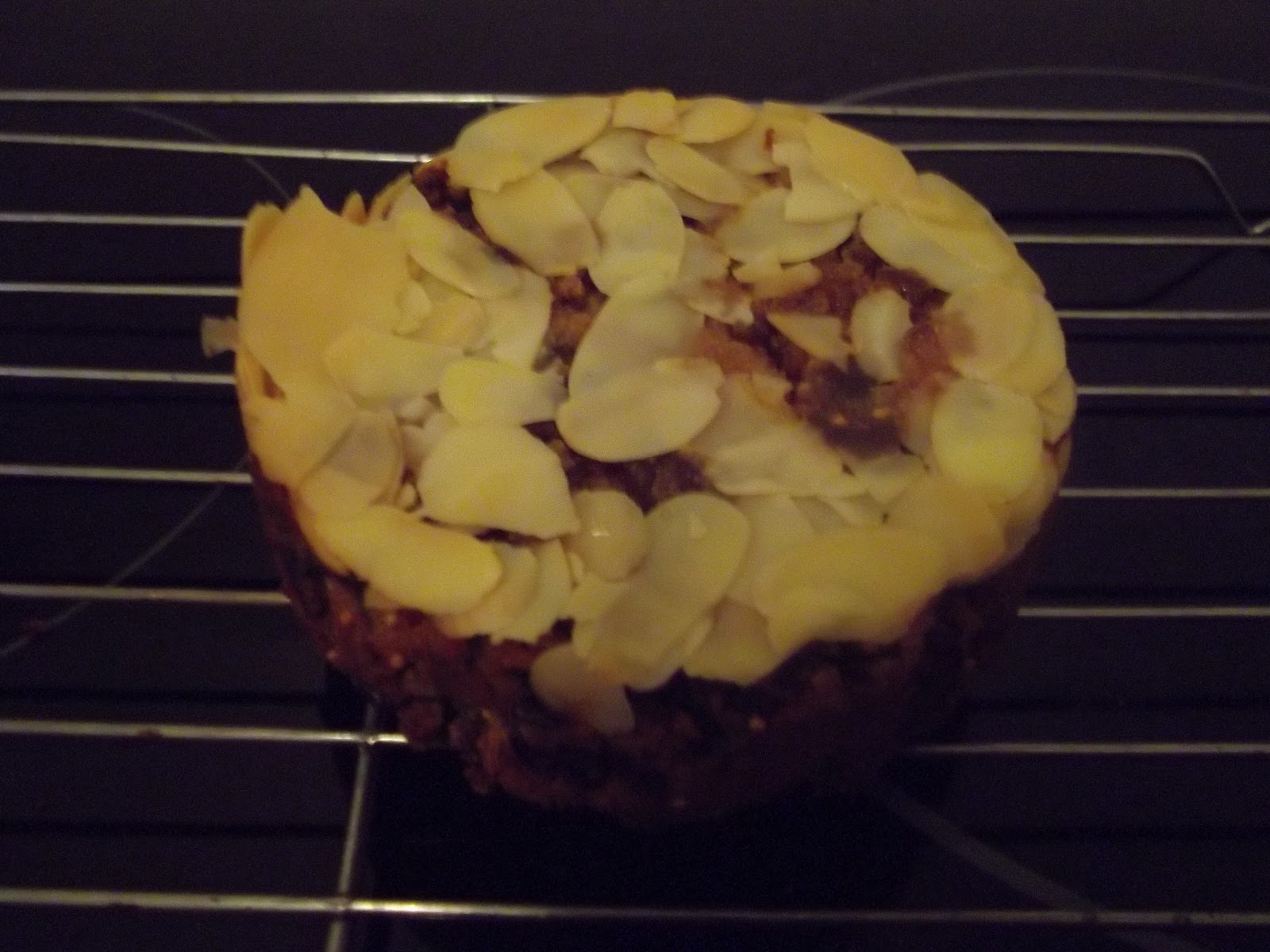
I adapted a recipe for Figey from the book Pleyn Delit. I did a test-run of the redacted original recipe, and it was delicious but didn't hold it's shape very well. For the final product, I added egg as a binder and extra almond meal to firm up the mix. I baked the mixture slowly in a log tin that was 3/4 full.


The mixing bowl full of spicy, fruity goodness
I forgot to take a picture of the log as it came out of the tin, but this should give an idea of how it looked. I used the leftovers to do a 'test' pudding to make sure the taste and texture was good. The yule log itself did not have flaked almonds on it though.


The pudding was shaped and a 'branch' added. The pudding was covered in marzipan which was painted with food colouring to look like a tree. I used a toothpick to put lines and whorls along the trunk and growth lines at the 'cut' end of the log. A depression was carved on the 'trunk' to hold an eggshell, and there was room for another eggshell in the 'vee' of the trunk and branch. Warmed brandy was poured into the shell and set alight to create the illusion of a flaming yule log. The subtletie was very well received by the guests.


The finished log before the eggshells were added


The high table at the feast


Monday, July 16, 2012

Sugarplate Hellebore Subtletie

For our recent Midwinter Coronation, I was asked to make a subtletie with a hellbore (Christmas rose)  theme.

Hellebores image from  serenityinthegarden.blogspot.com

I decided to make the flowers and leaves out of sugarplate and the base and supplementary leaves out of marzipan.

I used a bowl to make a base of silver foil which I covered with tinted marzipan to create a 'knoll'.


The plate I used as a mould


The foil base for the knoll

I tinted some marzipan green and rolled it to lay over the foil base. I added extra marzipan leaves to cover the sides.


The marzipan knoll drying
I made the flowers and main leaves out of sugarplate. There are many period recipes available in books on the internet; I avoid ones which contain egg white because the sugarplate is not cooked. I use a mix of superfine sugar, lemon juice, gum dragon or gum tragacanth and rosewater. It tastes a lot like Easter egg candy.

I originally moulded my leaves and flowers by hand, but they were very irregular so I changed to a cutter.


Some leaves and flowers drying flat on a plate


I let some of the leaves and flowers dry in an egg carton to give them a more natural shape


I used green lustre dust to tint the inside of the flowers. In period, parsley juice was used as a green colouring agent, but it does not taste very nice, so I used a commercial colour.


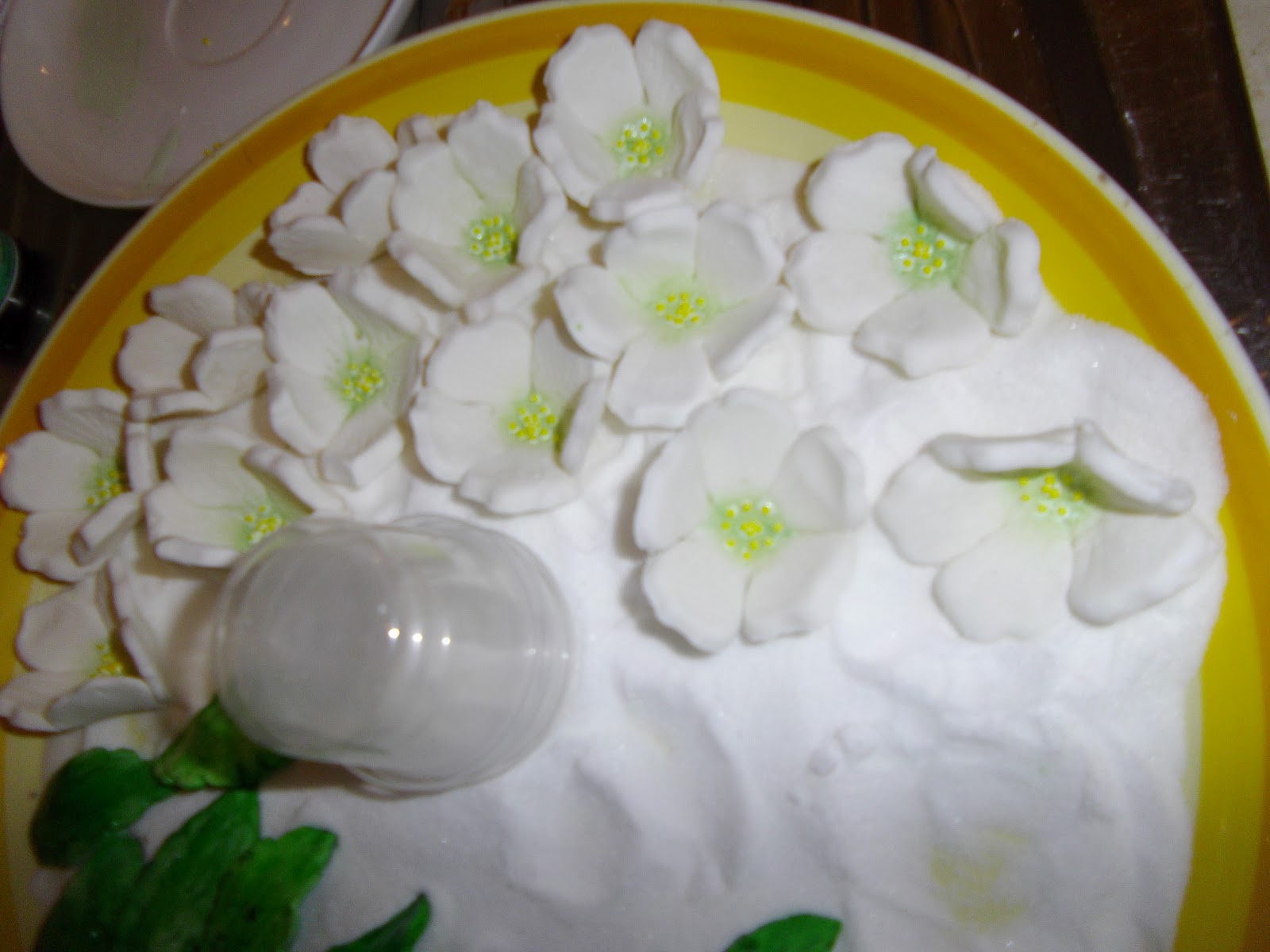
Flowers drying on a bed of sugar


Next, I 'glued' yellow non-pareils one by one to the centre of the flowers. I used white icing as 'glue' and applied them individually with a toothpick.


I was really delighted with how they turned out. 

I left them to dry. A couple of days later, I noticed that the icing 'glue' had 'melted' the lustre dust and the yellow on the non-pareils. I was VERY disappointed.

The 'melted' flowers

Non-pareils drying - minus the lustre dust.

I had to do some cosmetic repairs with new non-pareils and lustre dust to make the flowers look better. Then I began the tricky process of putting the subtletie together.


The dry base ready for flowers


The first flowers are placed


The flowers and leaves are arranged and glued


The subtletie drying

The subtletie had to be covered and transported to the event site. I was worried about damage in transit because the site was up in hills and the subtletie had to survive very winding roads. It made it to the event safely, although a few non-pareils did fall off in transit and one flower cracked.


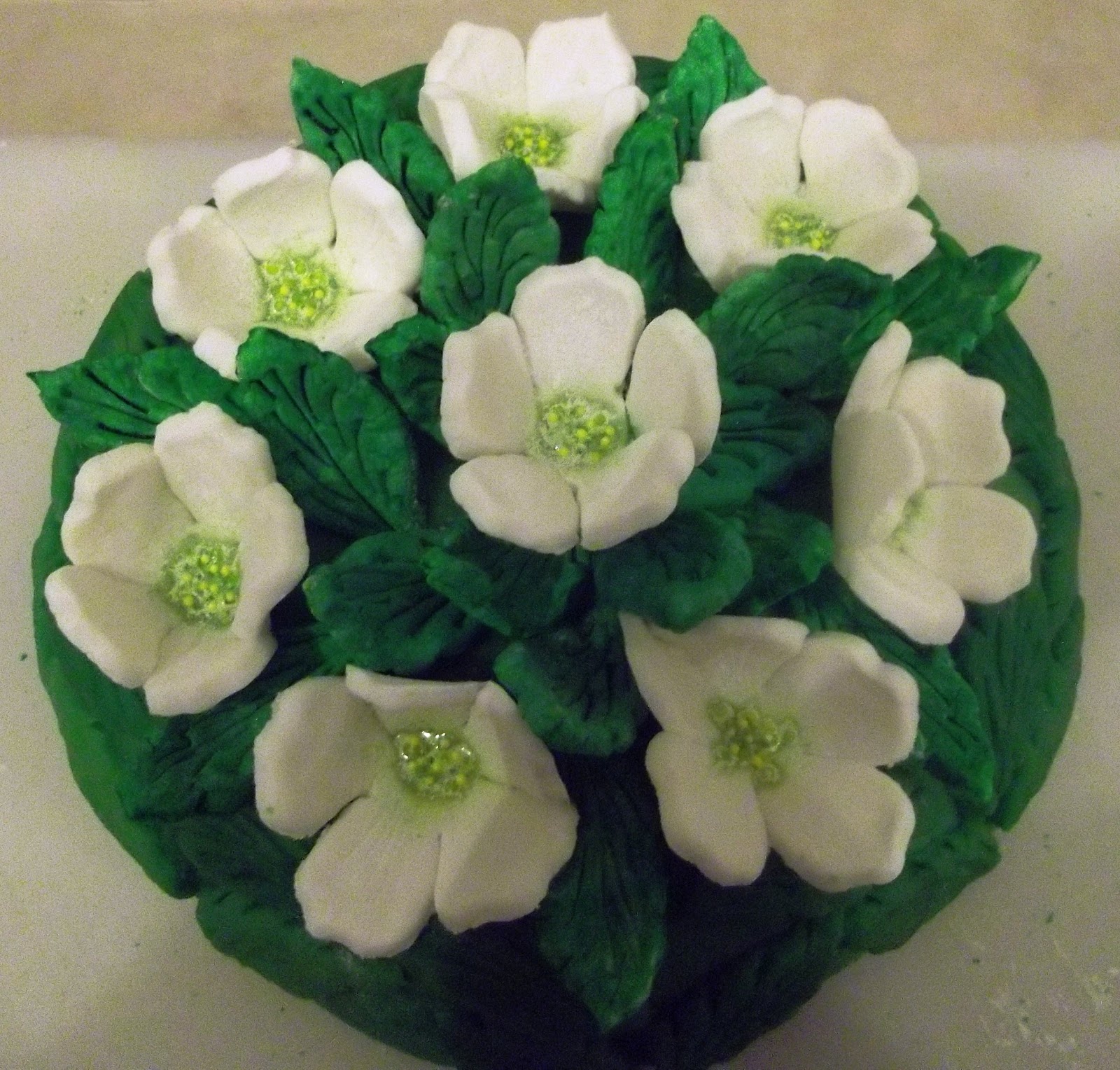
The completed subtletie ready to be presented to High Table.


Sunday, July 15, 2012

Cornucopia Subtletie


Here is a cornucopia that I collaborated on as a presentation piece for the recent Midwinter Coronation. It was presented to High Table and was well received.

Another talented member of my Barony made the pastry shell of the cornucopia and pastry leaves. The cornucopia is ornamented with decorative pastry swirls.

I made marzipan fruits to spill out from the horn of plenty and supplemented them with gilded nuts.


gilded chestnuts

gilded walnuts

marzipan fruits dusted with sugar placed for presentation


Wednesday, March 14, 2012

Hirchones/Hedgehogs

It has been a thundery day where I live; very humid. I cut out an Elizabethan loose underkirtle and a new Elizabethan sleeve pattern. When the garment is eventually finished, I will blog a write-up on how it all went.

In the spirit of all things renaissance-y, here is what I made to go with tea. I used Constance Hieatt's version of the recipe. I think it came from 'An Ordinance of Pottage', but it may have been 'Pleyn Delit'.

Hedgehogs made of  pork mince, spices and slivered almonds

Hedgehogs after cooking
Everybody enjoyed them!


Wednesday, February 1, 2012

Some completed subtleties


I will be quite busy over the next week or so, so I will go back to posting pictures of items that are already completed. Here are some photos of sugar plate and marzipan subtleties that I have made.....

A sugar plate cat that was filled with marzipan fish

Subtleties or 'soltelties' were illusion foods designed to astonish and amuse guests. They were very popular at feasts and were a demonstration of wealth and prestige as well as a way of honouring guests. There are many accounts of amazing illusion foods being presented at feasts in the sixteenth century. I prefer to focus on sweet subtleties with components like sugar plate, marzipan, toffee and gingerbread.

Sugar plate for the Mongol Feast


A sugar plate flower


Putti plate surrounded by sugar strawberries and bay leaves

This one suffered a bit of damage and got cracked

Marzipan strawberries

The mystical SpiderPig, made from marzipan and sugar plate

One of my first subtleties - A 'silly bub' in syllabub for a Fool's Feast


And for the same feast, a fruit fool in a jester's hat of marzipan