Friday, July 28, 2023

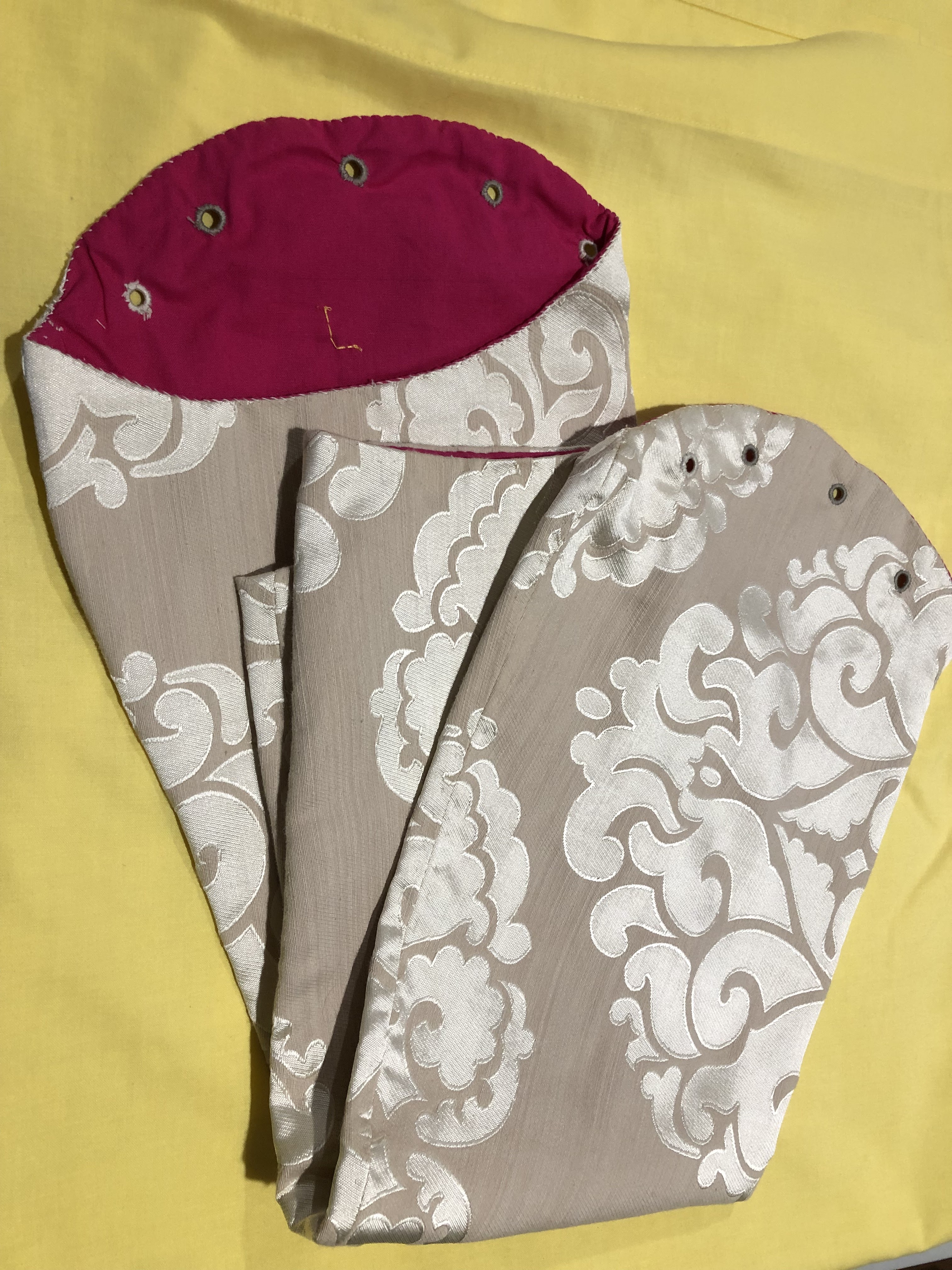
Red Velveteen Tie-On Italian Style Sleeves

Sleeves again this week, and boy! am I happy with these! So rich and soft - I love them. I got the velveteen before the quality of cotton velveteen being offered by my local Spotlight dropped, and the fabric is lush.


These were created in the same way as previous iterations: the pattern is my roomy, self-drafted pattern that is super comfortable and very wearable. The centre back seam of velveteen and stash fabric lining was machine sewn and hand felled. Then the pieces were put together, wrong way around, and machine sewn. The arc at the top of the sleeve was clipped, and then the sleeve turned right way out ("bagged out"). I generally choose to do a small whip stitch around the top of the sleeve to stop the lining rolling out with wear, and I did that with these. I usually embroider an 'L' on the left sleeve lining before hemming also, just to help with speedier dressing on those days when I am in a rush or brain foggy.

I hemmed the outer sleeve first, anchoring it with small stab stitches. Then I hemmed the lining; turning the lining under quite a bit more so that it won't show when I move my arms.

The final step is to slog through one of my hated jobs - eyelets. I am getting faster at them, but they are very hard on my sore hands. I generally use 4 strands of waxed sewing thread, and use an awl to make a hole. I then do a double running stitch around the hole and then cover the edges with what is essentially a satin stitch.

I am super happy with this pair of sleeves; they feel so wonderful to touch.

Thursday, July 20, 2023

Purple Tie-On Italian Style Sleeves

I'm still working on the UFO pile, and this week's completed item is a pair of Italian style tie-on sleeves in linen. 
They are lined in black cotton remnants, with hand worked eyelets. I had to ease in the linen on one of the sleeves, which has led to a small amount of wrinkling around the wrist on one of the sleeves. Hopefully it will settle with wear, or at least not be noticeable, because I don't feel inspired to unpick the sleeve and lining hem and re-sew the inner seam of the lining (especially since the inner seams on sleeve and linings are felled).


Saturday, July 15, 2023

Italian Renaissance Hair Jewellery

Yet another hair band, with pieces from two different filigree bracelets sewn onto a velvet ribbon band and backed with grosgrain ribbon to reduce slippage. I used three wig clips on the back for extra security.


Saturday, July 8, 2023

Italian Renaissance Hair Jewellery

 Another hair band this week, constructed in the same way as the previous ones. This one has necklace components sewn on to the velvet ribbon. Probably too sparkly to really be appropriate for sixteenth century, but I couldn't resist it!

This one has 2mm seed beads sewn along the edges. I recently saw a beading technique demonstrated on Instagram that might be useful for this sort or project - I will let you know how I go.


Friday, June 30, 2023

Italian Renaissance Hair Jewellery

I recently finished another billament/hair accessory. This one has been sitting around in a half-finished state for literally years because I wasn't super happy with how it looked.

The flower shaped findings came to be with a 'patina' that I wasn't delighted about, and when I made the band up, it just seemed to look a bit shabby and be lacking something. So it sat in the UFO pile for a long time.

I resolved to finish it as part of my recent UFO completion drive, and I added matte gold seed beads (4mm) on the joins between the flat findings, to disguise the stitches and give add a bit of textural variety. I then started sewing the grosgrain ribbon on the back, and added white tiny seed beads as I went. When that was complete, I added three wig clips on the back to hold it in my hair.

It is still not my favourite accessory that I have ever made, but I am pleased that it is finished. Hopefully it will look nice when worn.
 
This image (a detail of Sister Minerva from 'Portrait of the family of the artist' by Sofonisba Anguissola) shows how the band will be worn; either in front of dressed hair such as hair taping, or in front of a caul. Image fromSofonisba Anguissola Portrait of the family of the artist. Fragment. Sister minerva, 1568, 122×157 cm: Description of the artwork | Arthive

Here is the full painting:


Sunday, June 25, 2023

Italian Renaissance Hair Jewellery

I'm having a break from boring sleeve sewing and finishing up some headwear that has been sitting around for a long time.

I really like the Italian style of wearing a necklace or decorated band in the hair in front of the braid like in this portrait by Sofonisba Anguissola

Image from: Sofonisba Anguissola - Portrait of the Artist's Sisters Playing Chess - WGA00697 - The Game of Chess (Sofonisba Anguissola) - Wikipedia

Since a lot of our SCA events are outside in public places, I don't feel confident pinning jewellery to my hair, and instead have been sewing jewellery components and beads to velvet bands that are secured into the hair with wig clips.

It is fiddly work, doesn't take up much room to store, and very easy to put off for another day!

I recently finished this one, which has bracelet pieces sewn onto a velvet band and separated with gold coils. The edges have tiny gold seed beads sewn on, and the back is faced with grosgrain ribbon (which helps grip the hair). I use a central wig clip and one at each end to secure.

I got a lot of elements suitable for this type of band from shops like Lovisa, Diva and Collete pre-Covid. I don't really go shopping like I used to, but thrift stores and op shops can be a good place to pick up old bracelets that you can break down to make this style of headwear.


Friday, June 16, 2023

May Day Challenge - Tie-On Italian Style Sleeves #3 (Purple)

 Last year Duchess Constanzia Moralez of Lochac set a Challenge to all those interested -The May Day Challenge (a personal challenge on 'how to improve your SCA in any way by May Day, AS LVII'). 

Image credit: R. Vess

My Challenge was to work on that UnFinished Object pile and get some items finished. My friend won Crown during the Challenge, and so some of my energy was diverted into helping create garb for Them and Their Household, but I did manage to get some items finished before the Challenge ended.

This pair of sleeves had been languishing in the UFO pile, cut out but unsewn. I machine sewed the centre back seam on the lining and outer fabrics, and stab stitched the seams open. Then the sleeves were joined at the shoulder seam and the lining and outer parts were hemmed individually. I then whip stitched around the top of each sleeve to prevent any movement in the lining, and worked five eyelets at the top of each sleeve.


These sleeves look blue in the picture but are actually purple.


Sunday, June 11, 2023

May Day Challenge - Tie-On Italian Style Sleeves #2 (White with gold trim)

 Last year Duchess Constanzia Moralez of Lochac set a Challenge to all those interested -The May Day Challenge (a personal challenge on 'how to improve your SCA in any way by May Day, AS LVII'). 

Image credit: R. Vess

My Challenge was to work on that UnFinished Object pile and get some items finished. My friend won Crown during the Challenge, and so some of my energy was diverted into helping create garb for Them and Their Household, but I did manage to get some items finished before the Challenge ended.

Second is another pair of sleeves that just needed two more eyelets added on each sleeve and the top edge whip- stitched to be wearable.


Tuesday, June 6, 2023

May Day Challenge - Italian Style Tie-on Sleeves #1 (Cream damask)

Last year Duchess Constanzia Moralez of Lochac set a Challenge to all those interested -The May Day Challenge (a personal challenge on how to improve your SCA in any way by May Day, AS LVII). 

Image credit: R. Vess

My Challenge was to work on that UnFinished Object pile and get some items finished. My friend won Crown during the Challenge, and so some of my energy was diverted into helping create garb for Them and Their Household, but I did manage to get some items finished before the Challenge ended.

First up is a pair of sleeves that just needed two more eyelets added on each sleeve. (An easy task to put off, because I hate doing eyelets!)


Tuesday, May 23, 2023

Embroidered German-style Brustfleck - Eagle Design

I recently had the opportunity to help make an embroidered German-style brustfleck for His Majesty. The talented Sir Eva designed and traced out the complex design as well as supplying the materials.

The designed was traced out in Frixion pen and embroidered with DMC floss in one, two or three strands (depending on the area of the design). The main part of the embroidery was done in split stitch, but there are also elements that have satin stitch, backstitch and double running stitch.


Once the embroidery was finished, it was cut out and adhesive was added on the back. I fused the bird to the silk background for extra stability and stitched the panel edge down with tiny stitches. Then I couched down over the edges with silver cord.
The completed panel was then given back to Sir Eva for points to be added. Many thanks to Sir Eva for doing all the hard work in a very limited time frame!


Friday, April 28, 2023

Italian Style Green Gown for a Young Woman - Completed

Here is the completed outfit that I referenced in an earlier post. There are three foreparts and two sets of sleeves that go with the dress and it is mostly handsewn.


Tuesday, April 11, 2023

Sleeves - Italian Style Green Gown for a Young Woman

These are the sleeves that I made to go with the green Italian style gown that I did an earlier progress post on. 

The sleeve pattern is not in the traditional 16th Century style (with the seam running down the outside back seam), but rather a modern style sleeve with the seam underneath. This is because the patterns for  the bodice and sleeves were 'guess-timations' as the wearer was not available to be fitted.

The plain pair is self -lined, and the pair with hand-sewn trim have a light calico lining because the trim adds quite a lot of stiffness. The sleeves tie on with ribbons through hand-sewn eyelets. I fell my seams by hand to keep everything nice and flat, and I prefer to sew the sleeve hem and lining hem separately so that I can offset the lining to prevent it rolling out if the sleeve stretches a bit with wear.


Friday, March 31, 2023

Italian Style Green Gown for a Young Woman

I have been occupied for the last few weeks with a project for a friend. 

Lochac's big SCA event 'Rowany Festival' is coming up, and a young friend wanted to learn how to make an Italian style dress and make a new one in time for Festival. It was a great opportunity to pass on skills, but (as so often happens) there wasn't enough time to get much done during our designated time together. I have been working on the outfit when my health allows, and I can finally see the light at the end of the proverbial tunnel.

The dress is made from a hard wearing and washable cotton drill and lined in drill and calico. The light boning is removable as the wearer is still adjusting to boned garments. There is a pleat at the hem to allow for growth. Three seams are machine sewn, with all other sewing, including seam felling, being done by hand. The dress has commercially made trim applied. The pattern is based on an existing 16thC style dress that is comfortable for the wearer.


Some excellent images of 16th century working class dress can be found here:

Italy: Working Class Dress (1575-1600) - Sophie Stitches (weebly.com)

including this detail from the Nativity of Mary by Pietro Ronzelli which is in the style of the recipient's wardrobe-


Thursday, March 23, 2023

A split stitch design for a shirt, in the German style

I recently had a chance to make a collar panel for a friend's shirt as part of a collaborative project.

I used this pattern from 'Book of Embroidery: 1534', by Johan Schartzenberger, Woodcutter of Augsburg as my inspiration.

Time was short on this one, so I made some adjustments to make working the piece a bit faster.

The original woodcut is a bit wonky in places, as so many of the period embroidery designs are. I am always torn whether to alter the design to make it more symmetrical, or leave it as is. I altered some of the wonky bits, but left the majority of the design as it was published.

The base fabric is linen (donated by THL Sorcha - thank you). The embroidery is worked in split stitch with a bit of double running stitch. I traced the design onto the linen using a Frixion heat-removable marker and a light board.


Overall, and given the time restrictions, I am fairly happy with how this piece turned out. Now it has been passed onto the next person for making up.

Many thanks to THL Sorcha for donating the linen.


Thursday, March 2, 2023

Mouse Pouch

In my SCA Kingdom, admission to the Mouse Guard is given by the Crown in recognition of the contribution to our Kingdom by children between the ages of four and thirteen years old. Recipients are traditionally presented with a red pouch known as a 'mouse pouch'.

I found this unfinished mouse pouch in my Unfinished Object (UFO) pile, just lacking eyelets and ties. So I finished it off, and presented it to His Majesty to be presented to a new member of the Guard sometime in the future.


I'm pleased to have another UFO completed, and relatively happy with how the pouch turned out (although I would thread the ties differently next time).


Thursday, February 23, 2023

Post- Christmas Sewing Projects

 Hello everyone and apologies for the delay in posting. The usual post-Christmas flare has meant that I haven't been able to do most of what I wanted to get done. I have had a lot of very boring mending to do as well as mundane sewing, so I haven't had much to report that relates to historical projects - plus internet connectivity has been an issue.

I hope everyone had a pleasant festive season. I received a lovely, thoughtful gift from one of my friends.

The seam ripper has a hand-made wooden handle and was commissioned by a local artisan in Queensland (and has already had quite the work-out).

The yarn is hand spun by my friend. She only taught herself to spin in the last year or so, and I am very impressed. I need to think of a suitable project to showcase it.

Tuesday, November 15, 2022

Stringing Award Tokens

I have lots of little jobs on the to-do list, one of which has been to string some of the tokens we give to A&S judges.

I always seem to manage to get them tangled up, so I am going to see if putting them on cards is more effective.


Saturday, November 5, 2022

Coptic Roundel Embroidery

I recently made a start on a project that I have wanted to attempt for a long time but which has slightly intimidated me.

When I first got involved in the SCA and was interested in embroidery, I saw this piece of Coptic embroidery from the 7-8th century CE which is held in the V&A Museum .


Search Results | V&A Explore the Collections (vam.ac.uk)

(This is one of the other pieces assumed to be from the same tunic and held by the V&A Museum)

I loved the colours, and the unusual, almost cartoonish quality of the piece. I also loved the richness of the colour and texture of the densely worked stitches. I didn't know anything about the Coptic culture, but I knew that one day I would attempt something based on this piece.

The Copts were Christians from Egypt. Originally the term was used for all Egyptians, but came to mean Christians after the Muslims conquered Egypt in 639-646 CE (Wikipedia). These embroidered roundels have Christian imagery on them, and are from the seventh or eighth century.

The Egyptian culture is so old; Egypt has been a centre of global commerce for a very long time, and during the middle ages was at the axis of trading systems which linked Asia, Africa and Europe. There were two branches of the Silk Road there, with Alexandria (Mediterranean Sea), and Berenice (Red Sea), and a connecting road allowed products to travel between the two cities (and by extension, Asia to Europe and vice versa). There have been examples of Chinese silks and ceramics found in ancient sites, suggesting the great extent of the trade going on (UNESCO Silk Roads Program).

 The extant piece of embroidery is one of three in the same style (V&A accession numbers 814-1903, 815-1903 and 816-1903,), and all are quite big (around 20cm). I decided that an easy way to get a start on a project like this would be to start with some small roundels adapted from the border design of hearts (apples? modified arrowheads?,) and flower shapes. I have drawn up simple patterns for these and traced them onto scrap  linen with a Frixion marker. I am unsure how designs would have been drawn on at the time of construction of the original piece; perhaps ink, sharpened charcoal or chalk/ochre. In the sixteenth century, ink was definitely used to draw out embroidery designs, because there are extant unfinished examples showing the ink lines. I haven't seen any extant pieces from this time or region showing exactly how they did it.

As I have done more reading about Coptic textiles, I realise that I was lucky to find this piece as embroidery on Coptic tunics is relatively uncommon. Of the many extant clothing pieces (tunics) from the region that have been preserved by the hot and dry climate, the majority are highly decorated, and the main form of decoration is woven into the cloth. The V&A suggests that this unusual series of embroidered pieces may have been embroidered or imported by a non-Egyptian and that they were probably all from the same tunic.

The V& A Museum believes that these roundels may have been worn by a Coptic priest, possibly due to the religious scenes embroidered in the roundels (the Annunciation and Visitation). However, lay people and clergy wore the same type of decorated tunics. The tunic may have looked similar to this 6-8th century CE child's tunic held by the Walter's Art Museum – all extant tunics that I have seen follow a similar style.

 Tunic | The Walters Art Museum


The description of the pieces on the V&A Museum website simply lists embroidery on linen. The excellent zoom feature on the site allows the user to zoom right in for a closer look. The stitches look to be a combination of long and short stitches, split stitches and forms of couching.

I plan to use my mini-roundels on a tunic for a child, and so I opted to use split stitch. I like the speed with which long and short stitch works up, but I felt that split stitch would probably be more durable as the stitches are more densely packed and closely anchored.

I used silk floss on linen and will apply the roundels as slips. The original seems to have been worked straight onto the linen background, but kids grow out of things so fast that it seems like a good idea to do slips so they can be removed and reused if need be.

I love the lustre of the finished product but was very surprised at how long it took to work just one roundel. It has certainly given me an appreciation of just how prestigious a garment the original would have been, as well as how the embroidery would have glowed in the light.

When I have finished the current series of floral designs, I may experiment with using long and short stitches/satin stitches – perhaps on the 'heart' design. I have knotted my threads off on the back of the piece for extra durability.


Websites accessed

New World Encyclopedia 'Copts' Silk Road - New World Encyclopedia - accessed 29/10/22

Pinterest Pinterest -accessed 29/10/22 – well, daily, really :-)

UNESCO Silk Roads Program Egypt | Silk Roads Programme (unesco.org) - accessed 29/10/22

V&A Museum Search Results | V&A Explore the Collections (vam.ac.uk) - accessed 29/10/22

Walters Art Museum Tunic | The Walters Art Museum - accessed 29/10/22

Wikipedia 'Copts' Copts - Wikipedia - accessed 29/10/22