Monday, November 18, 2019

A Woolen Tunic with Short Sleeves

Back in June when I made the long sleeve woolen tunic for a friend, I also made a short-sleeved one. The wool was lovely to work with; no fraying and beautiful to hand sew. I used the same 'pattern' as the previous tunic - basically just rectangles, squares and triangles. The main body is two rectangles. The sleeves are four rectangles. There is an underarm gusset which is a square, and triangles of fabric are added into the 'skirt' to add fullness.

I don't know the artist of this particular pattern but it is a good indicator of how the layout of my tunic looked. I didn't use a faced neckline because the wool was quite bulky, but the rest of the layout is very similar. I measured the wearer's body and added a little extra for ease of movement plus seam allowances.
I sewed the long seams by machine.
Once the seams were sewn, I whipped the seams open and down.
I added a supportive placket around the collar split so that the pressure of normal wearing wouldn't end up ripping the split at the front.
The rest of the neckline was turned down with a small hand-sewn hem to reduce bulk.


I left this tunic plain so that the recipient could sew trim on if he wanted. I have yet to get a photo of him wearing it, but it looks nice on.


Friday, November 15, 2019

Heraldic Favour

Another project that I completed recently was a heraldic favour. It is a simple sash with a representation of my device embroidered on it.
 I marked the design out by tracing it with frixion marker.
I embroidered the design with split and satin stitch. I tried to add some texture to the satin stitch. I added a shiny black bead for the eye.
 I sewed the panel into a sash and added some gold braid at the bottom.
I made the pin by adding a hat pin to a purchased heraldic seahorse pendant.

Wednesday, November 13, 2019

Indoor Heraldic Banner

As well as a silk banner, I made an indoor heraldic banner for  my friend.

I used velveteen as the base material and cotton broadcloth for the backing. I usually pre-rinse my fabric in hot water and dry and iron it before starting a project.

I enlarged the owl shapes and cut them out of felt (which I also used for the band across the top). I like using wool felt because it is easily available and doesn't fray.

I whip stitched the felt down and then embroidered over the edges. I couched a piece of gold cord across the edge of the band across the top.


 I embroidered on the details of the owls.

 I gave the owls multi-layered felt eyes to give a sense of depth.


Once all the details were done, I put the backing fabric and the embroidered velveteen panel face to face and machine sewed around most of the edges. I left a small section un-sewn. I clipped the corners to reduce bulk and then turned the banner right side out, pulling it through the un-sewn section. This technique is called 'bagging out' and is useful for sewing banners. It is important to make sure that the inside seams are sitting nicely; I run a bone turner or blunt knitting needle along the seams on the inside.

The final steps involved hand-sewing the smalls section shut and then turning a section of the top down and towards the back to make a hanging rod pocket. I whipped the section down, making sure my stitches did not show through on the front of the banner.

Finally, I sewed a section of creamy gold onto the bottom of the banner to finish it off.

Good starting points for researching medieval banners include:
https://en.wikipedia.org/wiki/Heraldic_flag
http://www.larsdatter.com/banners.htm
https://www.southerntailors.com/blog/the-origin-and-evolution-of-the-gonfalon/
https://www.theheraldrysociety.com/articles/heraldry-in-italy-during-the-middle-ages-and-renaissance/
https://www.southerntailors.com/blog/the-origin-and-evolution-of-the-gonfalon/

Monday, October 28, 2019

Painted silk banner

I recently tried my hand at silk banner painting for the first time. I had attended a class on silk banner painting in 2018 which was run by Sir Eva von Danzig and I used the notes from that class as my guide. The aim was to create a heraldic field banner for a friend.

I used Settasilk silk paint and gutta and a fine silk background fabric.
The first step was to draw up my design. I drew it on tracing paper and went over it with a felt tip pen.
I traced the design onto the silk using lead pencil.
The next step was to stretch the silk out and attach safety pins around the edges. I used rubber bands (looped around the safety pins) to attach the silk to the frame. I made the frame out of PVC tubing. Once it was evenly stretched with good tension, I used black silk gutta to draw the outlines. I was so nervous (as this was for a friend) that my hands were really shaking and so my lines were quite wobbly.
Once the gutta was dry, I added the silk paint. There were a couple of areas where the paint ran past the gutta lines. I did two coats of blue and two coats of yellow, with some orange highlights, letting each coat dry before adding the second.
Then I let the banner air dry thoroughly.
I left it on the frame in a warm place to completely dry.
Once the paint was fully dry, I ironed the banner under an ironing cloth with a dry iron following the manufacturer's instructions.
I turned the edges over twice to form a small hem and pinned it into place. It was whip stitched down.
Checking to see how my own banner was constructed (as it was made for me by a friend,) I realised that the delicate silk has worn away at the tip of the banner. This made me decide to add a cotton broadcloth pole sleeve rather than use the silk fabric to hold the pole. Hopefully, it will make the new banner last longer. I also need to make a sleeve to put on my own banner to extend it's life.
 Essential tools
 
Pinning the sleeve onto the edge of the banner.
I machine sewed the banner sleeve onto the banner.
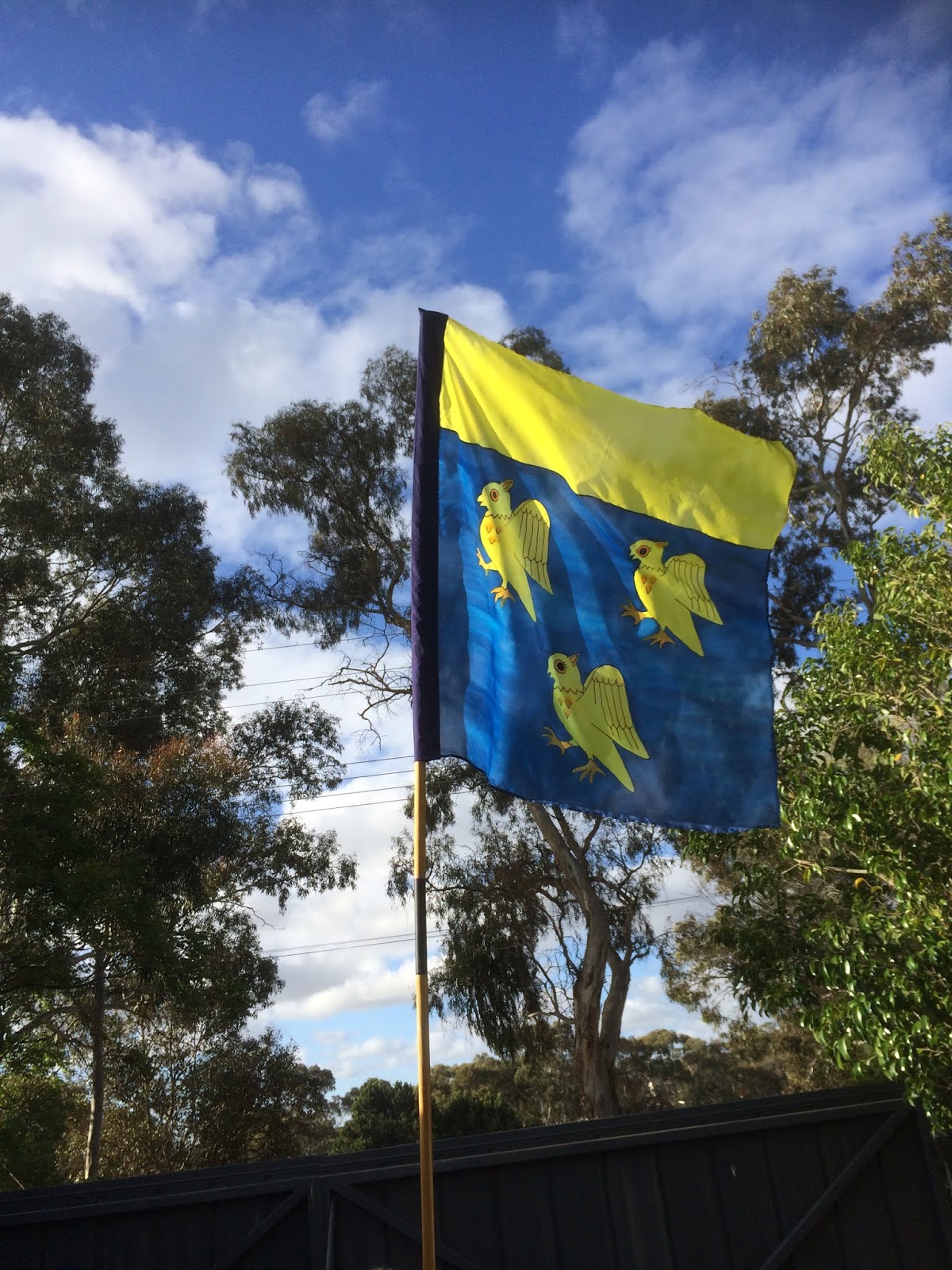
The finished banner flying.
I followed the instructions given by the manufacturers of Settasilk silk paint. If I did the project over, I would wash my silk first (called "scouring") and iron it. I also would use thicker gutta lines to reduce the chance of paint runs. I might try spraying the silk with a mixture of water and rubbing alcohol to slow down drying time and reduce the chance of lines in the background. And I would work out a way -somehow- to stop my hands from shaking.
This project was certainly a learning experience. Even though I was not very happy with my result, I learned a lot. I have a new and greater respect and admiration for people who make beautiful silk banners on a regular basis- the process was more challenging than I thought it would be.


Wednesday, October 23, 2019

Gilded Marzipan Fruits at a Pirate Tourney

I went to a pirate-themed tourney recently, and (as usual,) took plenty of food to share with my friends. Something that always has a big visual impact is marzipan fruits. They are so pretty, and adding edible gold leaf just adds that extra bit of richness.
Violas are in flower at the moment, and I wanted to candy some to add to the dish. I have concerns about using raw eggs in my cooking, so I attempted to candy them in sugar syrup. I made up a simple sugar syrup (with a high concentration of sugar and a splash of rosewater,) and soaked the washed flowers in it. Then I coated them in caster sugar. Once coated, I left them in a dish covered with sugar and with a few cloves for a couple of days to add a delicious scent. They didn't work out as nicely as when done with egg white, but I feel that was made up for by not having to worry about possible salmonella contamination. I will keep experimenting.

Tuesday, October 22, 2019

Short Holiday

I had a few days break on the coast at the end of September. It was a quiet trip as I ended up getting sick with a few infections, but luckily I have a great doctor there. I did some hand sewing and drew up some embroidery designs.


It is an area of stunning natural beauty, and a very nice place to recuperate.

Wednesday, September 25, 2019

A Sad Anniversary

Yesterday was the one year anniversary of my furry helper's death, and I wasn't feeling up to much.
I went through a couple of my UnFinished Object baskets and did some tidying up. I have an amazing array of unfinished items, but the standard of my work is noticably improving so I felt fairly positive about the nice things I will have when I get to work on the stack of incomplete projects.

Monday, September 16, 2019

Fealty Chain

This is the beautiful maille Fealty chain made for me by Law at the Mailed Stag.


Tuesday, September 10, 2019

Black Linen Front lacing Italian Gown for Summer


This was a quick project with some modern sewing techniques used to save time. I modified one of my other gown bodice patterns to drop the waist a bit, make the shoulders a little wider and put a bit more depth into the point of the bodice. I made this gown in January 2019.

The gown bodice was an experiment with no boning. The linen was lined with heavy cotton canvas and the two pieces 'bagged out' or sewn together with the machine. I hand sewed the bottom edge of the bodice and the armholes.

The trim is just simple ribbon, sewn on by hand.

The eyelets were all done by hand with an awl and sewing thread. I decided to add some bias binding along the front edges  and slip bones in for a bit of rigidity and to stop eyelets puckering. Once I tried the completed bodice on, I felt that it needed some extra boning, so I added bias at the centre-side seams and across the back of the bodice, and put four more bones in.

The skirt is simply a series of rectangles of fabric sewn together. I let the skirt hang for a long time to let the hem drop and reduce distortion due to the weight of the fabric.

I pleated the skirt on by turning the top edge under and then marking out regular dots along the skirt top edge. I ran a heavy thread through to draw the skirt up into cartridge pleats. Normally you would use a double row of thread to do this, but I cheated and only did one. The risks with one thread is that it may break and you will have to start all over again, and that the pleats may be slightly uneven if you are not very careful with your dot marking and needle placement. I usually do a two-part line of pleating; on a front opening gown, I run one line of pleating thread from centre-back to centre-front on one side, and do the same on the other. I find that it makes adjusting the pleats more manageable.

Once the lines of pleating thread are in, I put safety pins in to mark the centre-back and centre-sides of the skirt panel. I line the safety pins up with the corresponding side seams, centre-back point and centre-front point of the bodice. Then I carefully draw up my pleating thread, adjusting the pleats to sit evenly in their quarter. Then I adjust a quarter at a time to make sure the pleats are all evenly spread out and looking nice. A quarter panel at a time, I use heavy thread to sew each pleat onto the bottom edge of the bodice. I usually use four strands of sewing thread that has been waxed for strength. I also knot the thread off unobtrusively at about every 10cm point, so that if I were to rip some pleats out by accident when wearing the dress, the whole skirt will not fall off.

Once the skirt is on, I cut the pleating thread. This is optional; if you want defined cartrdige pleats, leave it in. I prefer less defined pleats so I cut mine. I hand finish the front opening gap of the gown and add a buttonhole bar at the bottom of the skirt opening for extra strength. I did not add hooks and eyes on the opening of this gown - I left a bit of extra fabric at the front of the dress that I could pin shut and would be adjustable. I then let the gown hang for several more days to  let the skirt drop if necessary and to let the pleats fall properly.

I had help from my dear Mum with the hemming, and I added some ribbon trim around the bottom when hemmed as well.

Finally, I used some scraps from gown construction and another project to make the pouffy sleeve heads (baragoni) that I like so much. I sewed strips of fabric together too make a panel approximately 2.5 times the size of the sleeve cap pattern that I drafted as a base. I pinned the puffs into place by eye, until I got roughly the look I was going for. This is a tedious task, but I can't think of a better way to do it.


Once pinned, I hand sewed down all the puff pieces in sections to keep it secure. Usually I make all the bulky fabric puffs point to the centre of the sleeve cap and then put the lining piece on top and machine sew most of the way around (without catching any of the puffs in the seam,) Then I trimmed the seams, turned the puff the right way out and hand sewed the gap shut. I also hand sewed around the edge of the entire puff to stop the bulky puff section moving or turning in. It is important to have a stable base for these puffs or they move around and stick up.

I added some lucet ties underneath so I can wear the dress with removable sleeves.

I made and wore the dress in January when it is very hot, and it was cooler than my other garb. I think I lengthened the bodice a bit too much and I have adjusted this on the pattern for future dresses.