Wednesday, July 29, 2015

Clock Necklace - Double Set

I grabbed a few minutes recently to make a smaller necklace (in matching beads) to go with my new clock necklace. I left a little space in the middle of the necklace to add a pendant at a later date when I find something appropriate.


Tuesday, July 28, 2015

Pink Pearl Earrings


I got an amazing bead bargain recently, and picked up some beads and findings for ten for $1. I made a pair of pearl earrings with my bargain buys. I used a different type of head pin than I usually do, and they are made of quite a soft metal. It will be interesting to see how the new headpins stand up to wear and tear.


The pearl beads were threaded on to a headpin and topped with a bell cap. Then an earring hook was added and the top of the headpin was bent over.

These earrings will be useful for sixteenth century garb, especially English and Italian clothing.

Monday, July 27, 2015

Wolf Banner Device


You may remember that my SCA Barony has an ongoing project of a banner that displays the registered heraldic devices of people in the group. From time to time I make a device for someone who doesn't have time to make their own. I recently finished this wolf device in felt.


The device before the eyes were added

Joke 'googly'eyes were added


Although I loved the 'googly'eyes, I opted for a less controversial type of eye and used black beads! They will be more durable as the banner is rolled up for storage and transport.


Saturday, July 25, 2015

Liebster Blog Award

I have been nominated by the Liebster Award by Nancy-Raven of Nancy-Raven's Attic. (Thank you Nancy-Raven.) You can find her blog here: http://www.nancyravencostumes.blogspot.ca/


The Liebster Award is basically an award that is by bloggers, for bloggers. It's passed from person to person to encourage connection and support within our writing community, and to aid in the discovery of new and upcoming bloggers. As such, here are some costuming and re-enactment blogs that I really enjoy following. I hope that you enjoy them too!

Is That An Apres http://daughterofthebull.blogspot.com.au/

It's About Time http://bjws.blogspot.com.au/

American Duchess  http://americanduchess.blogspot.com.au/

Dawn's Dress Diary https://dawnsdressdiary.wordpress.com/

The Parti-Coloured Fleur https://partifleur.wordpress.com/

opusanglicanum https://opusanglicanum.wordpress.com/

Racaire's Embroidery and Needlework http://www.racaire.com/

Madame Guillotine http://madameguillotine.org.uk/

A Damsel in this Dress https://adamselindisdress.wordpress.com/

La Bella Donna https://fleurtyherald.wordpress.com/

Katafalk https://katafalk.wordpress.com/

The Pragmatic Costumer https://thepragmaticcostumer.wordpress.com/

Monday, July 20, 2015

Clock Necklace

A friend in my SCA group organised some pendant clocks that we could use at events but that wouldn't look obviously modern. This weekend I finally managed to get time to make a necklace for mine.


It is strung on tiger tail wire with some clear glass, black gemstone and brass beads. I think I will make a smaller matching necklace to go with it so that I can wear them as a set.


Saturday, July 18, 2015

Reclaimed Seahorse Napkin


I recently found a linen napkin in an op shop that had a very worn cross stitch flower motif in one corner. It also had a nice decorative pulled hem. I bought it for two dollars, unpicked the motif and washed it. Then I embroidered the heraldic seahorse from my device in stem stitch in one corner.


The napkin after the motif was unpicked


I also ran a purple thread along the decorative pulled hem for a subtle highlight.


Detail of the finished embroidery

Thursday, June 25, 2015

More Syrup of Lemons

Well, the Syrup of Lemon was so popular that I am making more. This time I am adding some extra lemon zest to cut the sweetness a little.

Thursday, June 18, 2015

Elizabethan Coif Refurbishment Project

I have several Elizabethan coifs which are now too big for me, so I am gradually working on cutting them down to size and making a few changes to them.

One of the coifs that needs refurbishing

The only difficult thing about Elizabethan coifs is getting the pattern right for the wearer's head. I have found it to be purely a matter of trial and error. Playing around with paper and calico mock-ups before cutting your "good"fabric or starting your complex embroidery is definitely worth the time and effort.

In that spirit, I have been playing with patterns, and decided to make a simple coif which I hope will suit my face more than the old styles I have used before.


After working out my pattern, I cut the 'test coif'out in two layers of pre-washed white cotton voile.
I zigzgged the edges to reduce fraying, and sewed the two pieces together ("bag" fashion), leaving a small section along the bottom edge unsewn.


I turned the fabric right side out and whip stitched the bottom edge shut. Then I ironed the coif. I turned about a centimetre of the bottom edge up and did a small stab stitch to hold it in place to make a channel to thread a gathering cord through.

The next step was to put the two cheek pieces together by folding the coif down the middle vertically. 
I sewed the top edge together about two thirds of the way along with a whip stitch.

The last unsewn section of the top seam was then gathered with a tacking stitch. This is to allow a bit of space for braids or a bun at the back of the coif.


I confess, at this point, I completely forgot how to proceed. I have made several of these over the years and remembered that the gathered section is sewn up and then strengthened with buttonhole bars radiating out from where the gathers start and end (where my finger is in the picture above.) I needed a bit of a refresher on where to place the bars, but I couldn't find the book I needed. In the end I did three buttonhole bars radiating out from the centre to secure the gathering.


I will have to do this step in a bright colour next time to demonstrate the technique, because you really can't see the detail in this photo.

Once the gathers at the rear were done, I added some commercial bobbin lace with small stab stitches.


After that, I went through and did a little stitch on the edge to make sure the lace was sitting nicely.


I threaded a lucet cord (made by my friend Heather) into the casing, and the project was finished. I am quite happy with the fit, although I  may make the next pattern a centimetre longer at the bottom to cover my hairline. At least now I know which direction to head in with the coif refurbishment project!


Tuesday, June 16, 2015

Lemon Syrup

Having a respiratory infection, and lots of lemons, I was pleased to try this recipe:


SYRUP OF LEMON

"Take lemon, after peeling its outer skin, press it and take a ratl of juice, and add as much of sugar. Cook it until it takes the form of a syrup. Its advantages are for the heat of bile; it cuts the thirst and binds the bowels."

Recipe from 'An Anonymous Andalusian Cookbook of the Thirteenth Century' found at  
http://www.daviddfriedman.com/Medieval/Cookbooks/Andalusian/andalusian10.htm


Some quick Googling revealed that 1 ratl is approximately 468g.

I used 2 large lemons and 11 small lemons. Juicing these produced about 750ml of juice, which I added to a saucepan with the same amount of sugar.  I also threw in about a tablespoon or so of lemon peel which I peeled with a vegetable peeler. (I tried to avoid peeling off any of the bitter pith.)


I then brought the mix to a light boil, stirring regularly, and then let it all simmer until the mixture was no longer cloudy and thickened up a bit. After it had cooled, I strained the syrup to get a nice clear consistency. I ended up with around 700ml of undiluted cordial syrup.


I had hoped to try this syrup with hot water, but it was just so delicious and refreshing with cold water that none survived for a hot water taste test! I will certainly be making this recipe again for mundane and SCA use. If you like sweet/sour tastes, I think you will really enjoy it.

Monday, May 25, 2015

Navy and Purple Tourney Dress Diary- IRCC5


May has been a busy month for me. I decided to use thie Italian renaissance Costuming Challenge (http://realmofvenus.renaissanceitaly.net/challenges/IRCC2015/IRCC5-2015-Entrants.htm)  as an opportunity to try new techniques and experiment a little. This month I worked on a new tourney dress. I decided to try a front lacing dress with a large gap, and also to make it without boning. This was a big step for me, as I really like the support and smooth lines that boning gives.

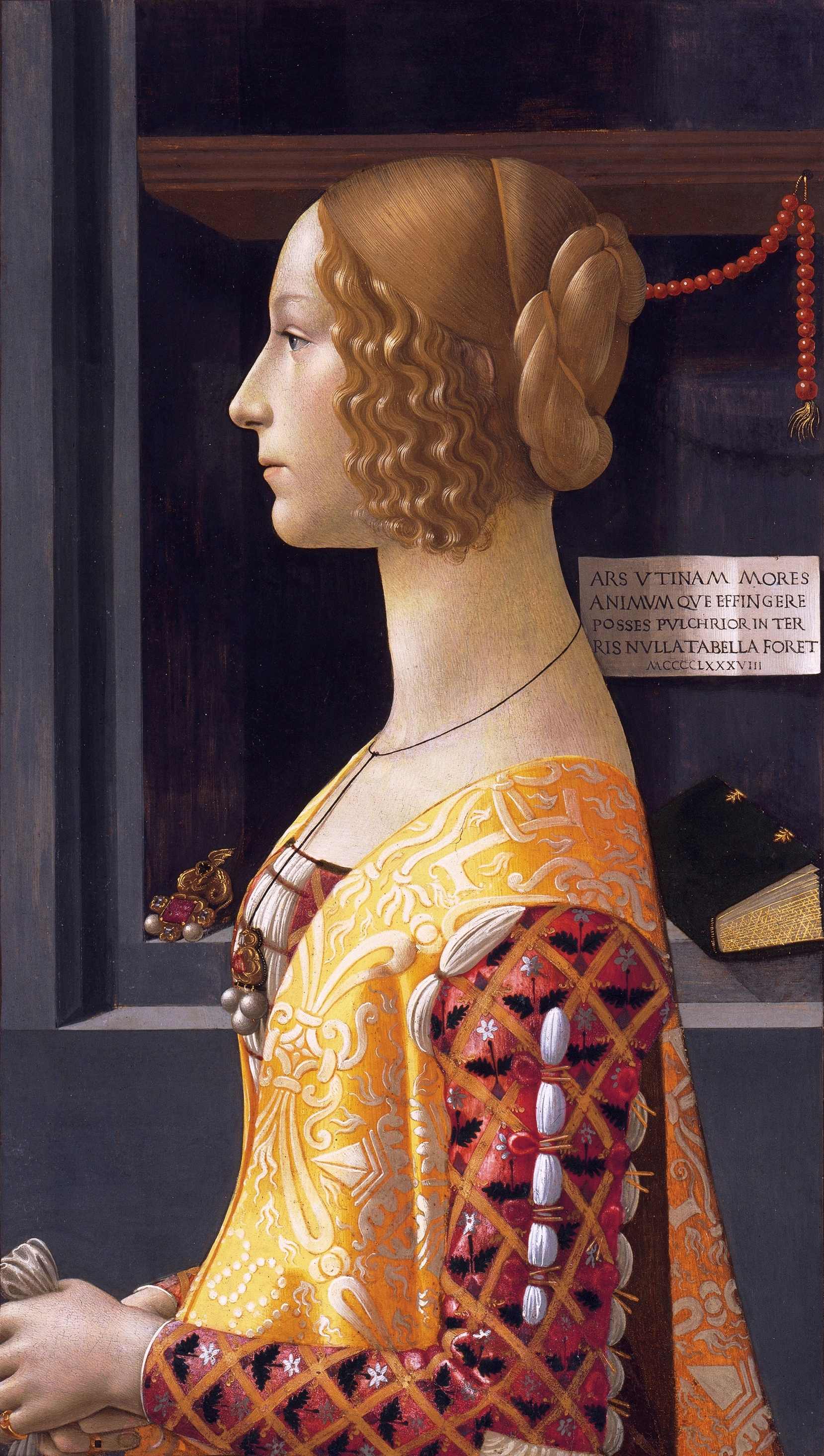
My inspiration was this style of dress as painted by Ghirlandaio:


image from- https://blogger.googleusercontent.com/img/b/R29vZ2xl/AVvXsEj1cfPPTc544n1nQg5N58H1s9jeSDSnAO79pSZSk_DH5YdCgSC3xO5UbZXq1M5jOBt-nFPJA22oAJEZX3hh613Wo-rJ93zcSG0pi6ZnRmMyiW-gZMsVTx27UglPqnfmwQE3kXsSctEFG5Jr/s640/w+Domenico+Ghirlandaio+(Italian+artist,+1449%E2%80%931494)+Ludovica+Tornabuoni+(2).jpg
I looked at many variations on this style and decided not to copy any particular one specifically. There are a wide range of bodice shapes, sleeve styles, lacing options, and trim designs seen in this period.


Portrait of Giovann Tornabuoni by Ghirlandaio
Image from: http://upload.wikimedia.org/wikipedia/commons/3/3b/Ghirlandaio-Giovanna_Tornabuoni_cropped.jpg


Detail from Birth of St John the Baptist by Ghirlandaio
Image from: http://it.wikipedia.org/wiki/Tornabuoni


Zaccharias Writes Down The Name of His Son by Ghirlandaio
Image from: https://blogger.googleusercontent.com/img/b/R29vZ2xl/AVvXsEh_CC-VZcpuD6gHsd8TJyFBhem2XH7xawzSpDtkJPCP-AaT-a-dKwFi9pYpdexGxcabmtEEq7bU5TvXiRaaVzmEtzm3IXjcqtsFRiHjTP7CUCBfv0vXC6PTms15jV2D7BIlWY-wXSV7PRCY/s1600/w+Domenico+Ghirlandaio+(Italian+artist,+1449%E2%80%931494)+Zacharias+Writes+Down+the+Name+of+his+Son+Ghirlandaio+Tornabuoni+Chapel.jpg


Birth of the Virgin (detail) by Ghirlandaio
Image from: http://www.poderesantapia.com/images/art/ghirlandaio/tornabuonibirth2600.jpg


I adapted an existing bodice pattern to make the neckline higher and more rounded. I cut my cotton fabric, lining and two interlinings and zigzagged all the edges. Then I sewed all the pieces together so I had an outer layer, two lining layers and an inner layer. I stab stitched all the seams open but did the rest on the machine to save time. Then I sewed the bodice layers together inside out, clipped the seams, and turned it all the right way out. I hand sewed the neckline the bodice and armholes closed.


(I have used this technique successfully in the past with boned bodices; I think that the plastic hoop boning that I like to use for bodices gives a thickness to the bodice and hides any bulk. I would not use this technique again for an unlined bodice because there is no hiding the bulk of all the seam allowances around the seam lines.)


Here you can see the bulky seam allowances showing through


I had a lot of fun playing with trim options:


But in the end, I sewed a line of purple gimp braid along the neckline edge for decoration.


I added brass lacing rings along the front of the bodice just to try a new option. I was a bit worried about using lacing rings on this bodice because I was worried that the rings might pull away from the fabric. I have worn the dress with a lightly boned pair of bodies, and it was fine. I just need to remember not to ''yank'' on the lacing in the way that I might do with a bodice that has lacing holes reinforced by boning. I think I do still prefer lacing holes though.


I added some lucet cord ties around the shoulder so that sleeves could be tied on. Thank you to Heather for making the cords for me.

I cartridge pleated the skirt onto the bottom of the bodice. I usually use 5mm pleats; this time I marked out 1cm pleats. My skirt was made of three equal rectangles of fabric joined together and finished at the top. I then turned the finished edge over to hide the machine sewing. Then I marked out a line of dots 1cm apart and went joined them up with a thick thread. Usually I use two parallel lines of quadrupled sewing thread to make my pleats. This time I tried out a short cut by using one piece of crochet cotton. It worked a treat and saved a lot of time, but I may just have been very, very lucky that the thread didn't break and cause me to have to start over again. I probably would go back to using a double row of threads next time, just to be on the safe side. Having said that, I managed to get the whole skirt marked out and pleated on in an evening, as opposed to the whole day that it usually takes me. I whip stitched through the centre of each pleat with a quadrupled strong thread to anchor the skirt to the bodice. I left a small split at the middle front of the skirt to make it easier to put on and take off.


After my trusty helper pinned my hem up for me (thank you Sharyn!),  I trimmed it and sewed it into place by hand.


 I added hooks and eyes at the front skirt split, but actually ended up just pinning the front into place when I wore the dress because it meant that I could adjust the lacing tighter or more loosely depending on  how I felt on the day.


 I am considering whether to add a line of purple ribbon around the bottom edge of the dress skirt.

The gown is not completely finished, and I am not completely satisfied with it, but it is wearable, and I am glad that I have tried a few new techniques.


Wednesday, May 6, 2015

Brown Velvet Padded Roll Italian Hat


You may remember that I recently made a padded roll style hat
(http://broidermebethan.blogspot.com.au/2015/04/italian-padded-roll-with-seed-beads.html). I had another on the go since last year that I originally intended to be a covered balzo, but it was so comfortable as a roll that I decided not to add the covering piece.

It is a tube of brown velveteen stuffed with Fibrefill. In period, rags, sawdust or horsehair would probably have been used, but Fibrefill is readily available and light to wear. Braid and velvet ribbon have been stitched to the roll, and two metal discs have been sewn on the front and anchored with beads. I sewed baroque freshwater pearls onto the velvet ribbon; white on the front and pale green on the sides.

All it needs now is another piece of velvet ribbon to cover the seam at the back.


Some examples of similar headwear:

Portrait of a Woman and Child by Paris Bordone
(This may be a Balzo)
Image from: http://realmofvenus.renaissanceitaly.net/wardrobe/BordoneBambino.jpg

 Rolls and braids
Image from: https://www.pinterest.com/pin/59883870020743031/


Maestro Palanquinos, h.1490-1500, Art Instute of Chicago, EEUU (detalle). Las tentaciones de San Antonio, anónimo, h. 1480, subasta (detalle)
Picture by Maestro Palanquinos c. 1480
Image from: https://www.pinterest.com/pin/59883870020860497/

Unattributed Image from ppp. 10-11 in "What Life Was Like At The Rebirth of Genius" by Time Life Books, ISBN: 0-7835 5461-3