Wednesday, March 26, 2014

Margery Kempe Autobiography

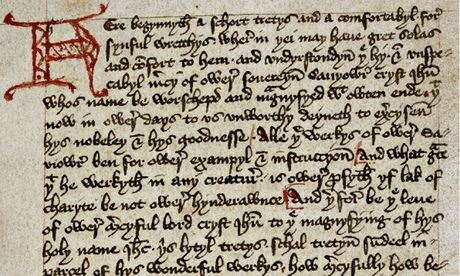
Margery Kempe, the first  

English autobiographer, goes online

The British Library digitises an original edition of the medieval mystic's  account of her life

Margery Kempe's autobiography

fromhttp://www.theguardian.com/books/2014/mar/20/margery-kempe-first-autobiographer-digitised-british-library


Monday, March 3, 2014

New Manizza/Muff


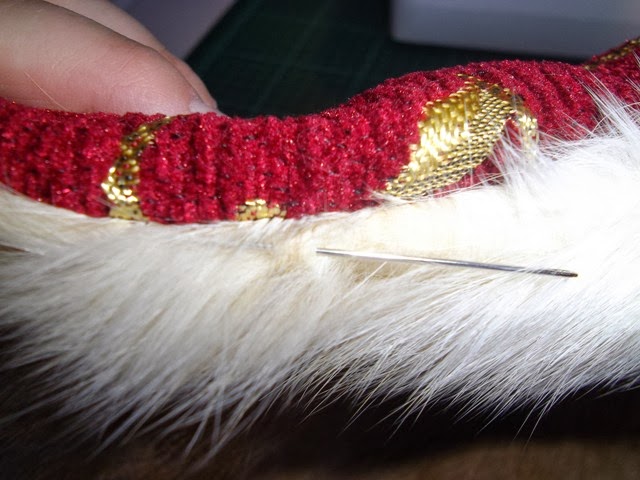
Muffs known as Manizzas in Italy and Snoskyns in England, were a handy way of keeping hands warm as well as a status symbol and sign of conspicuous consumption in the sixteenth century. The fur pelts, fine fabrics and craftsmanship all reflected that the wearer was someone who could afford luxury and was aware of fashion

Queen Elizabeth I had several muffs (also called countenances) and there is a record of Amyas Paulet purchasing a muff on her behalf in Paris in 1579 (Queen Elizabeth's Wardrobe Unlocked by Janet Arnold, p. 97). Ladies posed with manizzas or zibellini ('flea furs') are common in both Italian and English portraiture from the sixteenth century. Some of the portraits that I found inspiring can be seen on my earlier blog post about my earlier attempt at making a manizza or muff: http://broidermebethan.blogspot.com.au/2012/06/new-manizza-or-snoskyn.html

In January and February 2014, I was part of the Italian Renaissance Costuming Min-Challenge - "Fabulously Fashionable Fur (http://realmofvenus.renaissanceitaly.net/challenges/IRCMC-Jan2014.htm).
The weather here in South Australia was the hottest in recorded history, so it was not a good time to be sweating and working with fur. The competition's organiser Lady Bella graciously extended the challenge to allow for the weather. As usual, I went into the challenge with high hopes and huge plans. The more portraits I looked at, the more I wanted to make. I started with a muff because I had a small rabbit pelt that a friend had given me after finishing a pair of fur lined sleeves. (I do not support the fur industry in any way, but I do believe that if an animal is killed humanely for food then we should do our best not to waste anything. I have no issue with re-using or recycling vintage furs or the skins of animals slaughtered for food.)


All the materials that I used, I had in stash or had purchased for other projects. I made this muff quite small because the last muff that I made was quite a bit larger and can be a bit heavy and unwieldy. Also, I saw a gentlewoman at an SCA event last year with a small one hanging from her girdle, and I thought it looked very elegant.

My first step was to assemble materials and then make a rectangular paper pattern that would fit my hands and accommodate the pelt that I had.


The upholstery fabric that I had was a nice pattern but prone to thread separation. This would make it tricky to sew later on.

I am not a keen sewer, so my favourite part of any sewing process (apart from wearing the resulting pretty item!) is playing with trim and fabric options and dreaming of possibilities.


After trimming my fabric and pelt to size, I edged the fabric, pinned the fabric (wrong side out) and pelt (skin side out) together and sewed around the edges, leaving a small area unsewn for turning.


Once the pelt and fabric were sewn together, I had the tricky task of turning the 'bag' right side out.

Once the manizza or muff was the right side out, I made sure that all the seams were pushed out and the hair pulled out of the seams before sewing on some maroon satin ribbon.


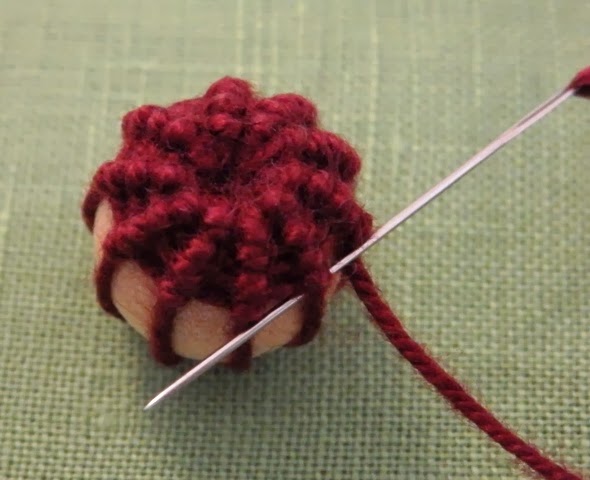
The next thing I decided to work on was the woven buttons. You can see the tutorial on how I did it here: http://broidermebethan.blogspot.com.au/2014/01/woven-button-tutorial-back-stitched.html
I added loops of gold DMC floss to the completed buttons and a decorative little knotted lump in the middle at the top. Next time I will use a bead, because I was not very happy with how this element worked out.
I made five of these buttons and stitched them to one side of the manizza.


I liked the way the ribbon looked by itself, but wanted to try out some trims. The plain gold upholstery trim was too much, but I had a small amount of maroon and gold trim that was purchased for the edge of a French hood. It looked pretty good on the ribbon, so I sewed it down in the centre of the satin ribbon.


I had some lovely little gold accents that I bought for a Tudor bodice from http://dragonsbloodcreations.com.au/
I thought that they looked nice, and would be a good way of hiding the join in the trim.


The last task was to make buttonhole loops for the button closures and to make an anchor point to hook my girdle chain to. I made a couple of loops of crochet cotton and then button hole stitched all around them before anchoring the thread and knotting off. This was a tedious task because the hairs from the fur kept getting stuck in the loops and pulling through with the thread. Also the fabric was quite loosely woven, so I had to be careful how hard I pulled the thread. Next time I will try lucet cord loops sewn into the seams because I found that the crochet cotton stretched quite a bit.


Once the loops were finished, I joined some lobster clasps and a key chain ring to a length of chain so I can hang the manizza from my girdle.


Although I didn't get all the other items that I had planned done (as usual!) I am satisfied with what I achieved in the challenge. I have a pretty accessory and I plan to make another for a friend at some later date.


I found these pages after I had finished my manizza, when I was looking for supporting pictures. I would recommend them to readers:
https://thepragmaticcostumer.wordpress.com/tag/album-amicorum/
http://webspace.webring.com/people/lo/oonaghsown/curves/muff_in_sixteenth_century_dress.htm
http://jeannedepompadour.blogspot.com.au/2012_03_01_archive.html
The ‘Portrait of Anna Radziwell’ 1583 shows what looks like a fur capelet. Hmmmm…. Ideas for the future!


Here is the link to see what the other entrants in the challenge have created:
http://realmofvenus.renaissanceitaly.net/challenges/IRCMC-Jan2014-Results.htm

Many thanks to Lady Bella  of Realm of Venus (http://realmofvenus.renaissanceitaly.net/) for organising this fun challenge.


Friday, February 28, 2014

Creating Historical Clothes (book)

I've been quite busy with mundane life and also working on those gifts that I have mentioned previously, and I forgot to share what I got for Christmas-


Although I can only do basic sewing, and very basic pattern alterations, this book has already come in handy and would be excellent for proficient costumers.

Tuesday, February 25, 2014

'Nankeen' Regency Boots


Another delectable new offering from American Duchess


Available from: http://www.american-duchess.com/shoes-18th-century/nankeen-fabric-regency-boots

Saturday, February 15, 2014

New pic of loose gown

Wow, just saw a portrait of a lady in a loose gown that I would love to have:

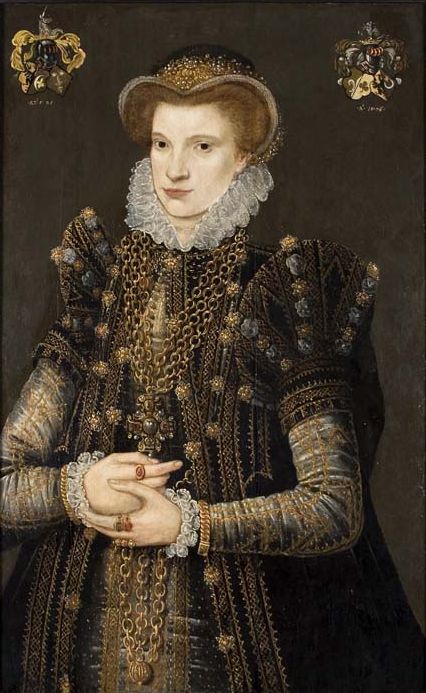
Portrait of Teth Douma van Oenema by Master of the Portraits of the Exiles

from: https://upload.wikimedia.org/wikipedia/commons/6/62/Master_of_the_Portraits_of_the_Exiles_Teth_Douma_van_Oenema.jpg

Friday, January 31, 2014

Another new girdle

All my glass bead girdles are very heavy, so I decided to make a light-weight one. I already had some black wooden beads and some large bronze seed beads left over from another project. Then I found a bulk pack of bronze filigree spacer beads on special, so my colour combination was decided. Finally, I found some left-over pieces of black tiger tail wire in my beading box as well, so I was very happy.


Usually I play around with different combinations and patterns of beads before starting to string a girdle, but this time I knew what I wanted. I felt that three black wooden beads and then a bronze filigree bead would be ideal. The bronze seed beads would go in between each large bead.


I usually start at the ''dangly'' end of the girdle when stringing, and this time was no exception. I had two pieces of tiger tail which I threaded with three bronze crimps and a small bronze hook clasp. The hook clasp is at the bottom and allows the pomander or decorative element at the bottom to be changed to suit the garment or occasion. Once the crimps were closed, I started stringing the beads. The first part of the girdle was fiddly because the filigree beads had very small holes and the two pieces of tiger tail was a bit too much for them. I ended up using a bead reamer to enlarge the holes slightly.


This diagram shows the way I string my girdles. The bottom 'dangly' part of the girdle has two strings of tiger tail wire which separate at a central bead or finding to become the two 'arms' of the belt.

I was a little unsure what to do when I got to the junction part of the girdle as I did not have any more triangular bead findings. I didn't want to have to purchase anything specially for this project, so I raided my stash for usable items. I found these three options for the central bead/finding where the two pieces of tiger tail separate to go around the waist. I tried all three, but thought the agate bead looked the best.


Once the agate bead was strung and the two pieces of tiger tail separated, it was standard stringing again. When each waist piece was done, it was finished with a clasp or a piece of chain to allow adjustments in size.

I happened to have a bronze filigree heart charm that I salvaged years ago from a cheap necklace, and I added this to the bottom of the girdle. I hung the girdle up for a few days to get the kinks out of the tiger wire.


This was a quick and easy project and I am very happy with the result.

Friday, January 24, 2014

What I Am Reading At The Moment

Recently, someone asked me to post about what books I am reading at the moment.

Currently, I am reading the following


The Savage Garden - Mark Mills


"The Savage Garden is the second novel written by British author Mark Mills. Set in 1958, the story tells of Cambridge student Adam Strickland and his trip to Tuscany, Italy; which started off as a chance to study the old, Italian renaissance architecture of a garden owned by the aristocratic Docci family and results in Adam solving two murders: one from the 16th century and one just after World War II. His discoveries shake the entire lineage of the Docci clan including his love interest Antonella's life."

Text and image from: http://en.wikipedia.org/wiki/The_Savage_Garden


The Shakespeare Secret - J. L. Carrell


"A modern serial killer - hunting an ancient secret. A woman is left to die as the rebuilt Globe theatre burns. Another woman is drowned like Ophelia, skirts swirling in the water. A professor has his throat slashed open on the steps of Washington’s Capitol building. A deadly serial killer is on the loose, modelling his murders on Shakespeare’s plays. But why is he killing? And how can he be stopped? A gripping, shocking page turner, The Shakespeare Secret masterfully combines modern murder and startling true revelations from the life of Shakespeare. It has been acclaimed as one of the most compulsively readable thrillers of recent years."

Text and image from: http://books.google.com.au/books/about/The_Shakespeare_Secret.html?id=h1kQq6cCFdwC&redir_esc=y


Mary Boleyn The Great and Infamous Whore - Alison Weir


A full length biography of Anne's sister and Henry's mistress.

More information available at http://alisonweir.org.uk/


The Samurai and the Courtesan - Lesley Downer


"1868: In the Floating World of Japan’s exotic pleasure quarters, sex is for sale and the only forbidden fruit is love. Hana is just seventeen when her husband leaves for war, leaving her alone and very vulnerable. When enemy soldiers attack her house she flees for her life across the shattered city of Tokyo and takes refuge in the Yoshiwara, its famous pleasure quarter. There she is forced to train as a courtesan."

Text and image from: http://www.lesleydowner.com/books/the-courtesan-and-the-samurai/


And I always refer to these Tudor Tailor books at least once or twice a week:


Images from and more information available from: http://www.tudortailor.com/

Thursday, January 23, 2014

Cranach Digital Archive

Readers with an interest in German art and clothing may find this reference useful -

http://www.lucascranach.org/


This site is a great resource, but dangerous for costumers with lots to do. I have already seen lots of things that I would like to attempt to make!


Portrait of a Bride Attributed to Lucas Cranach the Elder
from: http://www.lucascranach.org/object.php?&obj=DE_GNMN_Gm614_FR-none&uid=135&page=1&fol=01_Overall&img=DE_GNMN_Gm614_FR-none_2008-01_Overall.tif


A Prince of Saxony c. 1517
Attributed to Lucas Cranach the Elder
From: http://www.lucascranach.org/object.php?&obj=US_NGA_1947-6-1_FR123&uid=691&page=6&fol=01_Overall&img=US_NGA_1947-6-1_FR123_Overall.tif


A Princess of Saxony c. 1517
Attributed to Lucas Cranach the Elder
From: http://www.lucascranach.org/object.php?&obj=US_NGA_1947-6-2_FR124&uid=693&page=6&fol=01_Overall&img=US_NGA_1947-6-2_FR124_Overall.tif


Female Saint with a Page c.1520
From: http://www.lucascranach.org/object.php?&obj=DE_SKK_0118_FR137&uid=530&page=7&fol=01_Overall&img=DE_SKK_0118_FR137_2008-02_Overall.tif


Portrait of Katharina of Bora
by Lucas Cranach the Elder
From: http://www.lucascranach.org/object.php?&obj=DE_smbGG_637_FR190A&uid=101&page=10&fol=01_Overall&img=DE_smbGG_637_FR190A_1995-02_Overall.tif

Wednesday, January 22, 2014

Lacing Holes and Boning

I am currently working on a purple Italian style gown. When it came time to bone the back (where the lacing is,) I found that I only had quite wide steel bones (approx. 11mm wide.) I used what I had, but was not very happy with how the lacing looked.


I think the wider bones make the lacing holes look too far apart and too wide.


So I took a chance and ordered thin flat steel and sprung steel bones from an ebay seller. They arrived today, and I am quite delighted!

Tuesday, January 21, 2014

Anne Boleyn Files link


Here is an interesting read about Catherine Howard and the Bill of Attainder against her - http://www.theanneboleynfiles.com/21-january-1541-bill-attainder-catherine-howard-lady-rochford/

Image from http://www.theanneboleynfiles.com/21-january-1541-bill-attainder-catherine-howard-lady-rochford/

Sunday, January 19, 2014

Seriously Drool-worthy Reproduction Elizabethan Shoes


You would all be aware of how often I end up drooling over reproduction historical shoes that are not in my time period. Well, finally I present some that are!


Images courtesy of http://www.american-duchess.com/