I'm still very slow at sewing and embroidery due to the wrist injury that I did in November, so I was really pleased to be able to complete a project for a friend *before* the deadline. (Only a day before, but I count a win as a win!)
These embroidered flowers were appliqued onto a 14th Century gown. They were done in DMC floss in split stitch over a damask fabric. Using split stitch on appliqued decorative fabric is a really good way to cover a lot of area relatively quickly.
Elizabethan, Tudor and Renaissance inspired embroidery, clothing and accessories - historical costuming, embroidery and re-creation
Friday, January 25, 2019
Tuesday, January 15, 2019
12th Night Coronation - Lochac
Friday, January 4, 2019
Turnshoes of Purple Leather
I'm feeling a bit fuzzy-brained today because of an infection, so I am going to post about a previous project that I only finished late last year.
In late 2017 a local Laurel came to teach us about turnshoe making. I really wanted to have a try at making my own shoes, and decided to make a pair loosely inspired by this extant sixteenth century piece:
“Spanish decorative shoe (1590-1600) belonging to Bayerischen National Museum, Munchen. Source : Durian-Ress, Schuhe, 1992″ at https://www.pinterest.com.au/pin/390546598929865501/
I had some difficulties with the pattern, so simplified it a lot to make a pull on shoe. I wasn't sure how the slashing would impact on working the leather, so I decided to make a slashed pair when I had more experience.
I decided to sew a decorative strip of leather around the foot opening for extra durability
I was very pleased with how the shoes turned out. Not bad for a first try - but that is mainly due to the skill and patience of my friend Master William. I would like to try another pair, but have to wait for my wrist injury to heal as I found the process very hard on the hands.
In late 2017 a local Laurel came to teach us about turnshoe making. I really wanted to have a try at making my own shoes, and decided to make a pair loosely inspired by this extant sixteenth century piece:
“Spanish decorative shoe (1590-1600) belonging to Bayerischen National Museum, Munchen. Source : Durian-Ress, Schuhe, 1992″ at https://www.pinterest.com.au/pin/390546598929865501/
I had some difficulties with the pattern, so simplified it a lot to make a pull on shoe. I wasn't sure how the slashing would impact on working the leather, so I decided to make a slashed pair when I had more experience.
My friend Master William gave me some firm leather and helped me design a pattern from my foot. He also helped me with a lot of the cutting because the sole leather was quite firm and the cutting was hard going.
The front and back upper pieces were sewn to the sole by hand. I used an awl to make the holes and a saddle stitch to stitch them together.
A small strip of leather was also sewn in to reduce the chance of water coming through and wetting my feet and rotting the leather
Making the stitch holes with the awl
My finished, inside out shoe
My friend added an extra support piece inside the heel for extra strength
We wet the shoes and turned them inside out
And they looked so much better right side out! The turning was not very difficult because the toes are quite round
I decided to sew a decorative strip of leather around the foot opening for extra durability
We added some commercially made soles because I get clumsy when I get tired and I don't want to slip on the leather soles
I dyed the shoes purple with leather dye
I was very pleased with how the shoes turned out. Not bad for a first try - but that is mainly due to the skill and patience of my friend Master William. I would like to try another pair, but have to wait for my wrist injury to heal as I found the process very hard on the hands.
This was a fun and challenging project and I would recommend anyone thinking about it to give it a go.
Many thanks to Master William for giving up so many months to help so many in the Barony with this project, and for his generous donations of materials.
Wednesday, January 2, 2019
Happy New Year!
Happy New Year Readers, and thank you for your support over the last year.
I hope that 2019 brings you health and prosperity, and lots of time for sewing and crafting!
Sunday, December 30, 2018
Blue Plaid Tunic
This over tunic was also completed in October. It is designed to co-ordinate with the black flanelette undertunic posted about below. It is made of a light cotton with a plaid pattern which was chosen by the recipient.
As with the undertunic, it is made to a t-tunic design. I tried to enclose seams and hand sew wherever possible.
Commercial braid has been added over the joins where the sleeves were pieced, and blue bias strips have been added to the neckline and sleeves for decoration. A running stitch in cotton was added on top of the bias strips for extra decoration.
Seeing it on the hanger doesn't do it justice; it looks very nice on the recipient.
As with the undertunic, it is made to a t-tunic design. I tried to enclose seams and hand sew wherever possible.
Commercial braid has been added over the joins where the sleeves were pieced, and blue bias strips have been added to the neckline and sleeves for decoration. A running stitch in cotton was added on top of the bias strips for extra decoration.
Seeing it on the hanger doesn't do it justice; it looks very nice on the recipient.
Saturday, December 29, 2018
Black Flannelette Undertunic
As you may remember, I have been working on a suite of simple tunics for a friend. I finished this undertunic back in October.
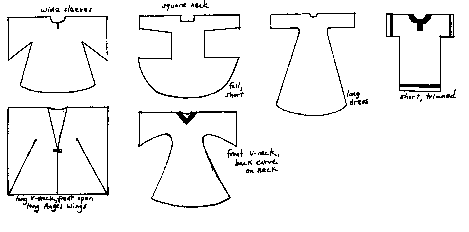
My friend requested the traditional SCA style t-tunic as it is what he is used to and likes. I still wanted to try and use techniques that I use on more authentic styles of clothing, so I enclosed seams, hand sewed exposed seams down and used rolled hems where possible. The long seams which wouldn't be seen were machine-sewn and the rest of the sewing was done by hand.
The undertunic is made of cotton flannel, chosen because it is very soft and preferred by the recipient.
My friend requested the traditional SCA style t-tunic as it is what he is used to and likes. I still wanted to try and use techniques that I use on more authentic styles of clothing, so I enclosed seams, hand sewed exposed seams down and used rolled hems where possible. The long seams which wouldn't be seen were machine-sewn and the rest of the sewing was done by hand.
The undertunic is made of cotton flannel, chosen because it is very soft and preferred by the recipient.
![]() |
| SCA style T-Tunics Image from http://allcraftsblogs.com/clothes_sewing_patterns/t_shirt_tunic/t_shirt_tunic.html |
Rolling the neck hem
Measuring the bottom hem in preparation for turning under again. The raw edges were zigzagged where possible to make the garment more durable
Here you can see where the internal seams have been hand-sewed down. The recipient is very tall and has long arms so I needed to piece the sleeves to achieve the required length
I hand-sewed cotton bias strips for a bit of decoration
The completed undertunic with one of the over tunics on top. It looks much nicer on and belted, and with co-ordinating trews
Wednesday, December 26, 2018
Tuesday, November 13, 2018
Wrist Injury
Hello friends,
I've hurt my wrist and can't sew or write or type beyond one-finger-left-handed typing, so I hope you will forgive me if the posts are delayed for a little while.
It is so frustrating! I have so many ideas, as well as items to finish!
I've hurt my wrist and can't sew or write or type beyond one-finger-left-handed typing, so I hope you will forgive me if the posts are delayed for a little while.
It is so frustrating! I have so many ideas, as well as items to finish!
Thursday, November 1, 2018
Happy Halloween
Happy Halloween to all my Northern Hemisphere readers!
Halloween isn't the big thing in Australia that it is in the USA, but a few kids do get into it and trick or treating is starting to become more popular. I enjoy seeing the costumes the kids are wearing, there certainly are some creative parents and kids around!
If you celebrate, I hope you have a wonderful time!
Halloween isn't the big thing in Australia that it is in the USA, but a few kids do get into it and trick or treating is starting to become more popular. I enjoy seeing the costumes the kids are wearing, there certainly are some creative parents and kids around!
If you celebrate, I hope you have a wonderful time!
Monday, October 29, 2018
Split Stitch Heraldic Weasel Badge
I recently finished this large (approximately 15 cm long) heraldic split stitch badge for a friend.
The design is traced onto calico that has been reinforced with iron on interfacing. I started in the middle of the design and worked out to try and keep the tension even.
I find that lining my inner embroidery hoop with bias binding also helps to maintain an even tension.

The design is traced onto calico that has been reinforced with iron on interfacing. I started in the middle of the design and worked out to try and keep the tension even.
I find that lining my inner embroidery hoop with bias binding also helps to maintain an even tension.
The embroidery is split stitch worked in wool. The weasel (meerkat) features and chevron outline are also worked in split stitch but I used a fine crochet cotton.
I rinsed the completed piece, and when it had dried a little I stretched out any tight patches using a hot steam iron on the back of the damp piece.
I trimmed the excess calico away leaving about 1.5cm around the edge.
I roughly sewed down the edges of the calico to the back of the piece.
Next I couched some silver gilt cord around the edge.
Finally I whipped a piece of felt onto the back to cover the stitching.
Subscribe to:
Posts (Atom)