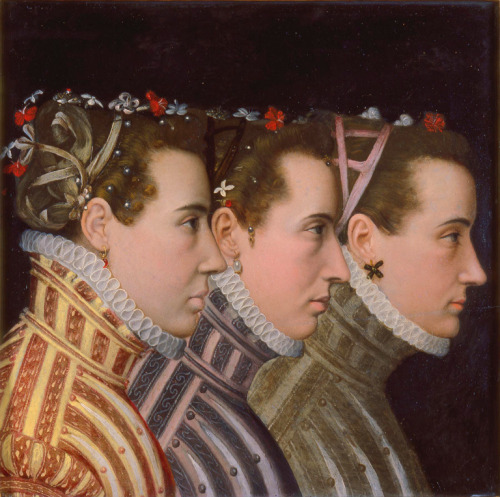
I recently had the opportunity to enter a Solteltie competition. Here is my documentation:
A Sinful Siren Solteltie for a Feast
Image from: Kongelige Bibliotek, Gl.
kgl. S. 3466 8º, Folio 37r
Medieval soltelties (subtleties) were illusion foods that
added to the spectacle and entertainments of a banquet or feast. Designed to
impress the guests and add to the stature of the host, accounts of important
banquets are dotted with references to impressive illusion foods that were presented
to entertain, and often to allude to a story or give a subtle message. The
medieval cook book “Le Viandier de Taillevent” has four pages of subteltie recipes, and two
pages of painted subtletie recipes.
With a theme of “sinfulness”,
the possibilities for soltelties are almost endless. I was unsure whether this
feast would run (due to lack of bookings) until last weekend, so the short time
impacted on what I could do. I had originally planned to make a sweet soltltie using sugarplate, but there would not have been enough time for it to dry.
Inspiration struck when I was looking at a book of
illuminated manuscripts, searching for ideas for scribal projects. I saw this
painting of a siren and a centaur (below), and I remembered that sirens are
symbols of (female) heresy, lust, vanity and worldly pleasure (p. 560).
Image from A Bestiary, perhaps by
Therouanne, circa 1270. JPGM, Ms. Ludwig XV 3, fol 78 – reproduced in ‘Illuminated Manuscripts from Belgium and the
Netherlands’, p. 45
Church writings from the medieval period emphasise that
women are the source of original sin and are very prone to lust and temptation.
“Medieval patristic sources constantly reiterate Eve’s weakness as the reason
for mankind’s suffering, and purport the concomitant weakness of her daughters
against which all men must guard” (Glen, p. 2). Glen (p. 4) also refers to
Salisbury’s (1994, pp.81–86) contention that “Galenic medicine held that the
female, cold of humour, seeks the heat of the male, hot of humour, and is for
this reason dangerously lusty at all times”. It is not surprising that mythical
female figures (sirens) who are part woman and part bird or fish were imagined
that could lure men to their ravishment and grisly deaths with their beautiful
singing. This suggests that worldly pleasures can lead to one being vulnerable
to sin, or even to being seduced by the forces of evil.
Creating an edible siren sounded similar to a recipe for a
Cockatrice that I had seen in Forme of
Cury.
“Forme of Cury 183 Cokagrys. Take and
make the self fars, but do therto pynes & sugur. Take an hold rostr cok;
pulle hym & hylde hym al togyder saue the legges. Take a pigg and hilde hym
fro the myddes dounward; fylle him ful of the fars, & sowe hym fast
togeder. Do hym in a panne & seeth hym wel, and whan thei bene isode: do
hem on a spyt & rost it wele. Colour it with yolkes of ayren and safroun.
Lay theron foyles of gold and siluer, and serue hit forth.”
There are other versions of this recipe available in Medieval sources,
and some are reproduced at godecookery.com; see below.
I obtained a fresh pigeon from a supplier of game and
cleaned, washed and dried it.
I seasoned it and basted and stuffed it with
butter. I roasted it at 190 degrees for twenty five minutes. Pigeon is traditionally
served rare (cooked for 12-16 minutes), but I overcooked it because I didn’t
want any juices dripping out of it. (It still looks too rare for my taste.)
45. Pigeons. Roast them including the heads but without the feet; eat
them with fine salt. In a pie; eat them with fine salt, wine, or scallion, with
the fat from the pie. (p.22)
I made the female part of the siren out of marzipan (also
called
marchpane). Because I was
limited by time, I used commercially prepared marzipan.
In period, cooks would
have peeled and ground their almonds and mixed the meal with sugar that had
also been ground (from a cone) and sieved. I have made marzipan this way, and
it is very time consuming and hard on the hands. Here is a recipe that suggests
how it would have been done in period:
from Delights
for Ladies by Kennelm Digby
1609 (online at http://www.medievalcookery.com/search/display.html?delig:18)
18 - To make a Marchpane. Take two pounds of Almonds being
blanched and dryed in a sieve over a fire: beat them in a stone mortar; and
when they bee small, mix with them two pounds of sugar being finely
beaten, adding 2 or 3 spoonfuls of Rose-water, and that will keeps
your almonds from oyling. When your paste is beaten fine,
drive it thin with a rowling ping, and so lay it on a bottom of wafers:
then raise up a little edge on the side, and so bake it: then yce it
with Rose-water and sugar: then put it into the oven once again, and
when you see your yce is rise up, & dry, then take it out of the oven,
& garnish it with pretty conceits, as birds and beasts, being
cast out of standing moulds. Stick long comfits upright in it: cast biskets and
carrowaies on it, and so serve it: gild it before you serve it: you may also print
off this Marchpane paste in your molds for banquetting dishes: and of
this paste our comfitmakers at this day make their letters, knots,
Arms, Escocheons, beasts,birds, and other fancies.

I used wooden skewers to attach the siren’s body to the body
of the bird. To emulate the gold feathers seen in the image from the
manuscript, I dusted the body with edible metallic cake decorating powder. In
the Middle Ages and Reniassance, cooks would likely have used an egg yolk
glaze or expensive gold leaf, but I always have concerns about using raw egg
products in cooking and gold leaf is beyond my budget.
The siren was shaped with my fingers and a toothpick and
then painted with commercial food colourings mixed with a little rosewater.
Period practices for colouring foods include using juices of herbs such as
parsley or alkanet, tinctures of bark such as sanders and cassia, meat juices
and egg whites. Tincture of lead and other poisonous ingredients were sometimes
used. A recipe for a coloured dessert is included in the supplementary recipe
section below.
The siren is presented on a bed of blue jelly to suggest
water because fish- and bird-bodied sirens are often depicted in water. Jelly
(or “gellye”) was a popular medieval food, and was served in both sweet and
savoury forms.
Here is a recipe from Le Viandier de Taillevent for
a savoury jelly:
70. Jelly of slimy fish, and of meat.
Cook it in wine,
verjuice and vinegar. Some add a bit of water. Take ginger, cassia, cloves,
grains of paradise and long pepper, steep in your broth, strain through
cheesecloth, and boil with your meat. Take bay leaves, spike lavender,
galingale and mace, tie in your cheesecloth (without washing it) with the dregs
of the other spices, and boil with your meat. Cover it while it is on the fire,
but when it is off the fire, skim it until it is set out.
When it is cooked,
[strain] your broth into a clean wooden dish until it is settled. Put your meat
on a white cloth. If it is fish, peel and clean it, and throw your peelings in
the broth until it is strained the last time. Make sure your broth is clear and
clean.
Because of the time restrictions I was faced with for this
project, I used commercially prepared sweet jelly.
Researching this project has piqued my interest in
representations of the ‘monstrous’ side of human nature and its portrayal in
medieval imagery. I intend to do further research in this area, and I suspect
that medieval bestiaries, church writings, and social commentaries will provide
me with a rich base of research material!
Image of a siren from Bibliothèque
Nationale de France, lat. 6838B, Folio 25v available online at
http://bestiary.ca/beasts/beastgallery246.htm#
Bibliography and
References
Kempf, Damien and Gilbert, Maria L. 2015 Medieval
Monsters, British Library, London UK.
Kren, Thomas. 2010 Illuminated Manuscripts from Belgium and the Netherlands, Getty
Publications, Los Angeles, California USA.
Morrison, Elizabeth. Beasts
Factual and Fantastic, Getty Publications, Los Angeles, California USA.
Shaus, Margaret. 2015 Women
and Gender in Medieval Europe : An Encyclopedia, Taylor and Francis Ltd,
London, UK.
Salisbury, Joyce E. 1994 The Beast Within: Animals in the Middle Ages, New York, NY: Routledge
Supplementary Recipes
RECIPES FROM
DOUCE MS. 55, Ab. 1450 AD
http://quod.lib.umich.edu/c/cme/CookBk/1:10.2?rgn=div2;view=fulltext
¶ Cokentrice. 
Capitulum ciij.—Scalde a capon̛
clen̛, & smyte hem in-to the wast oueretwarde, and scaude a pygge, and draw
hym, & smyte hym in the same maner; and then sewe the forthyr parte of the
capon̛ and the hyndyr parte of the pygge to-gedrys, and the forther parte of the
pygge [leaf 48.] and the hynder parte of the capon̛ to-gedyr: then draw the
whyte & the yolkes of eyren̛, and cast ther-to, and svette of a schepe, and
saffron̛, & salt, and pouudre of gyngeuere, and grated brede; and medle aƚƚ
to-gedre witℏ thyn̄
Ymages in Sugar
And if ye will make any ymages or any other thing in suger
that is casten in moldys, seethe them in the same maner that the plate is, and
poure it into the moldes in the same manere that the plate is poured, but loeth
youre mold be anoyntyd before with a litell oyle of almaundes.
from Pleyn Delit, 1996, Constance B. Heiatt, p. 142
The Second Part
of the Good Hus-wives Jewell, 1597
"To make a past of Suger, whereof a man may make al manner
of fruits, and other fine things with their forme, as Plates, Dishes, Cuppes
and such like thinges, wherewith you may furnish a Table."
"Take Gumme and dragant as much as you wil, and steep it in
Rosewater til it be mollified, and for foure ounces of suger take of it the
bigness of a beane, the iuyce of Lemon, a walnut shel ful, and a little of the
white of an eg. But you must first take the gumme, and beat it so much with a
pestell in a brasen morter, till it be come like water, then put to it the
iuyce with the white of an egge, incorporating al these wel together, this done
take four ounces of fine white suger wel beaten to powder, and cast it into the
morter by a litle and a litle, until they be turned into the form of paste,
then take it out of the said morter, and bray it upon the powder of suger, as
it were meale or flower, untill it be like soft paste, to the end you may turn
it, and fashion it which way you wil. When you have brought your paste to this
fourme spread it abroad upon great or smal leaves as you shall thinke it good
and so shal you form or make what things you wil, as is aforesaid, with such
fine knackes as may serve a Table taking heede there stand no hotte thing nigh
it. At the ende of the Banket they may eat all, and breake the Platters Dishes,
Glasses Cuppes, and all other things, for this paste is very delicate and
saverous. If you will make a Tarte of Almondes stamped with suger and Rosewater
of this sorte that Marchpaines be made of, this shal you laye between two
pastes of such vessels or fruits or some other things as you thinke good.
From: An Anonymous
Andalusian Cookbook of the 13th Century
available
online at
http://daviddfriedman.com/Medieval/Cookbooks/Andalusian/andalusian9.htm#Heading481
Fruit Made of
Sugar [Marzipan]
Add one part of sieved sugar to one part of cleaned and pound almonds. Knead
it all with rose water and roll your hand in almond oil and make with it
whatever you want of all fruits and shapes, if God wishes.
Marzipans from Libre del Coch 1520
Reproduced
online at http://www.medievalcookery.com/search/display.html?libre:135
135. Marzipans.
Take almonds which are select, and wholesome, and well-peeled in
boiling water. And grind them very well, moistening the pestle of the mortar
inrosewater so that they don't become oily. And when they are well-ground,
cast in as much syrupy sugar as there will be almonds; and let
it be well-ground, and strained through a silk sieve; and make
good paste incorporating the sugar little by little, and
not with large amounts, so that you don't make the paste viscous, and
spread them out very well.
The way to cook and
glaze them:
Take
fine sugar which is very well-ground, and strain it through a sieve
of silk; and for a syrup put it in this way, and blend it
with rosewater which is reasonably thick.
It is necessary that
the oven is not very intense, but temperate; and take the sheet on which you
will cook the marzipans, and heat it in the oven; and when it is hot,
cast flour on it, under the marzipans, so that they don't stick; and
put them in the oven until you see that you cannot bear to touch them
with the back of your hand; and if the outside is not cooked, be sure to return
it to the edge of the sheet with the outside on the inside. And then take them
out and with a little spoon cast glaze upon them, and with some feathers spread
it out all over. And then return them gently to the oven until the glaze
hardens, as you think [right] according to the practice you have seen.
182. Parti-coloured
white dish.
Take blanched and peeled almonds, crush very well, steep in boiled
water, [and make your milk]. For thickening you need some starch or beaten
rice. When your milk has been boiled, divide it into several parts, into two
pots (if you wish to make only two colours) or (if you wish) into 3 or 4 parts.
It should be as solidly thickened as Frumenty, so that it can not spread out
when it is set out on the plate or in the bowl. Take alkanets, turnsole, fine
azure, parsley, or avens. Sieve a little saffron with the greens so that they
will hold their colour better when boiled. Soak the alkanets or turnsole, and
the azure likewise, in some lard. Throw some sugar into the milk when it boils,
remove it to the back [of the fire], salt it, and stir it strongly until it is
thickened and has taken the colour that you wish to give it.




.jpg)